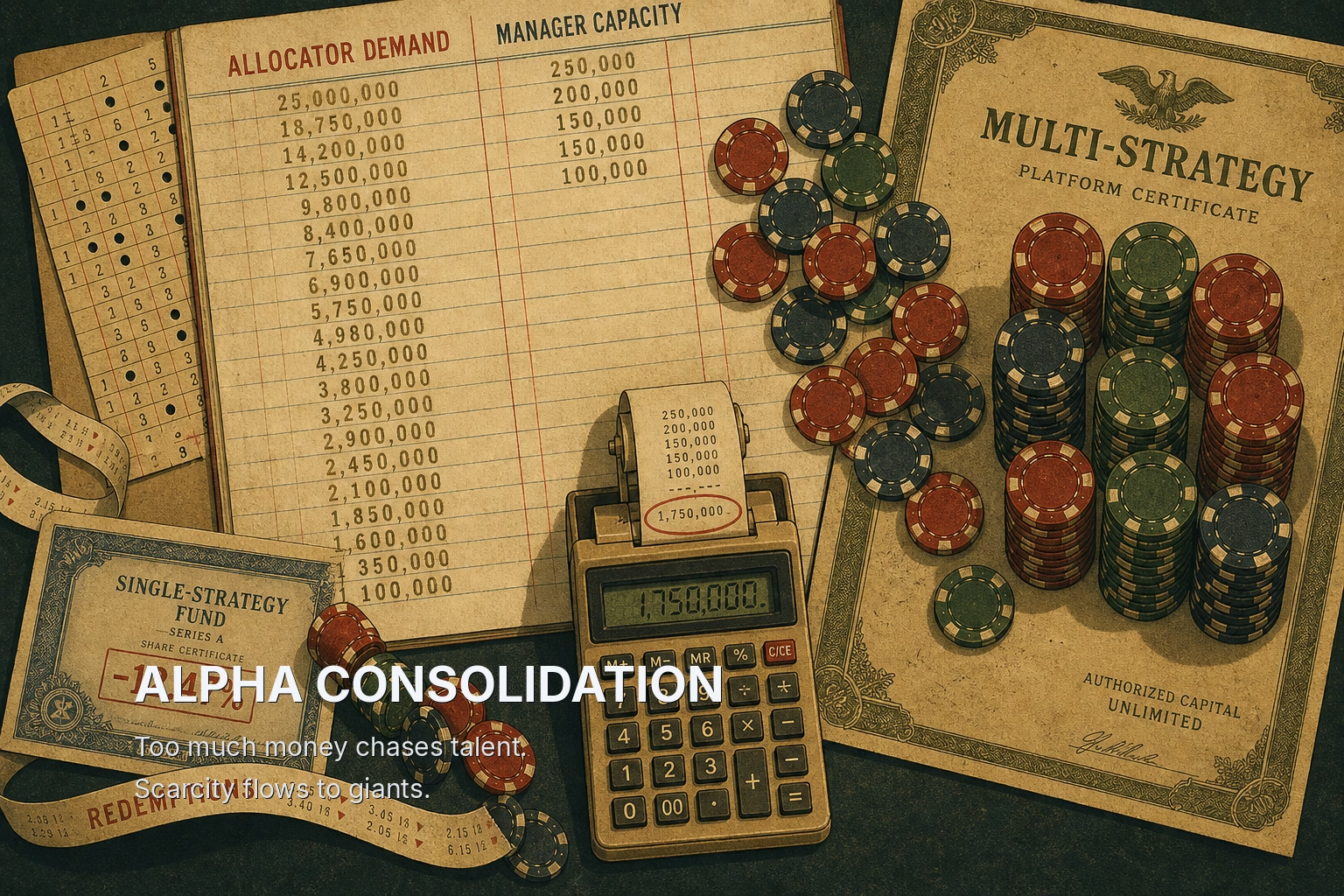
The scarce resource in hedge funds is not capital or investor appetite. It is capacity: the amount of money a manager can deploy before its edge decays. The most telling line in the Alaska Permanent Fund's story is its chief investment officer saying his optimizer would put half the portfolio into absolute return if it could. In practice he can't. The best funds are full. Read through that constraint, the current turmoil in multi-manager hedge funds looks less like a threat to the largest pod shops and more like the mechanism that frees up supply for them. Talent, risk budget and allocator commitments shed by weaker platforms have to go somewhere, and the platforms with the deepest balance sheets are the most likely buyers.
A Resource Bought at Auction
The Alaska fund exists because of an auction. In 1969, a year after oil was found at Prudhoe Bay, the state sold Arctic drilling rights for $900 million, about five times its annual budget. Seven years and a constitutional amendment later, it committed at least 25% of oil and mineral royalties to a permanent fund. Fifty years on, that fund holds $88 billion. It draws 5% a year for government services and the resident dividend, which comes to $1,200 per eligible resident this year.
The comparison to oil goes beyond the backstory. The headline number in an energy market is the spot price. What usually decides who profits is whether there is enough capacity to deliver at that price: pipelines, refining slates, storage. Uncorrelated return works the same way. Demand for it can be close to unlimited. Supply is limited by how many portfolio managers can produce it and how much capital each can run before returns fall off. Anyone who models the industry as a demand story will misread a shakedown. On the supply side, a shakedown is when capacity changes hands.
What Alaska's Ledger Actually Shows
The fund's hedge fund history is a clean before-and-after test of manager selection.
In 2004 it started allocating through three fund-of-funds managers. In the ten years to 2016 the program returned 3.4% annualized, with two down years, little protection in drawdowns, and a second layer of fees on top. In 2016, under Marcus Frampton, now CIO, the fund moved selection in-house with one screen: managers with a record of making money in down markets.
The results after the change:
- The sleeve now covers 18 managers and 8% of the total portfolio.
- In 2022, when both stocks and bonds fell, the hedge fund portfolio rose about 8%.
- Over the nine years since the restructuring, it has averaged 6.7% annualized, with no down years and low correlation to the broader market.
Frampton describes it as "CPI plus five, totally uncorrelated." For a fund that has to fund a fixed 5% draw every year regardless of market conditions, a return stream like that is worth more than its headline number. It cushions the draw in exactly the years when equities can't.
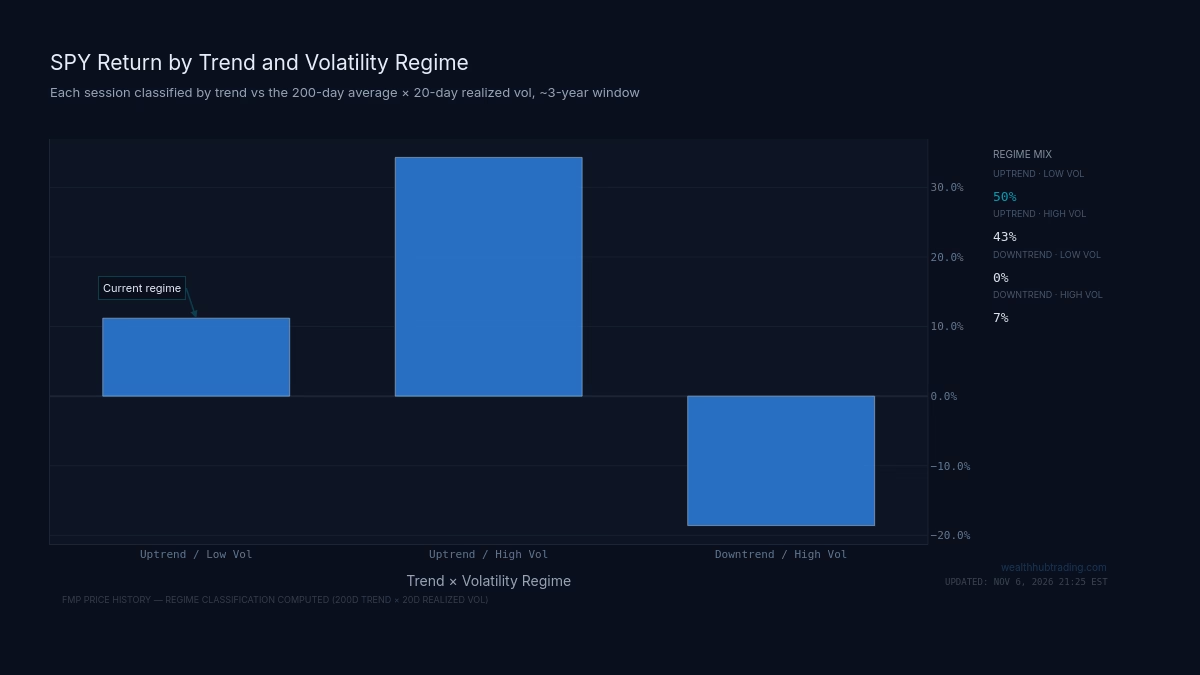
The demand-side math is obvious. A return stream that holds up in a volatile downtrend is worth most to an allocator whose equity book earns most of its return in calm uptrends and gives a large share back when volatility and trend turn against it. The constraint is the next sentence Frampton spoke: "the more money we push into absolute return, the harder it is to get that really special return because the good funds are capacity constrained."
Alaska's access to Millennium Management shows how tight that constraint is. Millennium's capital development team went to Juneau in summer 2018. Alaska invested $300 million early the next year, then added $80 million at the start of 2020, which required lifting its own cap on single-manager allocations. A consultant told the board the firm "has been closed forever and then reopens periodically." The best-known manager in the category is not something an allocator can buy at will. It opens a window, takes in money, and closes again.
How a Shakedown Redistributes Capacity
Millennium was about $35 billion when Alaska first invested. It is now approaching $100 billion. That growth is the real topic here. A platform that roughly triples in size without its returns collapsing has found a way to expand supply in a market where supply is the limit.
The multi-manager model scales capacity mainly by adding more independent risk-takers, not by putting more money behind the existing ones. Each pod runs a limited book with tight drawdown limits. The platform's capacity is roughly the number of good pods multiplied by what each can run. So a platform can only grow as fast as it can recruit portfolio managers who are genuinely good.
This is where a shakedown matters. The recruiting market is tight in normal conditions. Platforms compete for the same people with guarantees and payouts, and much of that cost is passed through to investors. Industry-wide stress changes the terms in three ways:
- Talent comes loose. Smaller platforms with thinner capital bases and less tolerance for drawdowns cut managers faster after a loss. Those managers, along with their track records, become available.
- Risk budget concentrates. A platform whose aggregate loss stayed inside its limits can keep allocating risk while others de-gross. Millennium's October fell into this category: down 2.3%, within its risk tolerances, and better than it might have been relative to peers.
- Allocators move to quality. Pension and sovereign investors who saw their second-tier managers stumble tend to consolidate toward the names whose risk controls held. In past episodes like this, the largest firms have often come out with more capital than they went in with. That pattern has exceptions, and the direction of this cycle is not settled, but it is the typical outcome.
The source analysis frames this as a question of whether "a market shakedown could leave the biggest pod shops stronger." Under the capacity framing, the answer is close to mechanical, as long as the biggest shops preserve their own capital. A drawdown that eliminates weaker suppliers raises the value of the supply that survives, much as a refinery outage raises margins at the refineries still running.
The Crowding Objection
The best argument against this view is that "uncorrelated" has been measured against the wrong benchmark.
Alaska's sleeve has low correlation to markets. Low correlation to equities does not mean low correlation among pod shops. Multi-manager platforms recruit from the same pool, run similar market-neutral equity books, apply similar factor constraints, and often hold overlapping positions. When several of them de-gross together, the losses come from that overlap, and a market index can stay flat while the trade unwinds. A Bloomberg hedge fund reporter wrote this week that in nearly 16 years covering the industry he could not remember a day like it. A day like that is consistent with a crowding unwind as opposed to a broad market selloff. The public material does not identify the cause, so this link is unconfirmed. It is the reading that would do the most damage to the thesis.
If it is correct, the capacity argument is weakened in two ways. First, an allocator spread across 18 managers may hold the same crowded exposure several times while believing it is diversified. Second, growth at the largest platform could be adding to the crowding instead of adding new supply. A $100 billion platform recruiting from the same talent pool as everyone else does not necessarily produce more independent alpha. It may produce more of the same alpha, sized up.
Scale has its own cost, separate from crowding. Each new pod is, on average, slightly less skilled than the one before, because the best candidates were hired first. Pass-through fee structures shield the platform from that decline more than they shield investors. A platform can grow profitably for itself while net returns to investors drift down. Alaska's 6.7% is a nine-year average. The figure that would show whether scale is costing investors is its rolling trend, and the public record does not provide that.
The November Print as the Clearing Price
These views can be tested soon. November is the month the source analysis marks as decisive, and it is the right one to focus on.
If Millennium and the other largest platforms finish November in line with October, meaning losses inside stated limits and clearly smaller than the rest of the field, the capacity reading holds. The industry's stress becomes their recruiting season, the next capital-raising window is likely to be oversubscribed, and allocators like Alaska that are limited by capacity get more room at the managers they already prefer. Frampton's case for a larger absolute-return sleeve would be backed by evidence instead of resting on an optimizer.
If the largest platforms instead post losses that track the weaker shops, the shakedown is a crowding event that hits everyone. The supply of uncorrelated return then turns out to have been one correlated trade split across many firms.
The variable to track is the dispersion of November returns across multi-manager platforms. Wide dispersion, with the biggest names at the better end, means capacity is moving to the strongest players. Narrow dispersion means the constraint was never as tight as it looked, and the asset class was mispriced on correlation all along.