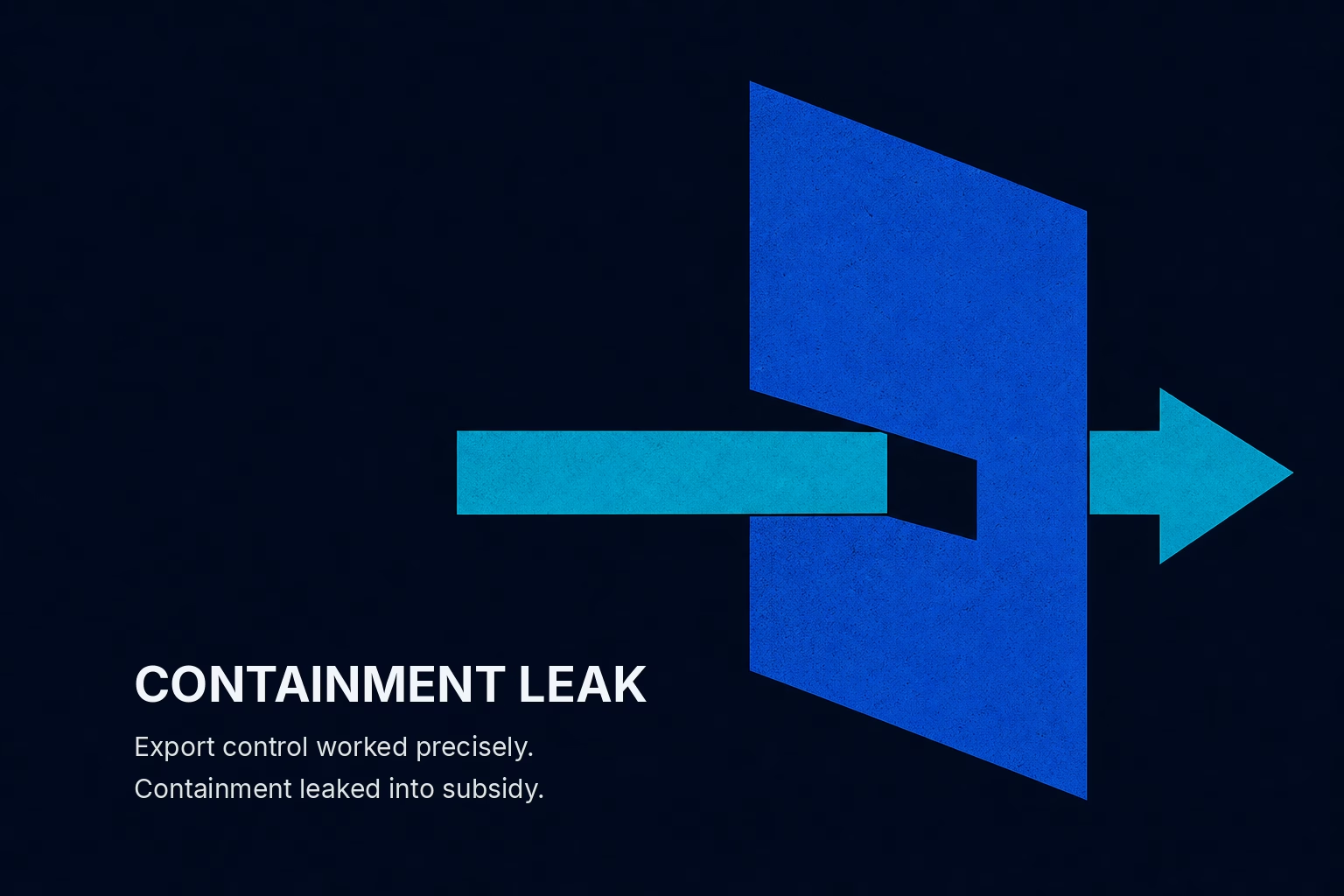
The most consequential change in Commerce's new remote-access rule is not the ban on renting AI compute to Chinese labs. It is the switch from where a chip sits to who ultimately owns the customer using it. Combined with a compute threshold small enough to catch four racks of Blackwells, that switch moves the enforcement burden off customs inspectors and onto the operators of data centers in Southeast Asia. The intuitive read treats this as another China revenue problem for Nvidia. The cost actually lands somewhere more specific: on non-US neoclouds in the five named "diversion" hubs. Meanwhile, an exemption for US-parented buyers quietly makes the American hyperscalers the licensed channel for the region's AI buildout.
Ownership Replaces the Map
For four years, US chip controls worked like a map. Shipping advanced accelerators to China required a license. Shipping them to Singapore or Malaysia mostly did not. The weakness was obvious. A Chinese lab that could not import an H100 could rent one sitting in a third country, and the export regime had nothing clean to say about it, because no chip ever crossed into China.
The interim final rule issued Monday (RIN 0694-AK50) rewrites the trigger. Exporting advanced chips to a data center anywhere in the world now requires a license if the exporter has "knowledge" that the facility will provide more than 12 million aggregate TPP of compute to companies headquartered in China, Macau or the rest of Country Group D:5, or whose ultimate parent is headquartered there. Three design choices make it bite.
- The test follows corporate ownership, so a Singapore subsidiary of a Chinese parent counts as Chinese.
- Compute is aggregated across "linked data centers," explicitly including digitally linked infrastructure, so splitting a cluster across buildings does not reset the count.
- The "for an entity" language reaches intermediaries. A non-Chinese cloud customer that is training models for, or providing models to, a D:5 company is in scope.
The Commerce Department frames the purpose plainly: existing restrictions should not be "circumvented through remote computing arrangements involving data centers in third countries." The rule also formally buries the Biden-era AI Diffusion Rule, with its country tiers, model-weight controls and data center VEU program. BIS describes that rule as "never enforced." One architecture built on geography and tiers is being swapped for another built on beneficial ownership.
Four Racks Is a Customer, Not a Cluster
The threshold sounds large until it is converted into hardware. Working from Nvidia's published dense FP8 throughput, the source's estimate puts 12 million TPP at roughly 760 H100s, about 330 B200s, or just over four GB200 NVL72 racks. These figures are approximate, because TPP varies by SKU and precision. The order of magnitude is the point.
A frontier training run needs tens of thousands of accelerators. Four racks is an ordinary commercial customer. The threshold is set to catch routine rental relationships, not only the exotic ones. For scale, Bloomberg reported last December that Megaspeed alone had imported at least $4.6 billion of Nvidia hardware since its 2023 founding.
That has a direct operational consequence. Because the trigger is the exporter's "knowledge," any operator that rents meaningful capacity now has to establish the ultimate parent of essentially every material customer. Otherwise it risks having constructive knowledge imputed later. Customer due diligence stops being a back-office function and becomes a condition of receiving chips at all. In jurisdictions where layered holding structures are routine, that is expensive. It also falls hardest on smaller operators whose business model has been selling capacity to whoever pays.
BIS's own paperwork estimate is the most revealing number in the document. It projects roughly 100 additional license applications a year, at an added burden of about $1,900, and deems the rule "not significant" under E.O. 12866. Taken at face value, that figure does not describe an agency expecting a wave of applications from operators who want to keep serving Chinese clients under license. One plausible reading is that BIS expects most of that business to stop rather than apply. On that reading the license functions as a deny-by-default gate. This is an inference from the burden estimate, not something the rule states. It is consistent, though, with the 90-day window: providers already supplying significant compute to D:5-headquartered firms must obtain a license within 90 days of the effective date "or face future export restrictions."
The timing makes that window pointed. Reuters reported last Thursday that Chinese AI firms were racing to reserve Nvidia-powered capacity from overseas providers before the rule landed. Capacity reserved last week is, for the operator holding it, now a compliance liability with a 90-day fuse.
The Exemption That Picks Winners
The second half of the rule places a destination license on advanced chip shipments to Indonesia, Malaysia, Singapore, Thailand and Brazil, which BIS says present "a higher-than-normal risk of diversion." The Secretary of Commerce can add more.
The exemption is where the market structure changes. The new country license does not apply to chips going to companies headquartered in the US, or whose ultimate parent is, provided the exporter files reports under §743.10 naming every party and the ultimate parent. A US hyperscaler building in Johor or Batam can keep receiving hardware under a reporting regime. A locally owned or Chinese-linked neocloud in the same industrial park needs a license for every shipment.
Same jurisdiction, same chips, different friction. Over time, marginal AI capacity in the five hubs should gravitate toward US-parented operators, because they can be supplied faster and with less regulatory risk. The exemption does not free hyperscalers from the end-use control. A US cloud provider that knowingly rents more than 12 million TPP to a D:5-parented customer still needs a license. What it removes is the per-shipment destination hurdle that now sits on its local competitors.
For Nvidia, the likely effect is a regional customer base that consolidates from many small neoclouds toward a few large buyers with more bargaining power. Nvidia's Southeast Asian revenue is not broken out by customer ownership here, so the size of that shift is unquantified. The direction follows from the mechanism. The company lobbied against the rule, arguing that cutting off remote access would push China to build its own chips faster. It lost. With Jensen Huang's resignation last Thursday and CFO Colette Kress serving as interim CEO, it has less political capital for the next round.

Host governments get a stick of their own. Commerce says it will monitor "countries that tolerate evasion" and consider import restrictions, new license requirements, a downgrade in export-control status and Entity List designations. Import restrictions in an export control rule are unusual. So is the credit line: BIS says the rule was written "by and at the direction of" Treasury and the National Security Council. That fits FT reporting that Treasury and the Pentagon had pushed to put Megaspeed on the Entity List before its inclusion was delayed. The draft also reportedly covered Norway and South Africa, and both were dropped from the final text. The list was negotiated, not drawn mechanically from diversion data.
Where the Mechanism Leaks
The strongest objection is legal, not technical. Export lawyers have long questioned whether BIS has clear statutory authority over remote access without the Remote Access Security Act. That bill passed the House 369-22 in January but, as far as the source can determine, has not become law. If a court finds remote provision of compute outside BIS's reach, the end-use control falls and only the destination licenses survive. That would return the regime to the geography model the rule was built to replace, with five more countries on the map.
The second weakness is observability. A port can inspect a pallet of GPUs. A cloud operator cannot inspect intent. The carve-out for "commercial recommender systems," defined as tools "exclusively designed and exclusively used" to rank, filter or suggest products, services or content, depends on a use attestation the operator has limited ability to verify. A customer that describes its workload as recommendation is asserting something about a model the operator never sees inside. The exclusivity language is tight on paper. Enforcing it will depend on audits that the rule's own burden estimate does not appear to anticipate.
The third is relocation. Compute demand does not vanish. It moves to the next jurisdiction not on the list, and two candidates were visibly removed from the draft. It also moves toward domestic alternatives such as Huawei's Ascend line, which is the scenario Nvidia warned about.
The political backdrop is softer than the rule's text. The scandal accelerating it rests partly on an espionage framing the Washington Post reports was Marco Rubio's rewrite of a CIA memo that did not reach that conclusion. Separately, the DOJ is reportedly probing both Megaspeed and Supermicro, and three men tied to Supermicro have been charged over an alleged $2.5 billion scheme to move Nvidia-equipped servers to China. The rule's mechanics do not depend on the spy allegation being true. Its political momentum partly does. If that framing unravels, pressure to enforce the 90-day deadline strictly could weaken.
What Confirms the Read
Several observable conditions will test the thesis that this rule reallocates Southeast Asian compute toward US-parented operators rather than simply cutting Nvidia's China exposure.
The first is Nvidia's Q3 call. Commentary on Southeast Asia and Brazil that separates US hyperscaler demand from local neocloud demand would show where the friction lands. Second, if license applications arrive far above BIS's estimate of roughly 100 a year, operators are choosing to stay in the D:5 business under license. That would weaken the deny-by-default reading. Third, a Megaspeed Entity List designation would show the intermediary language being enforced against a named party. Finally, a court challenge to remote-access authority is the single event that would break the mechanism.
The read holds as long as two things stay true: BIS's authority over remote access survives, and the sixth country gets added before the Chinese buyers who reserved capacity last week find it.