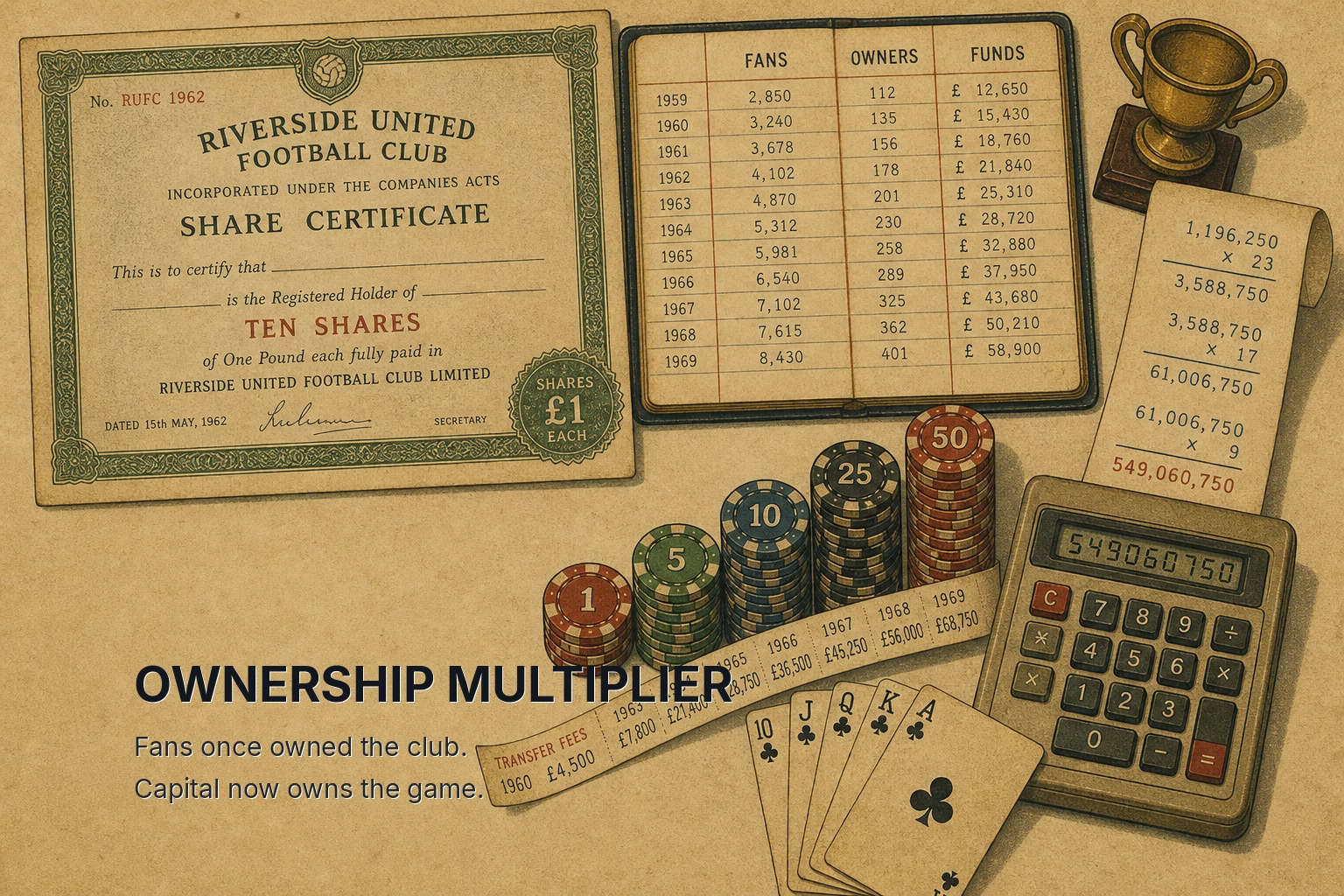
The most revealing number in Marc Rubinstein's account of owning a single share in Liverpool FC is not the £5.5 billion valuation the club fetched in August. It is the decade in which nothing happened. Between his 1996 exit and the 2007 takeover, the shares traded below his sale price. The club's equity went from £125 million to £174 million over eleven years, roughly 3% a year, during a period when English football was supposedly becoming a global entertainment product. Then, under Fenway Sports Group, the valuation went from £300 million in 2010 to about £5.5 billion in 2026, close to 20% a year compounded over sixteen years.
Club operations alone cannot explain that change in slope. The more likely explanation is a change in who was bidding. Football club equity has behaved less like a claim on cash flows and more like a scarce control asset whose price is set by the marginal buyer. Each time the buyer pool has been replaced by a deeper one (local heirs, then American sports owners, then oligarchs and sovereigns, now institutional private equity), valuations have re-rated. The question private equity's arrival raises is not whether football is an asset class. The question is who buys from private equity.
A Flat Decade, Then a Vertical One
Rubinstein's own figures make the point. When he sold, Liverpool had an equity value of £125 million. Hicks and Gillett paid £174 million for the equity, or £219 million including £45 million of debt they took on. Three years later FSG bought at £300 million. On those numbers, the first fourteen years of the modern era delivered modest gains. The steepness came afterwards.
The minority shareholder's experience is the cleanest test of what football equity is worth to someone who cannot control it. For about a century, Liverpool's minority shares "passed from generation to generation" and barely traded. Even after a 1991 over-the-counter platform made them tradable, they did not compound. The value a small holder actually extracted came from something that never appeared on a share register: the right to buy tickets. Hicks and Gillett had to offer lifetime priority access to home cup matches and cup finals to squeeze out the minorities. With Liverpool reaching nine cup finals in ten years, Rubinstein regrets losing that right more than he regrets his exit price.
That detail matters for an equity-fundamental read. The asset paid its holders in consumption, not cash. A minority stake in a football club has historically yielded access, and the capital return arrived only when a control buyer turned up with a reason to pay more than the previous one.
The Buyer Pool Is the Valuation Model
Rubinstein's most striking statistic is the Forbes 400 test. In 2010, every member of the list could have bought Liverpool for less than half their net worth. Today, despite the growth in global wealth, only 88 of them could.
Read as an equity analyst would, that is a disclosure about the depth of the bid. A market in which every billionaire could write the cheque is one in which a seller can run a competitive process among individuals. A market in which fewer than a quarter can is one in which the seller needs a different category of capital to sustain the price. David Moores described being priced out by the Abramovich era. The same arithmetic has now priced out most of the people who replaced him.
The capital filling the gap has three sources, and each has a distinct constraint.
- Sovereign wealth. Deep pockets, but Rubinstein flags rising regulatory scrutiny and the long-running controversy around Abu Dhabi's ownership of Manchester City as reasons this channel looks less likely to expand.
- Ultra-high-net-worth individuals. Still active, but the Forbes test shows the eligible pool has shrunk sharply at current prices.
- Institutional private equity. The International Centre for Sports Studies counts private capital in the shareholdings of a fifth of the 92 clubs across the Premier League and the three EFL divisions, up from 8% in 2010, and 40% within the Premier League.
The managers are positioning accordingly. KKR acquired Arctos Partners this year. Apollo launched Apollo Sports Capital as a separate business. Sixth Street, TPG and Avenue have all raised sports funds within the past year. Clearlake took full control of Chelsea last month at a £5 billion valuation. Silver Lake sits in Manchester City's capital structure.
Why "Undercapitalised" Is an Exit Argument
Apollo's Al Tylis sizes sports at a $2.5 trillion market across leagues, venues, media, merchandise, fitness and live events. KKR puts the addressable market at $650 billion and estimates private capital penetration at just 2%. Both firms call the sector undercapitalised.
That framing is worth reading carefully. A 2% penetration figure is sometimes offered as evidence of upside in operations. For a closed-end fund, it works just as much as a claim about future buyers: if penetration rises, there will be more institutional capital able to take positions from the current wave of entrants. Private equity does not hold forever. Funds have harvest periods, and the people who underwrite them need a credible exit. The bet embedded in a £5 billion Chelsea valuation or a £5.5 billion Liverpool mark is partly that the next buyer will be another, larger pool of institutional capital, possibly continuation vehicles, possibly sports-dedicated funds raised on the back of this cycle.
This is where the Liverpool history becomes a warning as well as a vindication. The asset has delivered, but its strongest returns coincided with a widening of the bidder universe. If institutional capital is the last large pool to enter, the re-rating mechanism that powered the past sixteen years has one more turn left in it, not an indefinite number.
The structure of the August deal adds a layer that the headline number obscures. 1892 Holdings bought a 38% stake, not control, at a valuation of roughly £5.5 billion ($7.3 billion). Rubinstein's own history shows that minority football equity has historically traded on very different terms from control equity. The excerpt does not disclose the stake's governance rights, preferences, or any downside protection, so the headline valuation cannot be compared directly with the full-control prices paid in 2007 and 2010. A minority stake priced at a control-style valuation could be a sign of conviction. Equally, it could indicate that the economics sit in terms the headline does not show. Without the deal documents, that link stays unverified.
The Public Market Check
Football has very few daily marks, which is part of why private valuations can drift away from cash-flow arithmetic without visible correction. Manchester United's New York listing is one of the few places where a Premier League club is priced continuously by investors who own no tickets, no boardroom seat and no control premium. The connection between its share price and private deal values like Liverpool's is our inference, not something the source addresses. It is still the closest available test of what minority football equity is worth when control is not on offer.
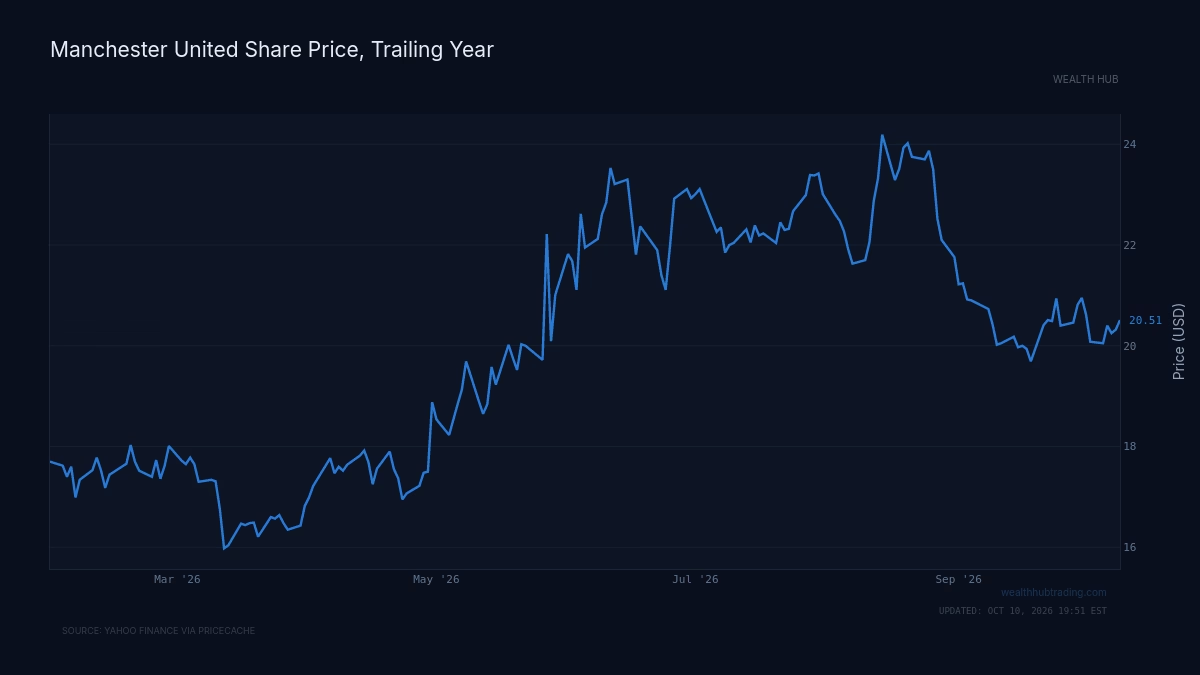
If the listed minority price and the private control marks continue to diverge, that divergence measures how much of the private valuation rests on control and scarcity rather than on what a passive holder can extract.
The Countercase: Cash Flows Did Change
The strongest objection to the buyer-pool reading is that the business genuinely transformed. Moores himself pointed to the influx of overseas stars on superstar wages after Euro 96. Global broadcasting, sponsorship and commercial income have made top clubs into international media properties in a way the 1996 Liverpool was not. On this view, the post-2010 re-rating reflects revenue growth that the flat decade simply preceded, and private equity is paying for a media asset at a reasonable multiple.
There is real force in that. A buyer pool cannot widen indefinitely on scarcity alone; some of the 20% annual compounding must be operational. The excerpt does not supply Liverpool's revenue or cash-flow history, so the split between earnings growth and multiple expansion cannot be measured here.
Two observations still weaken the countercase. First, the same wage inflation that drove revenue also drove the cost base, and Moores's own conclusion was that running the club "as an 'investment'" would have come unstuck quickly. Higher revenue matters to an equity holder only if it is not consumed by the playing squad. Second, the Forbes test is a direct reading on price relative to wealth, independent of club income. Valuations have outrun the growth of the richest individuals' fortunes so far that the individual bidder has largely left. That is a statement about price, not about operations.
What Would Change the Read
Rubinstein closes his preview with the right question: is football a viable asset class? On the evidence available, it has been a viable control asset, rewarding owners who sold into a deeper pool of capital than the one they bought from. Whether it qualifies as an asset class in the institutional sense depends on a test none of the current entrants has yet passed: a private equity owner selling a major club, at a gain, to a buyer that is not another vehicle of the same type.
The first full exit from the current cohort sets the decisive mark. If Clearlake's Chelsea or a comparable holding changes hands at or above entry valuation to a strategic or sovereign buyer, the asset-class argument gains a real data point. If exits instead run through continuation funds, secondary sales among sports-dedicated managers, or minority recapitalisations that preserve the headline valuation while shifting risk into deal terms, the market will be confirming what the flat decade at Liverpool already suggested: the price of a football club is set by who can afford to bid, and that pool has a limit.