The interesting number in the Syracuse story is not the $450 million of new dorm debt or the 93 programs it paused. It is the 55 programs that had zero ...
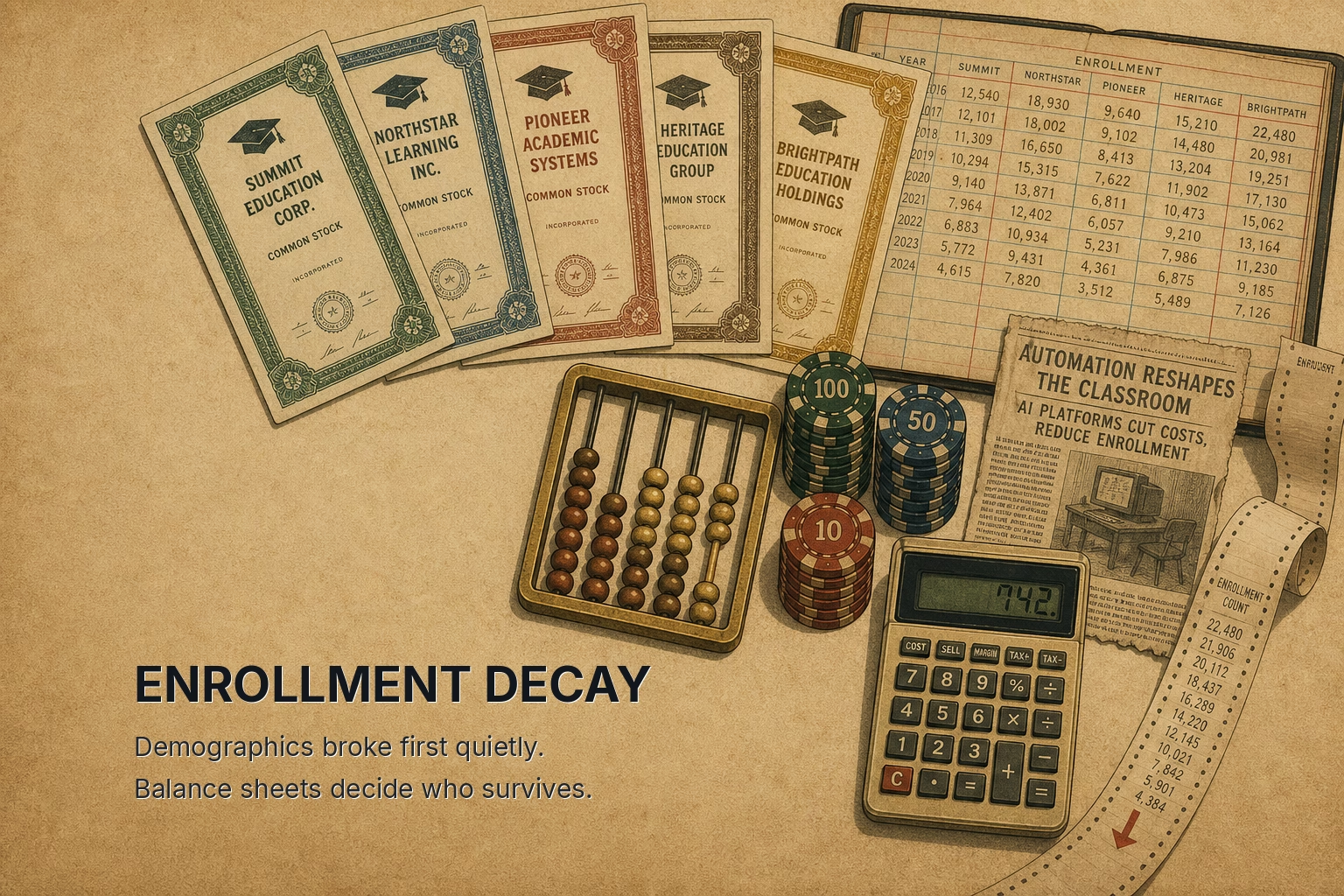
The interesting number in the Syracuse story is not the $450 million of new dorm debt or the 93 programs it paused. It is the 55 programs that had zero students enrolled while the university kept the lights on for all of them. That is a fixed-cost problem masquerading as a demand problem, and it tells you exactly how the education sector will break: not through a dramatic AI-driven collapse in the value of a degree, but through operating leverage running in reverse against a customer base that was already contracting before AI entered the conversation.
That distinction matters for anyone pricing education-exposed equities, because the market is anchoring to the wrong catalyst. The AI story is vivid, quotable, and largely unfalsifiable on a five-year horizon. The demographic story is boring, arithmetic, and already visible in the enrollment data. One of these is priceable today. The other is a narrative.
The Cliff Was Already on the Calendar
America graduated roughly 3.9 million high schoolers in 2025, and the Western Interstate Commission for Higher Education projects that figure declines steadily through 2041. That is not a forecast contingent on technology adoption or labor-market shifts. It is a headcount of children who have already been born, moving through a pipeline that ends at the admissions office. Colleges face fifteen years of fighting over a shrinking pool of eighteen-year-olds regardless of what any large language model does to entry-level hiring.
An institution like Syracuse, carrying a roughly $2.1 billion endowment and a sticker price near $100,000 a year, does not have a variable cost structure. Tenure, physical plant, and administrative overhead do not flex down with a soft enrollment year. When international enrollment falls precipitously, as the Journal reported, revenue drops but the cost base does not follow. That is the mechanism behind the current-year budget shortfall, and it is the mechanism that closes Hampshire College at the end of this year and suspends academic operations at the University of Valley Forge.
The lesson for equity selection is that the survivors will be operators whose cost bases are genuinely variable, not institutions with $450 million of fresh capital tied up in buildings.
Where AI Actually Changes the Math
The AI angle is not wrong; it is mistimed. Stanford's Digital Economy Lab found that among workers aged 22 to 25, employment in AI-exposed occupations sits roughly 19% below comparable less-exposed occupations, and the gap has widened. In Britain, more than a third of surveyed employers said they had cut entry-level opportunities partly due to automation. When Gallup asked this summer, 46% of Americans said AI would make degrees less important over five years against just 20% who said more important.
This is real, and it feeds the demand problem. But it feeds it slowly, through the willingness of a parent to spend $200,000, or $400,000 at Syracuse, on a credential whose payoff arrives in 2031. Sentiment shifts of this kind show up in application volumes and yield rates over multiple cycles, not in a single reporting period. The AI narrative is a discount-rate story on the perceived value of the degree, and the market cannot yet observe the cash-flow consequence.
Meanwhile the balance-sheet consequence of the demographic cliff is observable now, in the default data. Roughly 9 million borrowers were in default on $220 billion of federal loans as of March 2026, up 1.3 million from the prior quarter. That is the demand side already failing to clear at current prices, before AI has meaningfully repriced anything.
Reading the Operators by Their Cost Structure
The blast radius extends past the universities themselves to the publicly traded companies that sell into them and around them: online program managers, courseware providers, for-profit operators, and the payment and lending infrastructure. The right screen here is not exposure to AI headlines. It is the shape of the cost base and the durability of free cash flow when volume contracts.
A useful frame comes from comparing capex intensity across cash-flow generative businesses. 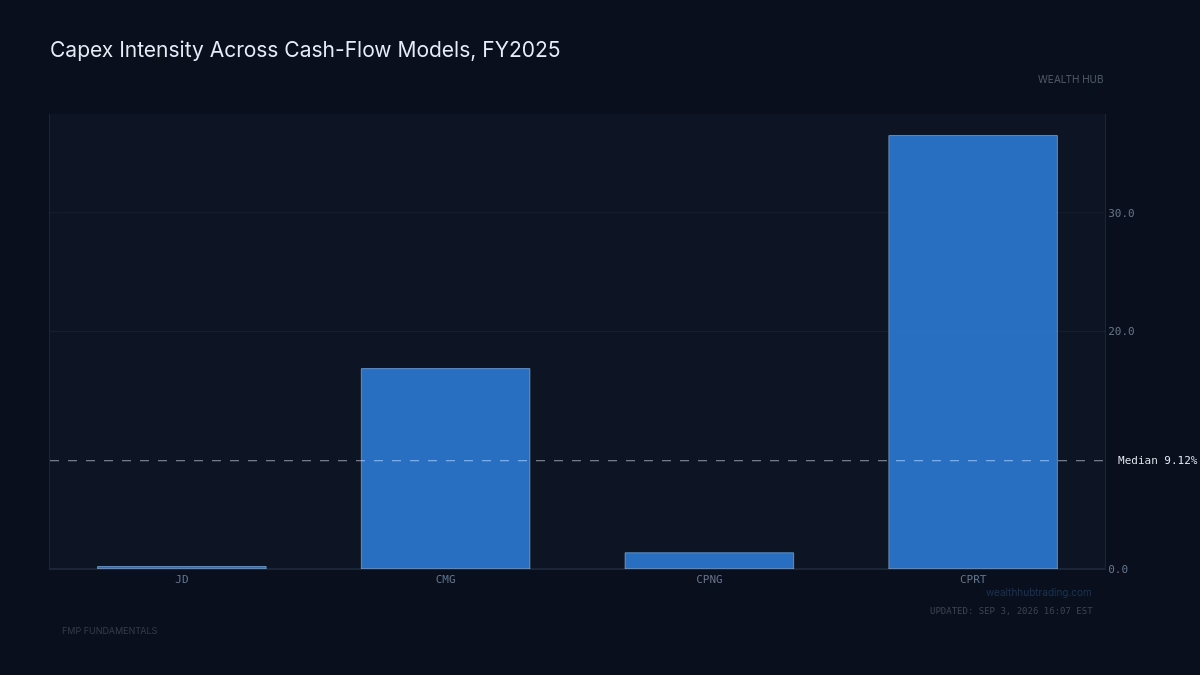
Translated to the education sector, the operators worth owning through a fifteen-year enrollment decline are the ones whose margins hold when volume contracts and whose capital is not sunk into physical capacity. The ones to avoid are those that levered up to build for a peak that already passed in 2025.
The Case Against This Read
The strongest counterargument is that consolidation concentrates the survivors. A shrinking market that closes Hampshire and Valley Forge does not shrink pro rata across the sector; it hands the marginal student to the institutions and platforms that remain. A well-capitalized courseware provider or online program manager could see its addressable share rise even as the total pool falls, the way a retail category can consolidate into stronger economics for the last operators standing.
That case is legitimate, and it is the reason the sector is not a blanket short. But it turns on a specific condition: that the surviving operators actually capture the displaced volume rather than watching it exit higher education entirely. The Gallup and default data suggest a meaningful share of the shrinking pool is not migrating to a cheaper competitor; it is declining to enroll at all. Consolidation only rewards the survivors if the students stay in the market. If the AI-driven repricing of the degree pushes them out of it, the survivors inherit a smaller pie, not a larger slice.
What Would Confirm the Trade
The read is confirmable on a schedule the market can watch. The demographic decline is fixed through 2041, so the tell is whether enrollment-exposed operators guide to volume declines that match the WICHE trajectory or claim share gains that offset it. The distinguishing evidence in each earnings cycle is the gap between an operator's revenue guidance and the disclosed cash-flow flexibility behind it: an institution guiding to flat revenue while its capex-to-operating-cash ratio climbs is not absorbing the shock, it is deferring the recognition of it.
The thesis breaks if surviving operators demonstrate durable pricing power and share capture that hold free-cash-flow margins flat through a down enrollment year. Until an earnings cycle shows that, the cleaner reading is that education equities are carrying a demographic contraction the market is mislabeling as an AI story, and the operators with variable cost bases and self-funded capital will separate cleanly from the ones that borrowed against a peak.