The reason AI adoption doubled among the region's firms without a wave of layoffs is not that the technology is weak. It is that adoption and integratio...
The reason AI adoption doubled among the region's firms without a wave of layoffs is not that the technology is weak. It is that adoption and integration are two different things, and almost every firm in the New York Fed's latest survey has done only the first. A tool sitting on a desk is not a workflow rebuilt around it. Until it is, headcount does not move much.
That distinction is the mechanism, and it is where intuition about AI and employment goes wrong. The instinct is to read a rising adoption number as a rising displacement number, on the assumption that each percentage point of firms using AI translates into some proportion of jobs no longer needed. The survey breaks that chain in the middle. Firms are adopting broadly and integrating narrowly, and it is integration, not adoption, that would put jobs at risk.
Adoption Went Vertical, Investment Did Not
The headline numbers are genuinely steep. Sixty-one percent of service firms in the New York and Northern New Jersey region reported using AI in 2026, up from 40 percent in 2025 and 25 percent in 2024. Manufacturers went from 16 percent to 26 percent to 51 percent over the same three surveys. Roughly doubling in a year, tripling over two, is not a marginal trend. These shares sit at the high end of what other workplace studies have found.
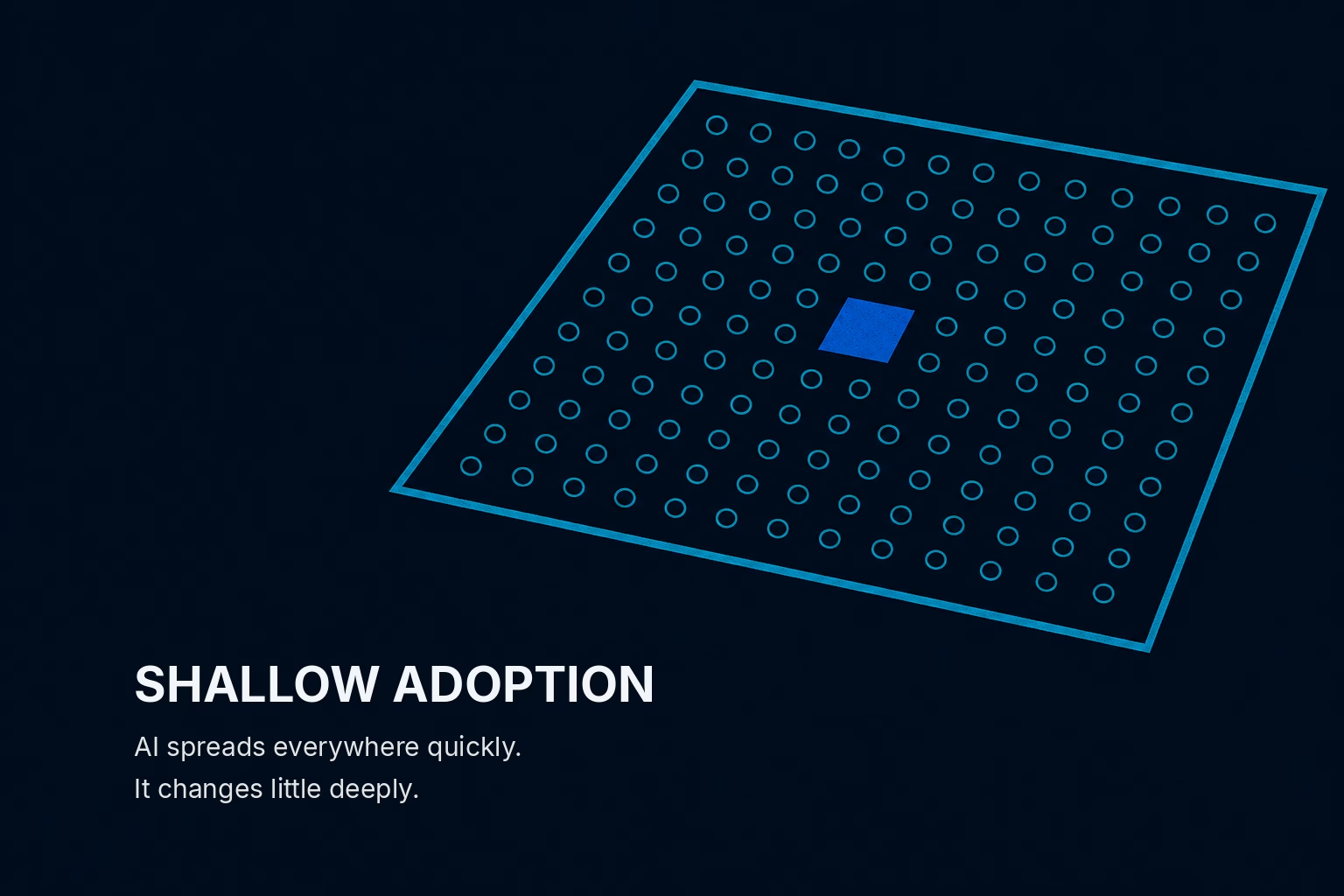
But the money tells a different story than the participation rate. Three-quarters of service firms and more than 90 percent of manufacturers describe their AI spending as minimal to modest, a bucket that runs from free tools to a small slice of overall budget. Only about 5 percent of service firms call AI a major strategic investment, and no manufacturers do. The adoption curve is vertical; the investment curve is nearly flat.
That combination is the tell. Widespread, cheap, shallow adoption is what you get when a technology is easy to try and hard to embed. It is the signature of experimentation, not transformation.
The Depth Number That Actually Matters
The single most important figure in the survey is not an adoption rate. It is the share of workers actually using the tools inside firms that have adopted them. Among service adopters, the median is 17 percent of the workforce. Among manufacturers, it is 7 percent.
Read that carefully. A firm that "uses AI" often means a firm where fewer than one in five employees touches it. The technology has entered the building through a side door, in a handful of functions, held by a minority of staff. That is not the profile of a workforce being restructured. It is the profile of a pilot.
This is why the layoff numbers stay quiet. Job losses come from redesigning a process so that fewer people are required to run it, and that requires deep, wide integration, the exact thing the depth figures say has not happened. You cannot cut a role that AI has not yet absorbed. At 17 percent worker penetration, most roles remain untouched by the tool, whatever the firm reports about its own adoption.
Why Firms Stopped Short
The reasons non-adopters give confirm that the barrier is fit and trust, not price. Cost was among the least-cited deterrents. About half of non-adopters said the type of work they do does not lend itself to AI. Roughly a quarter said the technology is not yet good enough to help their business.
The rest of the objections are about friction. More than a third cited concerns over data privacy, security, or confidentiality. A similar share flagged accuracy and reliability. And roughly a third said they lack staff with the technical skills to use the tools effectively.
That last point matters more than it looks. A skills gap is a depth constraint disguised as an adoption constraint. Even firms that have nominally adopted face the same wall internally, which is why usage concentrates among a small share of workers and why retraining, not hiring or firing, is the dominant response. When the binding limit is human capability rather than software cost, the natural adjustment is to build the capability, not to shed the people. Retraining remains the primary way firms are adjusting their workforces, and some firms have added workers specifically to help them use AI, an effect that runs opposite to the displacement narrative.
What Would Break This Reading
The optimistic read has a clear expiration condition, and it is worth naming precisely so it can be watched rather than assumed away.
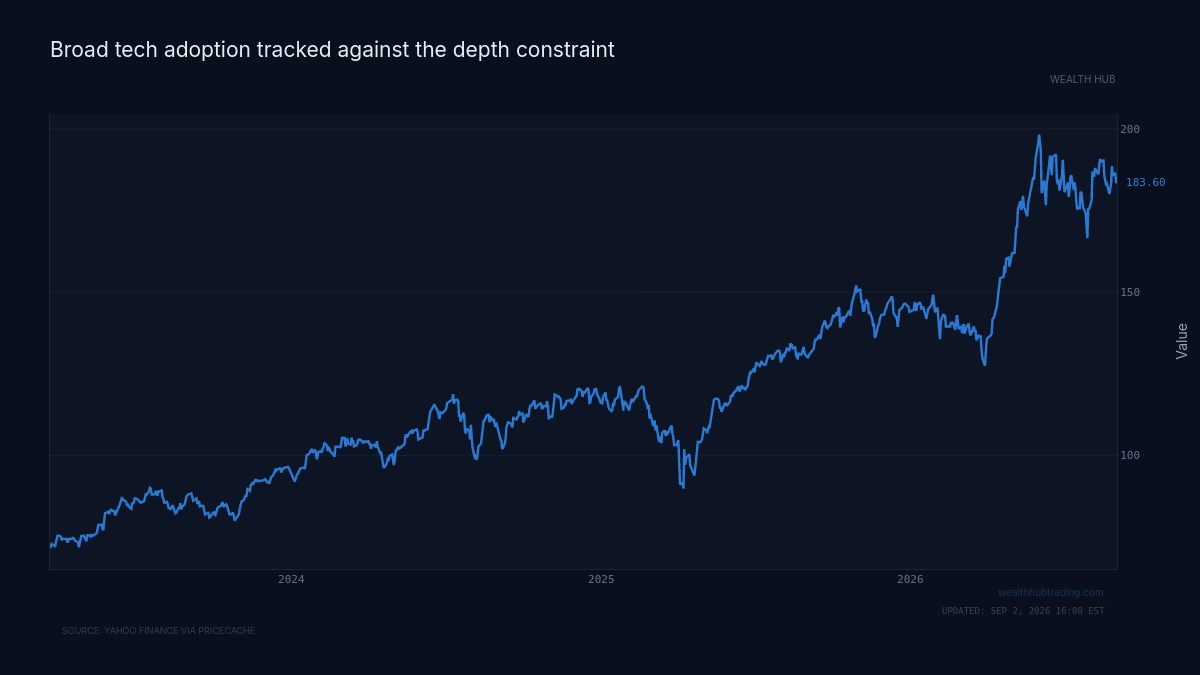
The current calm rests on shallow integration. The moment to worry is not when adoption climbs further, since it is already near ceiling for services. It is when the depth metrics move. If the median share of workers using AI within adopting firms climbs from 17 percent toward 40 or 50 percent, and if the investment mix shifts so that "major strategic investment" stops being a rounding error, the mechanism that has protected jobs would begin to invert. Deep integration is what converts a tool into a process redesign, and process redesign is what removes roles.
There is also a composition risk the aggregate hides. Adoption is highest in knowledge-intensive sectors: information, business services, and finance. If depth advances fastest exactly where cognitive tasks are most automatable, the benign region-wide average could sit on top of concentrated dislocation in specific white-collar functions. A stable headline number is not the same as a stable distribution.
The honest counterpoint to the whole thesis is timing. Surveys capture a moment, and this one captures an early one. The gap between broad adoption and shallow integration may simply be the lag between buying a capability and learning to use it. If that lag is closing, today's benign snapshot is a lagging indicator of a labor adjustment already in motion beneath it.
The One Series to Track
The employment question will not be answered by the adoption rate that generates the headlines. It will be answered by two numbers the survey already reports and can track over time: the median share of workers using AI inside adopting firms, and the share of firms treating AI as a major strategic investment rather than a modest experiment. As long as both stay low, the retraining-over-layoffs pattern holds and the transformation stays additive. When both start rising together, the mechanism that has kept jobs intact loses its footing. That, not the adoption curve, is the series to watch.