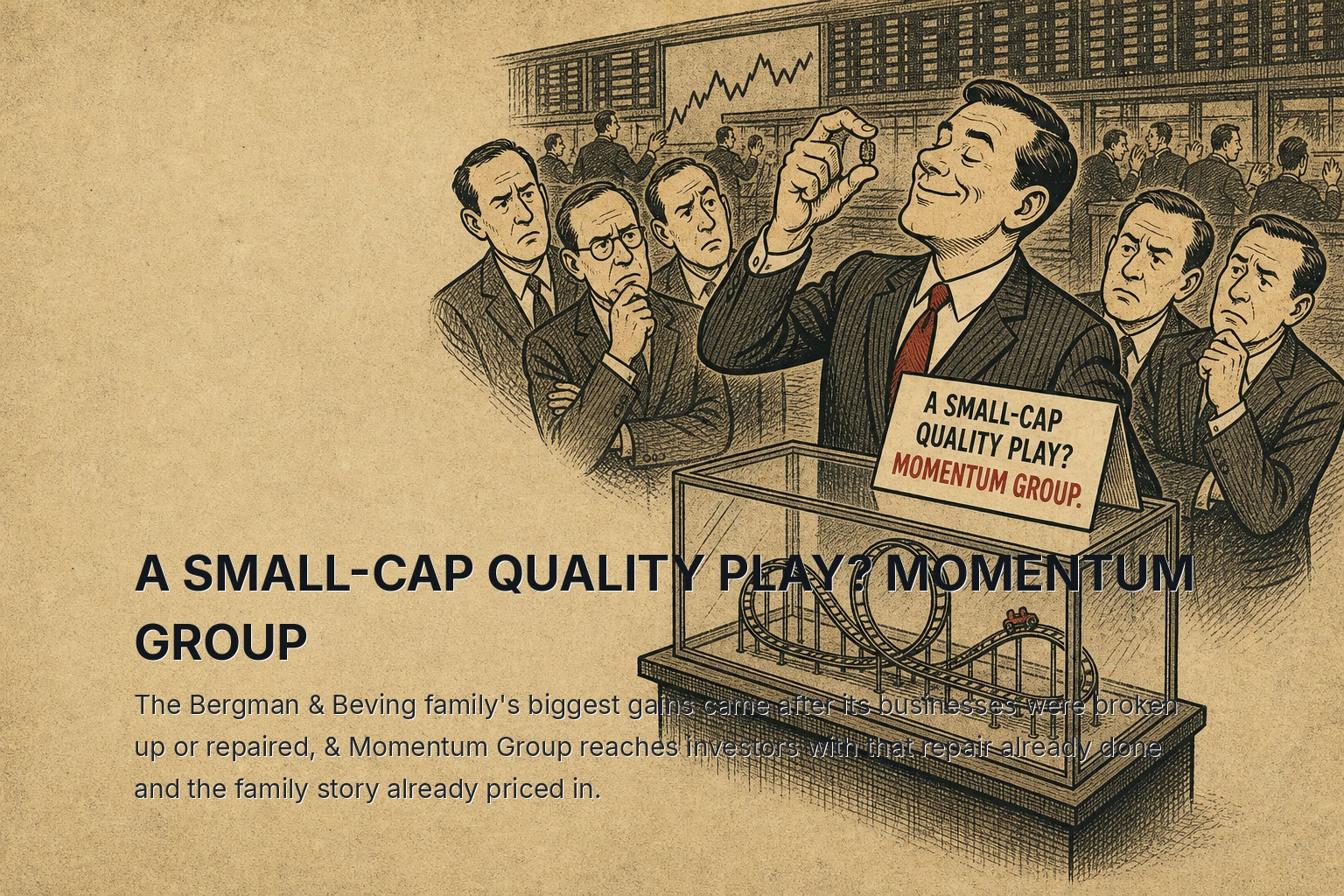
The Bergman & Beving family tree has produced its great returns from resets rather than from pedigree. Momentum Group, the newest and smallest branch, is the first to reach public investors with the reset already behind it and the family legend already reflected in its multiple. The newsletter case for the stock rests on lineage: two 100-baggers and an 80-bagger from one Swedish group. The lineage is real. What it actually teaches is narrower and less comfortable than the pitch implies.
A pitch made in late October 2026
On October 29, 2026, Compounding Quality made its case for Momentum Group AB. The company acquires industrial distributors and owns 35 subsidiaries, nearly all in the Nordics plus one in the United Kingdom. Most of what they sell is aftermarket components, the spare parts that keep expensive machinery running when downtime is costly. The pitch opened with a base rate. Fewer than 3% of public companies become 100-baggers, and the ones that do take roughly 26 years on average. It then argued that one family of companies had beaten those odds repeatedly and that Momentum Group could be next.
The supporting evidence was strong by most measures:
- Capital efficiency. EBITA to working capital stood at 58%, against an internal floor of 45%.
- Leverage. Net debt was 1.7 times free cash flow.
- Cash generation. Free cash flow had historically exceeded net income. Part of that gap came from acquisition amortization, which Swedish acquirers treat as an accounting cost rather than an economic one.
- Management. CEO Ulf Lilius owned about 1.4% of the company. CFO Niklas Enmark had spent seven years as CFO of Lagercrantz.
- Shareholders. REQ Capital, a fund that specializes in serial acquirers, held Momentum as the largest position in its Nordic Compounders fund. The Swedish family office Nordstjernan was the largest shareholder.
Two numbers in the same pitch pointed the other way. The stock traded at 21.1 times EV/EBITA (21.3 times in the summary table, a small inconsistency that does not change the picture). Organic growth had fallen four years in a row: +10% in 2022, +7% in 2023, +3% in 2024 and -2% in 2025. The newsletter judged the shares fairly valued and called the slowdown an industry-wide pattern among Swedish serial acquirers rather than a problem specific to Momentum.
To judge whether "fairly valued" is the right conclusion, it helps to go back through the episodes that built the family's reputation and look at what each one began from.
Bergman & Beving before the word "serial acquirer" existed
Bergman & Beving began buying distribution companies in 1967. That was nearly three decades before Mark Leonard founded Constellation Software in 1995, the firm most investors now treat as the template for the model. The company listed in 1976, nine years after its first acquisitions. According to the newsletter's figures, the stock has since returned roughly 7,500 times its listing value, so that $1,000 became about $7.5 million.
The strategy that produced this result was simple:
- Buy small, capital-light distributors that hold inventory but need no factories.
- Turn their working capital into cash.
- Use that cash to buy more distributors.
Each step was modest. Over decades, the repetition compounded.
The family's real innovation was not the acquisition machine but how it was governed as it grew. Bergman & Beving restructured itself several times, splitting off units whenever the group grew large enough to threaten the entrepreneurial culture of its subsidiaries. The idea is the one Leonard later summarized as wanting "to become big by staying small." Leonard travelled to Sweden to study the family, and Constellation later spun off Topicus and Lumine. The influence ran from Stockholm to Toronto, not the other way around.
The 2001 split and the decades that followed
In 2001 the group divided into three listed companies. Bergman & Beving itself was renamed B&B Tools and later took back its original name. Addtech and Lagercrantz were spun off as separate acquirers. Both operate across many industrial niches and avoid software.
The results that followed form the core of the family's reputation:
| Company | Origin | Outcome cited in the pitch | |---|---|---| | Addtech | Spun off 2001 | Share price compounded at more than 20% a year; roughly a 96-bagger | | Lagercrantz | Spun off 2001 | A very similar trajectory to Addtech | | AddLife | Spun off from Addtech, 2016 | Significant shareholder value in medical distribution |
The record is impressive and it deserves the attention it gets. The part that tends to be missed is where these companies started. The 2001 spinoffs were small, mostly unknown units newly separated from a parent. They had no famous lineage of their own because they were the beginning of it. The valuations at which Addtech and Lagercrantz first traded are not given in the source material, so the starting multiples cannot be compared directly. What can be said with confidence is that no newsletter in 2001 was selling Addtech on the strength of an existing 96-bagger sibling. The pedigree did not exist yet. The shares were priced as whatever the market thought a small Swedish distributor was worth.
The centralization detour, and the man who undid it
The second episode matters more to the Momentum story. It is less often told, and it is the one in which Momentum's own chief executive played the central role.
In the years before 2012, Bergman & Beving's leadership pursued a centralized model. The goal was to capture synergies and economies of scale by running the group as one integrated business rather than a federation of independent companies. On paper the logic held up. Shared purchasing, combined logistics and centralized functions should have reduced costs across many subsidiaries selling overlapping product lines.
It did not work. Moving decisions to headquarters weakened the subsidiary-level ownership that had made the model succeed, and the company struggled. The source describes the experiment as failing badly.
The two sides of this episode looked at the same facts and drew opposite conclusions:
- The centralizers saw a fragmented collection of distributors and treated fragmentation as waste. They assumed that the scale, once assembled, was the source of value and that coordinating it centrally would release more. Across much of industrial history that reasoning is correct, which is why it was persuasive.
- The decentralizers treated the fragmentation as the source of value. In their view, the subsidiary managers' local knowledge, customer relationships and sense of accountability for their own working capital were what the numbers actually measured. Remove them and the numbers would weaken, however tidy the new structure looked.
The board sided with the second view. It appointed Lilius, then head of the best-performing unit, to restore the decentralized approach. From 2012 to 2017, Bergman & Beving shareholders earned more than 40% a year, one of the strongest periods in the company's history.
The lesson of this period is easy to overlook. Those 40% annual returns did not come from a smoothly compounding machine. They came from a repair. The company started from depressed performance and depressed expectations, after a period in which the market had good reason to doubt the business. Lilius restored the operating model, and the share price rose as both earnings and the market's confidence recovered. Returns that start from broken expectations have two engines: business growth and a rising valuation. A machine already running at full speed has only the first.
Momentum's two births
In 2017 Bergman & Beving spun off Momentum Group, and Lilius chose to run the smaller company rather than stay at the larger parent. About five years later he did the same again. The first Momentum Group was split into Alligo and the present Momentum Group, and he again took the smaller entity. The current board continues the family links. The chairman also chairs AddLife, and another director sits on the board of Lagercrantz.
Momentum 2.0 inherited one design choice that sets it apart from its relatives: it extends capital allocation down to the subsidiaries. A subsidiary that keeps EBITA to working capital above 45% earns the right to make its own add-on acquisitions. Employee incentives are tied to the same ratio. The newsletter says this is unusual among Swedish acquirers. It goes a step beyond Lilius's original repair, because headquarters now lends part of its central decision-making power to the units that have proven they can use it well.
The cash results of that design show clearly in the filings.
Capital spending is so small that the newsletter observed it is barely visible on a cash flow chart. Nearly all operating cash becomes free cash, and most of that free cash is reinvested in acquisitions. A small dividend comes out of what remains.
What the arithmetic now asks of the machine
The newsletter's framework for serial acquirers multiplies return on invested capital by the reinvestment rate. For Momentum, roughly 18% ROIC multiplied by an average reinvestment rate above 85% gives about 15.3%. That matches the company's own target of growing intrinsic value by 15% a year, a target it has historically exceeded.
The weakness lies in what that formula leaves out. It counts compounding from acquisitions but ignores organic growth entirely. When organic growth was +10% in 2022, acquisitions added to growth that already existed. At -2% in 2025, acquisitions are doing more than all of the work, because they must also make up for a shrinking existing business. That does not mean the model is failing. It does mean that every percentage point of the 15% target now has to come from the deal pipeline. It also means the newsletter's own observation that the slowdown is common across Swedish acquirers cuts both ways. If the whole group's existing businesses are slowing together, then the whole group is bidding more aggressively for the same pool of Nordic distributors.
That competitive pressure is an inference, and it should be presented as one. The source material contains no data on acquisition multiples. Still, the mechanism is easy to follow. The family's playbook has become famous. REQ's fund managers have written a book, The Compounders, profiling nine serial acquirers, and Constellation's founder made a study trip to Sweden. When a strategy is well documented and widely copied, the targets it depends on tend to become more expensive. That is a common pattern, not a rule.
The valuation work in the pitch is honest about what it requires:
- Earnings growth model. It assumes 15% annual growth in EBITA per share and a 1.1% dividend yield. It also assumes the multiple shrinks from 21.1x to 17.5x over five years, which subtracts about 3.4 percentage points a year. The result is a 12.7% expected annual return. That figure depends almost entirely on the 15% assumption, and the 15% now depends almost entirely on acquisitions.
- Reverse DCF. It starts from SEK 350 million of free cash flow in 2026, against SEK 330 million in 2025. On that base, the current share price implies only 6.8% annual FCF growth to deliver a 10% return.
The reverse DCF is the strongest point in favor of the stock, and it deserves to be taken seriously. A 6.8% growth requirement is low for a company with this record. A company growing at 15% while the market prices it for less than 7% leaves a real margin of safety.
What separates Momentum from its predecessors is where that margin of safety comes from. Addtech and Lagercrantz in 2001, and Bergman & Beving in 2012, offered investors two sources of return: the business could improve, and the market's low expectations could rise. Momentum at 21x EBITA offers mainly one. Even the newsletter's base case expects the multiple to shrink. Investors are paying in advance for the governance quality that earlier shareholders received without paying for it.
The pattern, and the one way this branch differs
Across all four episodes, the family's growth machine ran the same way: buy small distributors, convert working capital into cash, and keep subsidiaries small through repeated spinoffs. What varied from episode to episode was the starting point.
- 1976: The company listed before anyone knew how far the model could go.
- 2001: The spinoffs began without any track record of their own.
- 2012: Lilius started from a business damaged by a failed experiment.
- 2026: Momentum enters a fully informed market, run by the person who led the repair, with organic growth falling and the family reputation fully understood.
The rhyme that the current enthusiasm overlooks is that this family's largest gains often came at moments when the market was underestimating the machine. Those moments came either because the unit was too new to have a reputation or because recent results had given the market reason to doubt it. Momentum today is neither unknown nor in doubt. It is the best-understood branch of the tree, priced by investors who have read the history.
None of this makes the company a poor business, or the stock a poor holding at a 12.7% expected return backed by a low reverse-DCF requirement. It makes it a different kind of opportunity from the ones that created the 96-bagger and the 7,500-bagger. Those were bets that the market had it wrong. This is closer to a bet that the market has it right and will keep being right for 20 years.
The structural lesson is about sequence, not the family's name. Organizational quality earns its highest return in the period between being proven and being recognized. Once a decentralized acquirer's discipline is documented in books and fund letters, investors can still earn the company's compounding rate. They stop collecting the premium for having noticed it first. With Momentum, the inherited pedigree tells investors a great deal about how the business will run, but much less about how much more value remains to be discovered.