The most telling figure in the Tsinghua experiment is not Qwen's 85.3% return. It is Claude Opus 4.7's cumulative stock-picking alpha of 0.2%, the best result in the field. When the best model's genuine selection skill rounds to zero, the raw performance chart is measuring something other than stock picking. That something is factor exposure. Large language models trading equities appear to work mainly as factor-tilt generators: they take on style and risk bets that public text makes easy to adopt, and they get paid when the market rewards those bets. A Barra attribution strips the bets out, and in this test almost nothing was left underneath.
The common intuition fails at one specific point. Most readers assume that anonymizing stocks removes the model's edge, so whatever performance remains must be reasoning. That is half right. Anonymization removes memory. It does not remove characteristics, and characteristics are exactly what a factor model prices.
Ten Models, Five Winners, One Coin
The research team, Zhu et al. (2026), had ten models trade Chinese A-shares from the start of 2024 to 10 April 2026 and measured them against the CSI 300. The raw results look like a mixed but encouraging scoreboard. Qwen 3.6 Plus returned 85.3% against the index's 36.9%, beating it by roughly 48 percentage points. Kimi lost 24.2%. Across the ten models, five beat the benchmark and five fell short of it.
A five-five split across ten portfolios is what you would expect if selection skill were absent and outcomes were driven by whatever exposures each model happened to hold. This does not prove the absence of skill, since a sample of ten is too small to prove much of anything. It does mean the headline "AI beats the market" result cannot be separated from luck using raw returns alone. That is the reason attribution exists.
After the researchers removed each portfolio's incidental factor and style exposures with the usual Barra framework, the picture reversed. Opus 4.7 kept 0.2% of cumulative alpha. Every other model was negative, and Gemini, DeepSeek, GLM and Kimi were sharply negative. The source describes the alpha measurement as covering a 16-month test, which is shorter than the full January 2024 to April 2026 trading span. This suggests the attribution applies to a specific evaluation segment, though the excerpt does not spell out how the two periods relate.
Why Anonymized Stocks Still Carry Factor Labels
The researchers' main contribution is methodological, and it deserves credit. Earlier backtests of AI traders had a lookahead problem: a model trained on public data through a given date already "knows" which stocks rallied during that window. Any backtest inside the training window rewards memory, not foresight. The same author previously cited a study in which AI inflation forecasts deteriorated once they were pushed past the training cutoff. Stripping identifying information from every stock in the universe is a reasonable fix. The model cannot recall that a particular battery maker tripled if it does not know which ticker is the battery maker.
Look at what still reaches the model. It sees a stock's recent returns, its volatility, its valuation ratios, its size, and its earnings profile. Each of these maps directly onto a standard factor: momentum, low volatility, value, size, quality, growth. A language model has absorbed an enormous amount of investment writing that turns those characteristics into rules of thumb. Buy what is working. Favor cheap stocks with improving earnings. Avoid the expensive and the illiquid. When the model applies those rules, it is not picking stocks in the sense of finding mispriced individual securities. It is building a portfolio with systematic tilts.
That is the mechanism behind the gap between the two charts. Raw returns pick up the payoff on the tilts. Barra-style attribution measures the tilts, assigns them their factor return, and treats the remainder as selection. If a model's choices are mostly the echo of well-documented factor heuristics, the remainder will be small. It will also tend to be negative once trading friction and the cost of noisy, concentrated bets are included, and that is broadly what the alpha chart shows.
The intuition error, put plainly: anonymization guarantees the model is not cheating. It does not guarantee the model is doing anything a cheap factor ETF could not.
The Market Gave Away Its Return in a Burst
The benchmark itself makes the attribution point clearer. A large part of the CSI 300's gain over this window came from a policy shock rather than gradual earnings repricing. The stimulus package announced in late September 2024 sent Chinese equities sharply higher within a few sessions. A portfolio that happened to be overweight high-beta, small-cap or beaten-down names going into that week would have produced a striking raw return without any stock-specific insight.
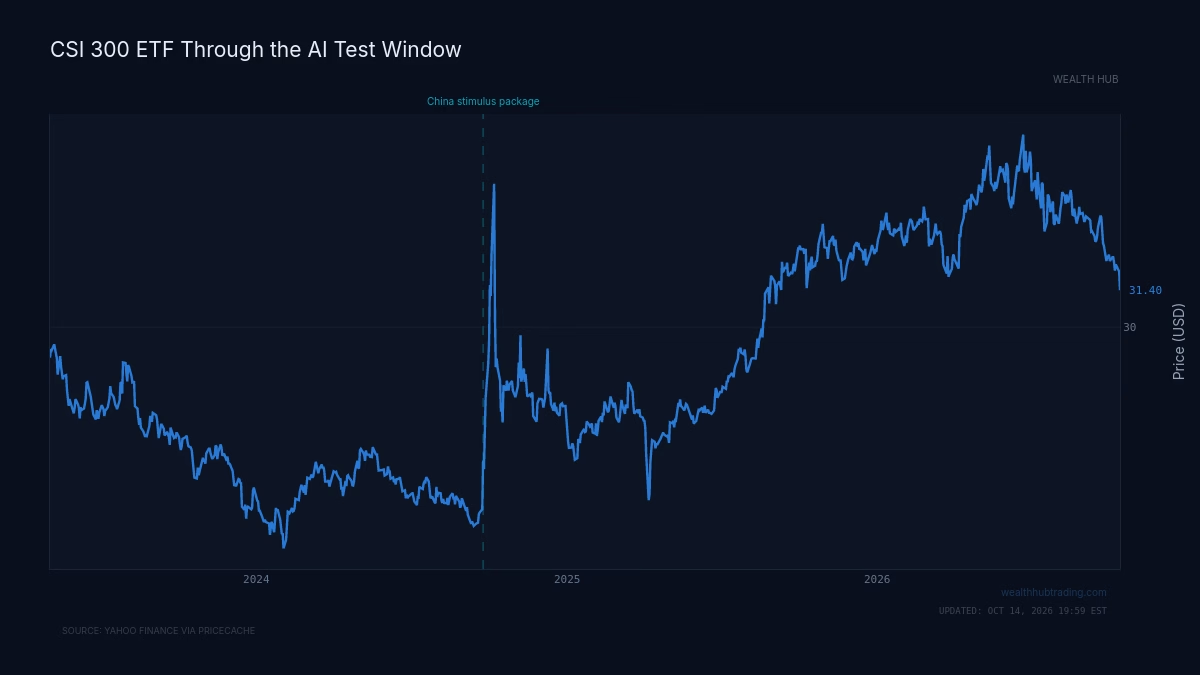
The chart uses the US-listed CSI 300 ETF, so its path includes currency effects as well as the index level. The shape is the point: the move was concentrated, and it was macro-driven. Shocks like this reward exposure. A model that loaded up on beta and momentum would appear brilliant on a cumulative return line and ordinary in a factor decomposition. This is a plausible explanation for some of the gap between Qwen's 85.3% and its attributed alpha, but it is an inference. The excerpt does not break down each model's factor loadings.
Where the Attribution Verdict Is Weakest
The case against the models depends on a risk model, and risk models embed choices. Three objections deserve a fair hearing.
First, factor timing can be a skill. If a model rotated into momentum before momentum paid off and out of it before it reversed, Barra assigns that return to the factor, not to the manager. A defender could argue that the models showed real judgment about which exposures to hold, and that the attribution defines this judgment away. The argument has some merit, but factor timing is notoriously hard to sustain. The models that did worst on alpha did not obviously make up for it with consistently good tilts, given that half of them trailed the index even on raw returns.
Second, the window is short. Sixteen months of residual returns in a retail-heavy, policy-sensitive market like A-shares is a noisy sample. An alpha of 0.2% cannot be distinguished from a modestly positive true edge or a modestly negative one. The negative results for Gemini, DeepSeek, GLM and Kimi are harder to dismiss as noise because of their size, but even those would need replication across windows and markets.
Third, the anonymization may handicap the models in ways that would not apply to a human analyst. Much of the real edge in Chinese equities comes from understanding policy exposure, state ownership, and sector priorities. A model that cannot tell a grid operator from a property developer cannot use that knowledge. The experiment therefore tests a narrower skill than "can AI pick stocks." It tests whether AI can extract alpha from numerical characteristics with no identity attached. That is a fair test of reasoning, but it is not the whole job.
The strongest evidence that the overall finding holds survives all three objections. The best result, after cleaning, is approximately zero, and the dispersion is lopsided toward losses. Even a generous reading of the attribution does not turn that into a positive skill result.
What Would Change the Read
The practical implication is about evaluation more than technology. Any AI-managed equity product, whether a fund, a robo-adviser or an internal desk tool, should be judged on residual return after factor attribution, not on its return against an index. Raw outperformance by a language model in a backtest is a statement about its exposures until shown otherwise. For allocators, the question to ask any vendor is what the portfolio's factor loadings were and what remains after you price them.
Two observations would weaken this view. The first would be positive residual alpha from anonymized models that persists across several non-overlapping windows and in more than one market. A single 16-month segment in A-shares cannot carry that claim. The second, oddly, would be persistently negative alpha. If models like Kimi or Gemini lose to their factor exposures consistently rather than randomly, their errors would contain information, and inverting them would be a strategy. Neither result appears in the work as excerpted.
Until one of those emerges, the productivity argument for AI in stock selection rests on a cost saving rather than an edge. These models can build a factor-tilted portfolio quickly and cheaply. They have not yet shown they can do what managers charge for, which is to be right about individual stocks for reasons the factor model cannot explain.