Meta's decision to give its frontier coding models away for free is not a pricing decision. It is a data-acquisition strategy dressed up as generosity, ...
Meta's decision to give its frontier coding models away for free is not a pricing decision. It is a data-acquisition strategy dressed up as generosity, and the thing being acquired is a feedback loop that compounds faster than any benchmark can measure. The token flow tells the story the price tag hides.
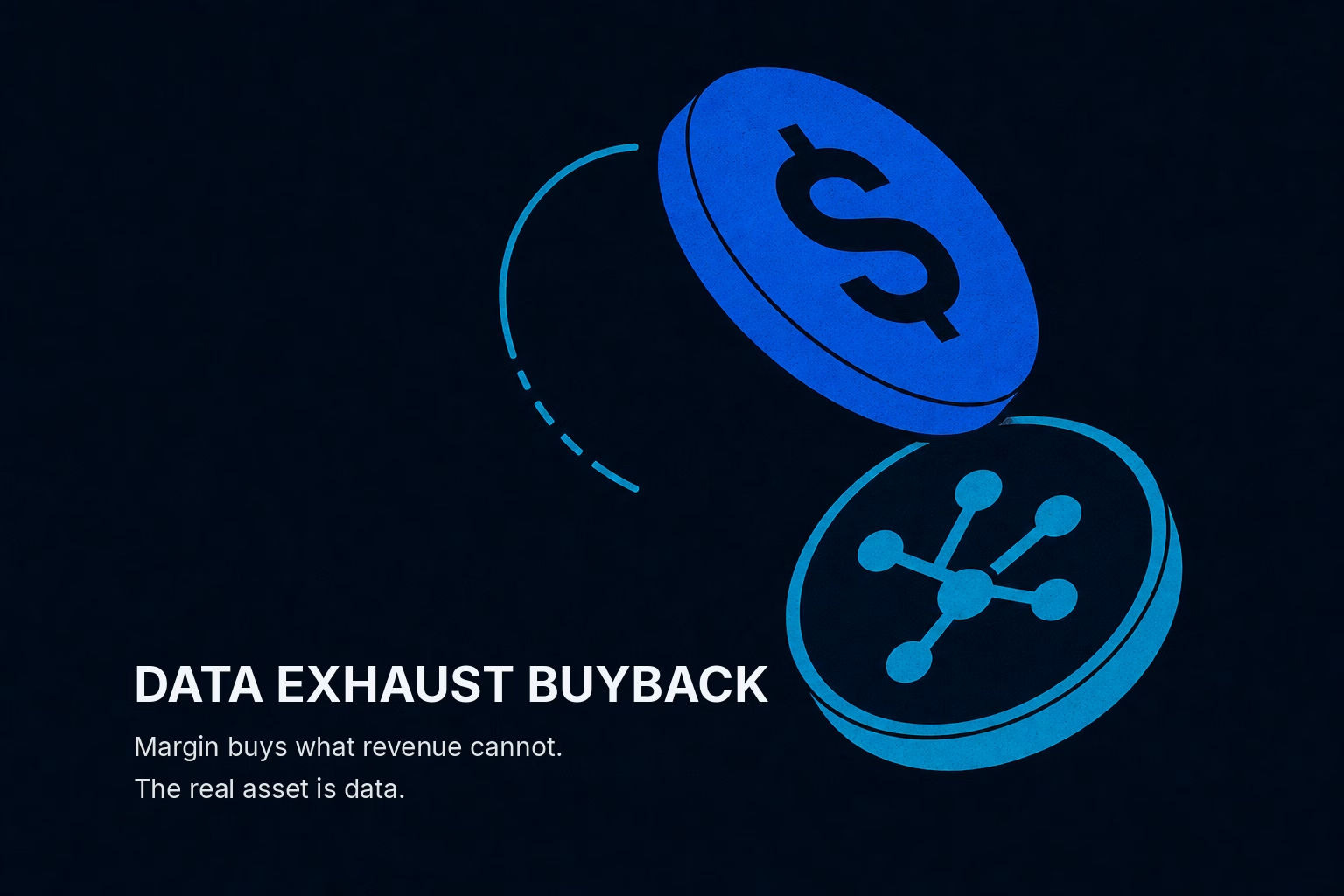
The setup is worth stating plainly because the intuitive read gets it backwards. When a lagging player slashes price to zero, the reflex is to call it desperation, a company that cannot compete on quality buying share it does not deserve. That framing misses the mechanism entirely. Meta is not buying share of a market. It is buying the raw material that lets it manufacture the next model, and it is willing to forgo external monetization to do so because the internal economics already justify the trade.
The Token Flow Is the Product
The observable fact that anchors everything: following the Muse Spark 1.3 release, Meta's share of tokens processed on OpenCode moved from 25% to 40%, and the platform recorded Meta crossing 5 trillion tokens processed in a single day. That is not a marketing number. It is a measure of how much real developer work is now flowing through Meta's models, and every one of those tokens is a coding interaction Meta can, under its own terms of use, feed back into training.
To size what 5 trillion daily tokens means, the useful comparison comes from Google. In June 2026, while proposing an $80 billion equity raise, Sundar Pichai described the Antigravity coding harness doubling its token throughput every few weeks and reaching more than 3 trillion tokens a day. He called that scale "a powerful feedback loop to improve our current and future models." Take Pichai's framing at face value, and Meta is now pulling roughly twice that volume of coding data on OpenCode alone, from a starting position months behind. Google's total throughput across Antigravity is certainly larger today; the point is not that Meta has overtaken anyone. The point is that Meta has acquired Google-shaped coding data through price, and it did so in weeks rather than quarters.
Why the Free Model Pays for Itself
The reason Meta can afford to bypass what Elon Musk half-jokingly calls "RevenueBench", the idea that wallet share is the only benchmark that cannot be gamed, is that Meta's return on this trade does not depend on external revenue at all.
Two internal economics do the work. First, Meta is reportedly on track to spend on the order of $10 billion on Anthropic's models, with the true figure likely higher once OpenAI usage is included. Every internal coding task that a competent first-party model can absorb is a task Meta no longer pays a frontier vendor's margin to run. A free external model that is merely on par with the frontier at coding pays for itself internally by displacing that spend, regardless of whether a single outside customer ever converts.
Second, and this is the structural fear rather than the accounting one, a frontier developer that keeps its best model for its own first-party products while shipping older, weaker models through the API can slowly starve everyone who builds on top of it. Zuckerberg has been visibly worried about exactly this asymmetry, and the lopsided risk-reward of not owning the frontier is a risk that is really only felt at the founder level, which partly explains why the founder-led firms treat frontier ownership as existential rather than optional. Buying the feedback loop now is insurance against being locked out of it later.
The Benchmark That Stopped Working
There is a second-order reason the timing matters, and it sits underneath the whole strategy. Model release cadence has accelerated to the point where frontier models saturate most public benchmarks, and the benchmarks themselves are visibly struggling to keep pace. When the leaderboard flattens because everyone scores near the ceiling, the leaderboard stops discriminating.
That is precisely the environment in which "RevenueBench" gains authority, because revenue reflects users voting with their wallets and that is harder to fake than an eval score. But revenue is a lagging indicator. It tells you a model worked after the wallet share has already moved. Benchmarks, for all their fragility, are a leading indicator, so demand for evals will not disappear even as their signal degrades. The real difficulty going forward is separating the signal from the noise as the release cadence compresses.
Meta's move is best understood as a bet that during exactly this window, when benchmarks are noisy and revenue is slow, the cleanest available signal is neither. It is token flow. Token flow is observable in near real time, it maps directly to training data, and it is a leading indicator of the thing that actually compounds. 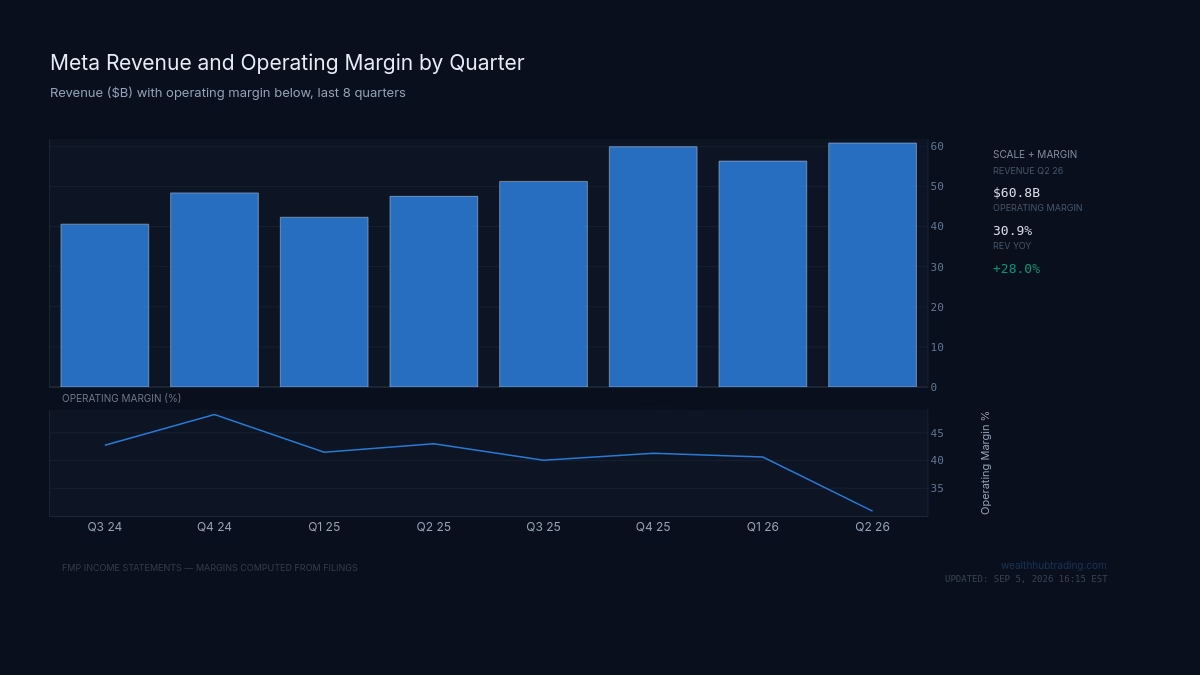
Where the Read Could Break
The thesis rests on one unverified link, and it is worth isolating rather than burying. Pichai's claim that token volume creates "a powerful feedback loop" is an assertion by an interested party, not a demonstrated law. If the marginal coding token past a certain volume adds little to model quality, because the data is redundant, low-diversity, or dominated by a handful of repetitive workflows, then Meta is buying share of a data stream whose returns have already plateaued. In that world the free model is a cost center that displaces some vendor spend but does not close the frontier gap, and the strategy degrades into subsidizing developers to use a product they would not otherwise pay for.
There is also a consent-and-quality question the token count cannot answer. The trade Meta offers, free models in exchange for training rights on your code, only works if developers who accept it are producing the kind of high-signal data that improves future models, rather than routing throwaway experiments to whichever model costs nothing. Five trillion tokens of low-intent traffic is a smaller asset than the headline implies. The OpenCode share gain is real; what those tokens are worth as training data is the part that is genuinely unproven.
What Would Confirm It
The read confirms if Meta's next frontier model shows a coding capability step that tracks the data it has been ingesting rather than the compute it has been buying, and if the OpenCode share holds above 40% after the novelty of a free frontier model wears off. Share that decays back toward 25% once a competitor matches the price would signal that Meta rented attention rather than acquired a durable data pipeline.
The cleaner tell is on the cost side. If Meta's external inference spend on Anthropic and OpenAI models flattens or falls over the next several quarters while internal token volume keeps climbing, that is the feedback loop paying for itself in the one currency that does not lag. Until either signal appears, the honest reading is that Meta has bought the loop on credit, and the bill comes due when the next model ships.