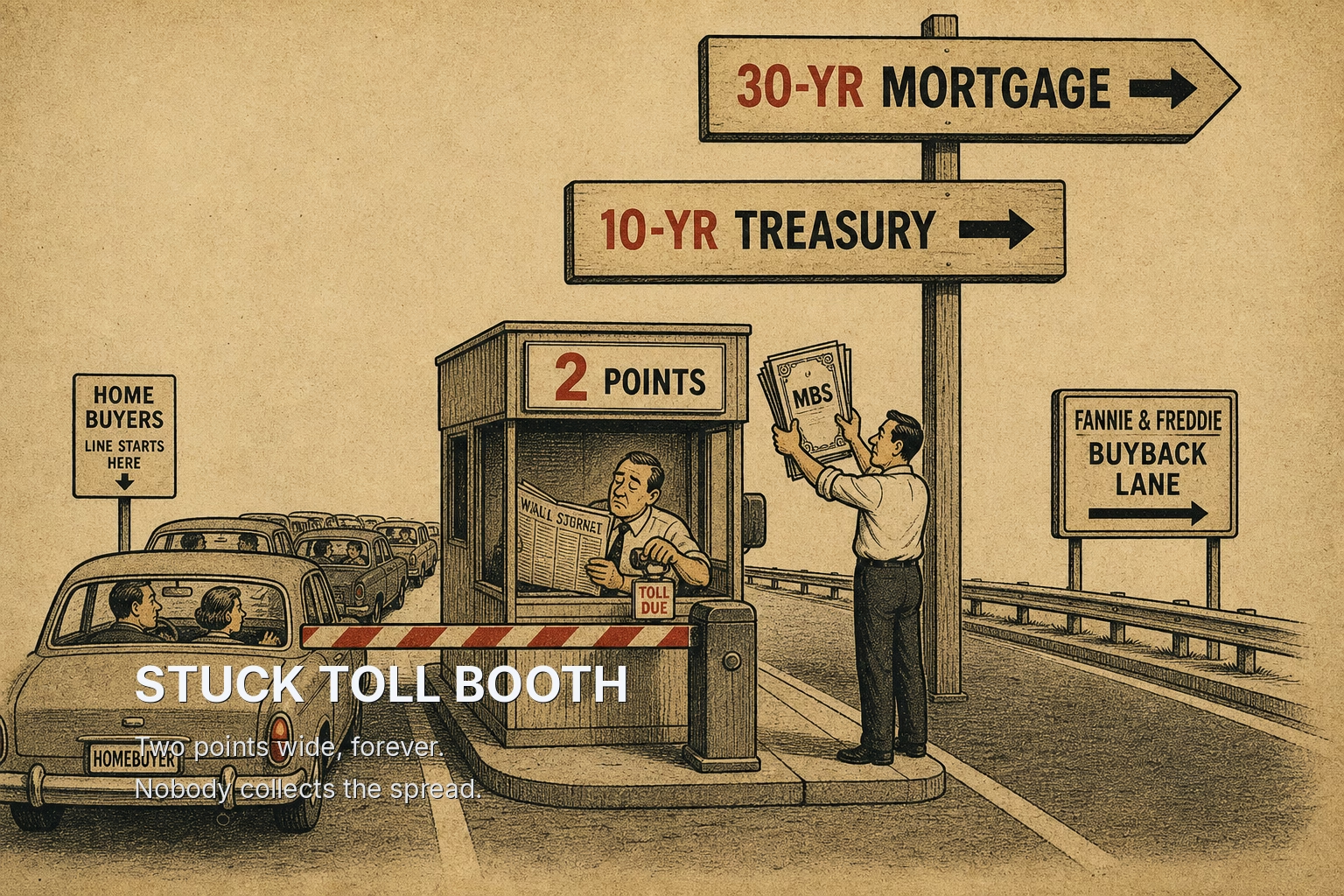
A pawnbroker does not care who you are. He cares what the watch will fetch on Monday. The lenders who put in $90 billion of orders for SpaceX's $25 billion bond sale in June thought they were underwriting a rocket company with a GPU appetite. They were underwriting a share price. That share price is underwritten by a discount rate that has been climbing for months.
Wolf Richter is right that the corporate bond market is in la-la-land on AI debt. He also shows, without quite saying it, why the calm holds. BB spreads at 1.94 percentage points are not an independent judgment about AI credit risk. They are a derivative of AI stock valuations, and those valuations are a derivative of the 10-year Treasury yield. Credit has handed its risk assessment to the equity market and assumed the equity market will keep its window open.
So the first thing to move will not be the spread. It will be the multiple.
Is the Bond Market Actually Calm?
At the index level, yes, and the numbers support it. The ICE BofA BB option-adjusted spread widened to 2.04 percentage points in early October, then narrowed back to 1.94. In March 2020 the same spread went above 8 points. During the Financial Crisis it peaked near 15. Even the tariff shock after April 2, 2025 pushed it above 3. The B-rated spread, the middle of junk territory, sits at 3.15 points. No AI bond or loan has defaulted. By any historical yardstick, the BB index is behaving as though nothing is wrong.
At the level of individual issuers, it is not calm at all. In June, SpaceX's $6 billion tranche of 10-year senior unsecured notes priced with a 5.875% coupon, roughly 110 to 120 basis points over a 10-year Treasury near 4.7%. The notes were rated BBB+ by Fitch and BBB by S&P, the bottom rungs of investment grade. Today they trade around 90 cents on the dollar, yielding 7.20%, close to 200 basis points over Treasuries. That is the BB spread. A bond sold as investment grade four months ago now trades like junk, with no default, no missed coupon, and no downgrade in the source material.
The arithmetic matters. The yield rose about 132 basis points. Treasuries account for roughly 50 to 55 of that, given the 10-year's move from about 4.7% to the current level. The other 80 or so is spread. On a note with duration in the neighborhood of seven and a half years, 132 basis points works out to about ten points of price, which is the decline the market shows. Most of the loss on the flagship AI bond came from the market repricing SpaceX credit, not from the rate environment.
The index looks calm because the index is an average, and averages are where tail risk hides.
What Is a BB Spread Really Pricing?
Start with how a creditor reasons when lending to a company whose stock market value runs in the trillions. The debt sits senior to a huge equity cushion. More importantly, the cushion can be refilled. SpaceX raised $86 billion in its IPO, capital it will never pay interest on or repay, and it can issue more through follow-on offerings. OpenAI and Anthropic are lining up behind it. If an AI borrower gets into trouble, the lender's working assumption is that it sells stock before it misses a coupon. On that assumption, a 194-basis-point spread for BB risk is not careless. It is the price of a put option the equity market has written on the bond market's behalf.
That is the actual structure of the la-la-land Richter describes. The bond market is not ignoring the risk. It has priced a backstop and is relying on the backstop staying solvent. Richter makes the link himself: trillion-dollar valuations and future trillion-dollar IPOs are "confidence inspiring for the bond market," and the bond market gets frazzled once share sales become difficult. That is correct. The part consensus misses is that the backstop has already failed once, and the failure was waved off.
Firmus, the Nvidia-backed Australian infrastructure company, tried to raise about US$5.5 billion in an IPO. The deal collapsed and was pulled. Richter treats it as a local overreach, an issuer that pushed too hard, with investors who perhaps finally read a prospectus. That may be all it was. A first pulled deal is sometimes idiosyncratic. It is also, often enough to take seriously, the first sign that marginal equity demand has a price limit. The equity window does not slam shut for everyone at once. It shuts first for the weakest issuer at the highest valuation, then moves up the quality ladder.
Then there is what SpaceX is doing with its access. After an $86 billion IPO and a $25 billion bond sale, it is reportedly negotiating with Apollo and a group of banks to borrow another $40 billion to buy Nvidia GPUs. A company with cheap equity capital would ordinarily use it. One that keeps adding debt on top of record equity raises is telling you how much capital the plan requires, and that equity alone is not enough to cover it. The hardware being bought turns over on a product cycle of two to three years. The debt raised in June runs out to ten. The terms of the new $40 billion are not public, so its maturity profile is unknown. The direction is clear, though: lending that is long relative to the collateral, justified by a stock price.
The spread is not pricing AI credit. It is pricing AI equity.
Where Did the Riskiest Debt Go?
Part of the reason the index looks so composed is that the most aggressive borrowing is no longer in it.
The US corporate bond market, investment grade and high yield combined, is about $12 trillion, according to SIFMA. The large AI companies alone are adding roughly $500 billion this year. They are not the only issuers. Paramount Skydance is funding its acquisition of Warner Bros. Discovery with $52 billion of debt, including $44 billion of bonds, $12 billion of them junk, leaving the combined company with about $80 billion of debt. Above all of it sits the federal government, which has to finance roughly $2 trillion of deficits a year. Everyone is competing for the same pool of duration buyers.
Richter notes that some AI borrowing has moved off balance sheet into special purpose vehicles, commercial leases, and purchase commitments, and that private credit is crowding in. SpaceX's next $40 billion is aimed at private credit and banks instead of the public bond market. Consider the timing. The issuer's own public bonds had just traded out to junk spreads, and its next round of borrowing heads for a venue that does not mark to market daily.
That is selection bias built into the measurement. A borrower whose public paper was just repriced lower routes around that market. The public index ends up measuring the borrowers who could still clear it, while the marginal and most leveraged financing moves into loans whose spreads never show up on a screen. A private credit fund holding a $40 billion GPU loan does not publish a daily option-adjusted spread. It publishes a quarterly mark, and quarterly marks are a matter of judgment.
The thermometer is calm because it sits in the coolest room of the house.
None of this is fraud. Moving financing from public bonds to private loans is a reasonable choice for a borrower. It does mean that a BB spread hovering near historic lows says less about aggregate AI leverage each quarter. The quoted spread is accurate for the sample it measures. The sample is shrinking toward the most comfortable borrowers.
What Breaks First at 5.22%?
Here the rates channel decides the outcome, and here the consensus framing has the order wrong. The worry is that credit spreads will blow out. The more likely sequence runs through equities first.
The 10-year Treasury stood at 5.22% on October 8, with the 2-year at 4.75% and the 2s10s spread at a positive 0.47 percentage points. That is a curve steepening from the long end. Long yields are rising faster than policy expectations, which points to term premium and supply rather than the Federal Reserve. Richter says yields are only back to the pre-2008 normal range, which is accurate and somewhat beside the point. The relevant question is not whether 5.22% is historically high. It is what 5.22% does to an asset whose cash flows sit years in the future.
AI stocks are the longest-duration equity in the market. Their valuations rest on earnings that are mostly far off, and the revenue model needed to justify the planned capital spending, as Richter puts it, remains in fantasy land. A higher discount rate hits those cash flows harder than any others. When the 10-year rises 30 basis points in a couple of weeks, the first casualty is often the growth multiple, not the credit spread. Sometimes banks gain briefly on wider net interest margins. Long-duration tech usually pays.
So the chain runs like this. Long Treasury yields rise. AI multiples compress. The IPO and follow-on window narrows, first for a Firmus and later for better names. AI borrowers lean harder on debt at the moment their equity cushion is shrinking. Only then, with the backstop visibly impaired, does credit reprice. In this structure, credit comes last. The BB index at 1.94 points does not contradict the risk. It is a lagging reading, one or two steps behind a move that has already started in the Treasury market.

The 2022 inflation shock is the obvious precedent and an imperfect one. That year the Fed tightened at its fastest pace in four decades, equities fell about 20%, and long-duration bonds had their worst annual losses in generations. Rates broke the multiple first, and credit followed. The key difference now is that inflation started from a lower base, so the Fed has less reason to hike aggressively. That would be comforting if the Fed were the source of the pressure. It is not. With 2s10s positive and the long end leading, front-end rate cuts do little to bring down the rate that matters for a ten-year AI note or a long-duration AI stock. The Fed can ease at two years without easing anything at ten.
The currency market adds a less certain layer. By available positioning data, commercial hedgers in dollar index futures are net short about 11.2% of open interest while speculators are net long. That split has often come before dollar weakness, though not reliably enough to trade on alone, and I would not bet on its timing. If it does resolve against the dollar while long Treasury yields stay above 5%, that combination is the dangerous one: foreign buyers asking for more to hold US duration, with no supportive dollar inflow. I do not know whether that is the regime ahead. It is the version of the next six months that would push the multiple, the window, and the spread down in close succession instead of slowly.
Who Is Left Holding the Paper?
The exposure is concentrated, and it can be named.
First come the holders of long-dated, low-investment-grade AI debt bought this summer at 110 to 120 basis points over Treasuries. They have already absorbed about a ten-point mark on the SpaceX 10-year, and they hold paper whose spread assumes the equity window stays open for its full term. Next come the private credit lenders and banks negotiating the $40 billion SpaceX facility. They are being asked to lend against GPU collateral at a point when the public market has already marked the same borrower to junk. Then there is the circularity that rarely gets discussed: a meaningful share of AI hardware demand is now financed with borrowed money, with Nvidia on the receiving end. NVDA, and the semiconductor complex in SOXX more generally, are not only the backstop for AI credit. They also depend on AI credit continuing to flow. If the lending slows, part of the order book slows with it.
On the probabilities, I do not know, and the honest framing is about shape rather than precision. The most likely path is a slow grind. Index spreads stay near historic lows, AI multiples drift lower as long yields hold above 5%, and the damage shows up as pulled deals and weaker marks on individual bonds rather than a broad credit event. A smaller but real possibility is acceleration, where a sharp equity drawdown and a credit repricing happen together because the cushion and the borrowing depend on the same market. The least likely outcome is the one the bond market is effectively priced for: long yields stabilize, the window stays open, and la-la-land turns out to have been sensible. That last case is not impossible. It is the minority outcome that the market treats as the default.
The positioning follows from that. Hold the front end and short-duration inflation protection, such as STIP, rather than long-dated AI paper. Treat the BB index as a lagging confirmation, not an early warning. Watch the IPO calendar and follow-on pricing more closely than spreads, because the equity window will close before the credit window does. Every new AI bond priced near 1.94 points over Treasuries is a bet that SpaceX, OpenAI, and Anthropic can keep selling stock at current valuations for the next decade.
The bond market is not asleep; it is leaning on the stock market.
And the stock market is leaning on the 10-year.