There is no cash "in" the market to flow into or out of. Every dollar a buyer spends on a share is a dollar a seller pockets at the same instant; the ca...
There is no cash "in" the market to flow into or out of. Every dollar a buyer spends on a share is a dollar a seller pockets at the same instant; the cash never enters an aggregate reservoir because no such reservoir exists. John Hussman's March letter opens on this deliberately unglamorous point, and it is the correct place to start, because almost every popular explanation of the current bubble rests on the fiction that money "goes into" equities and lifts prices the way water lifts a boat. It does not. Understanding why is the whole game.
What a Price Actually Is
A market price is not a level that money pushes around. It is the point at which the most eager remaining buyer and the most reluctant remaining seller agree to transact one marginal share. That agreement clears exactly when someone else's opposite order is filled. Volume measures how many people disagreed enough about value to trade; price measures where the last pair of them stopped disagreeing. Both are outputs of belief, not of quantity of dollars.
This is why "flows" language misleads even sophisticated readers. When a commentator says $50 billion "flowed into" equities in a month, what happened is that $50 billion of shares changed hands and the marginal transaction price drifted higher because the buyers were, at the margin, more insistent than the sellers. The stock of cash held by the public did not fall. It was simply relocated from share-buyers to share-sellers, penny for penny. No net cash was consumed by the market. The index rose because the reservation price of the least-willing seller kept climbing, and enough marginal buyers kept meeting it.
The distinction is not pedantic. It determines what can and cannot explain a bubble.
The Part Passive Money Can Explain, and the Part It Cannot
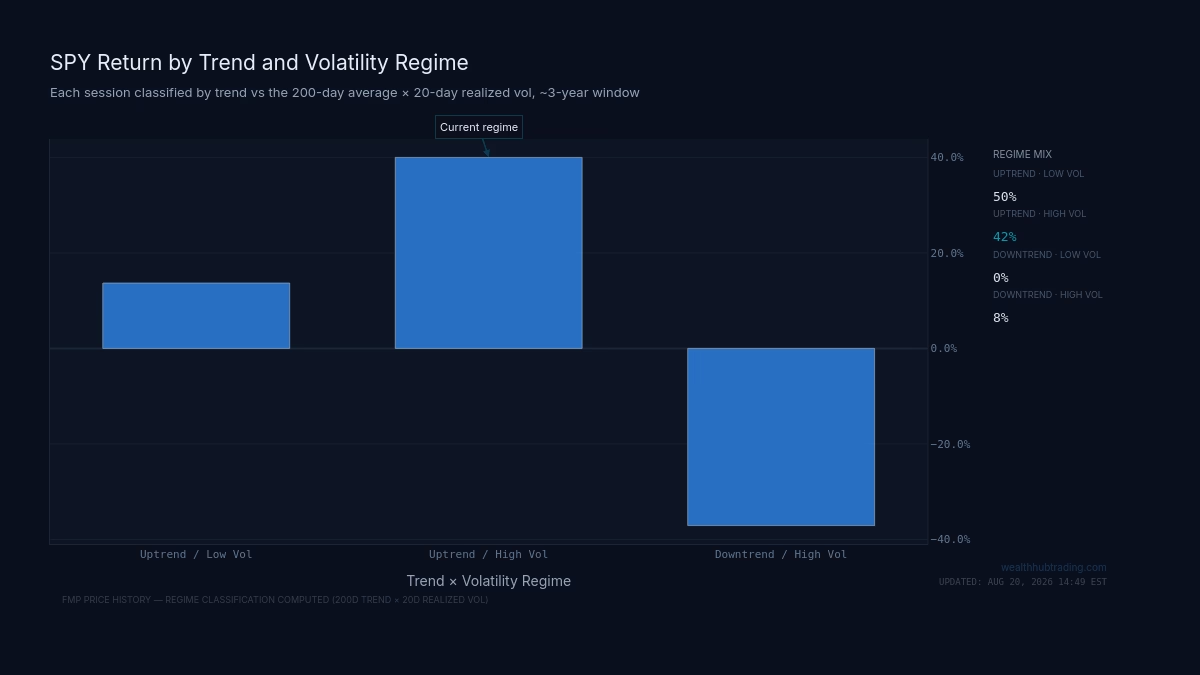
Hussman's sharper move is to separate the mechanical from the behavioral. Passive index investing genuinely does force buying: a 401(k) contribution allocated to an S&P 500 fund must purchase the index constituents regardless of price, and it must find a seller. That is real, price-insensitive demand. It plausibly compresses the risk premium at the margin, because it removes a class of buyer who would otherwise have said "not at this price."
But mechanical flows cannot explain the magnitude of what has happened, and this is where intuition gets it wrong. Passive buying is proportional and steady. It does not, by itself, produce a handful of names carrying the entire capitalization of an index, nor does it explain why investors have become insensitive to valuation rather than merely price-taking. A price-insensitive buyer still transacts against a seller who chose to sell. If the seller's reservation price is anchored to a belief that the asset is worth far more tomorrow, the clearing price ratchets up for reasons that have nothing to do with the size of the passive bid. The belief is doing the work. The flow is only the accounting.
That is the "bubble on a bubble" Hussman describes in information technology: a first layer where genuine innovation justified a re-rating, and a second layer where the re-rating itself became the reason to buy, with valuation treated as irrelevant so long as the marginal seller keeps raising his ask. Glamour capitalization is a belief cascade wearing the costume of a flow.
The Lopsided Ledger Underneath
The letter's economic backdrop is the accounting-identity sense of equilibrium: every deficit is someone's surplus, and the totals close. Record corporate profits are not free-standing. They are the mirror image of deficits run elsewhere, government dissaving and household dissaving chief among them. Profits at a share of output far above historical norms are, by identity, a claim on saving that some other sector is failing to keep.
This matters for the market thesis because the profit level that underwrites current valuations sits on the surplus side of a ledger whose other side is fiscal and household deficits. Those deficits are not permanent by decree. When the offsetting sectors stop supplying the deficit, the profit share compresses mechanically, not because sentiment shifts but because the identity forces it. A valuation regime resting on both a belief cascade in prices and a historically extreme profit share is leaning on two supports that are correlated in the wrong direction: the same macro reversal that pressures profits tends to be the one that punctures the belief.
Where the Argument Could Be Wrong
The strongest counter is that "belief cascade" is unfalsifiable in real time. Every persistent bull market looks like irrational belief until it is revealed to have correctly discounted a real transformation. The technology capitalizations that look like a bubble-on-a-bubble may instead be the market pricing a genuine and durable shift in where profits accrue. Hussman himself concedes that the distribution of corporate profits tracks whichever industries dominate at a given moment, and that concession cuts against his own alarm: if the profit concentration reflects real economic gravity rather than mania, then the "second layer" is not a bubble at all but a repricing that will hold.
There is also the awkward fact that a valuation-insensitive market can remain valuation-insensitive for years. The mechanism Hussman describes says nothing about timing. A ratcheting clearing price driven by seller reservation values can ratchet in one direction far longer than any solvency or identity argument would suggest, precisely because the marginal seller keeps deferring.
What Would Confirm the Read
The mechanism gives a cleaner test than any valuation ratio. Watch whether marginal sellers begin lowering reservation prices when the passive bid remains constant. Because flows are penny-for-penny neutral, a falling index on undiminished passive contributions is direct evidence that belief, not money supply, was holding the level up, and that the belief has begun to release. That is the observable condition. Until sellers start marking themselves down against a steady bid, the bubble is intact and the flow-based explanations will keep being offered for a phenomenon they were never able to describe.