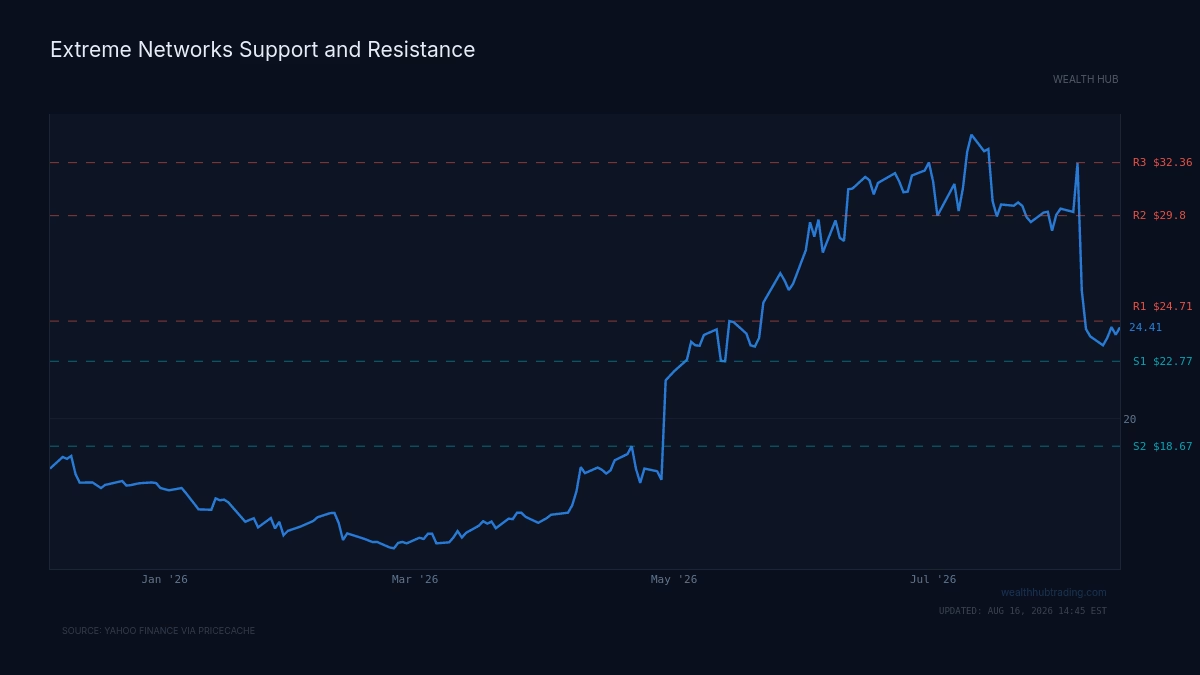
Extreme Networks got sold as a small-cap tech casualty at exactly the moment its business became the most predictable it has ever been. That is the mismatch. The stock trades at a historic low on a free cash flow basis, roughly 9.5x the next twelve months of estimated FCF as of mid-July, while its product backlog sits near 25x pre-Covid levels. Cheap valuations usually accompany deteriorating visibility. Here the two moved in opposite directions, and the market has priced the pessimism it applied to the whole non-profitable tech complex onto a name that is throwing off cash and taking share.
The rotation worth watching is not the index level. It is the relative-strength turn underneath the small-cap tech wreckage, where a handful of names got repriced for a fundamental story that no longer describes them. Extreme (EXTR) is one of them.
The Backlog Is the Whole Argument
A networking hardware company normally ships what it books. Extreme's product backlog historically ran $20 to $40 million in any given quarter, made up almost entirely of orders that arrived near quarter-end and would otherwise have shipped immediately. That backlog now stands at $513 million.
This is not demand pulled forward by clever sales incentives. It is demand that supply chain constraints prevented the company from fulfilling, sitting in a queue of orders the customers want as soon as possible. The distinction matters because it changes what the backlog predicts. A promotional backlog borrows from future quarters. A supply-constrained backlog of "ship it now" orders is deferred revenue with a customer already committed, and it converts to shipments as components free up rather than as salespeople persuade.
Management has said it expects the backlog to keep growing through fiscal 2023, with the CEO publicly guiding to roughly another $150 million in additions even as the top line grows on releasing supply. If that holds, product backlog approaches $600 million. Lead times, meanwhile, are the lowest in the industry, ahead of Cisco, which is prioritizing its largest customers. That combination, shorter lead times plus a growing order book, is the operational signature of a share gainer, not a company riding a cyclical wave it cannot control.
Where the Cash Actually Comes From
Backlog realization is only half of it. The software platform is the part consensus appears to be ignoring entirely. Recurring SaaS revenue has crossed $100 million and is growing 40% year over year, and it is doing so just as it reaches the scale where the economics start to matter to the whole P&L.
Put the two together over the realization window, roughly ten quarters, and the plausible outcome is over $750 million in free cash flow across the next three years. Against a market capitalization of about $1.8 billion and an enterprise value near $1.9 billion, that is not a growth-stock cash flow profile. It is a cash flow yield that implies the market does not believe the numbers.
The balance sheet reinforces how far the story has traveled. Entering 2020 the company carried net leverage above 3.0x and watched new product orders briefly collapse around the pandemic shutdowns. Today leverage sits under 1.0x. The business survived its worst-case demand shock, delevered through it, and emerged with a larger order book and a scaling software annuity. The shares are cheaper than they were at $4, when the risk was materially higher.
Why the Discount Exists
An opportunity this clean requires an explanation for why it persists. There are two, and both are behavioral rather than fundamental.
The first is guilt by association. The bursting of the unprofitable-tech bubble dragged down nearly every small-cap technology name indiscriminately. Systematic selling does not distinguish between a company burning cash to buy growth and one converting a constrained backlog into free cash flow. Extreme got repriced with the cohort, not on its own merits.
The second is a credibility gap. Management laid out a detailed three-year vision at its June analyst day. The market is discounting it on two grounds: short-termism, which refuses to underwrite cash flows ten quarters out, and skepticism toward a specific management team's long-range guidance. That skepticism is not unreasonable as a prior. Networking is cyclical, guidance often disappoints, and a backlog can normalize faster than expected if orders were double-booked or if customers cancel when lead times elsewhere improve.
The Fact That Would Break the Thesis
The bull case rests on one load-bearing assumption: that the $513 million backlog is real, wanted, and convertible rather than inflated by customers ordering at multiple vendors to secure whatever ships first.
During the supply crunch, double-ordering was a documented behavior across the entire components-dependent hardware world. If a meaningful share of Extreme's backlog is phantom demand, orders placed as insurance that get cancelled once supply loosens, then the realization schedule collapses and the FCF math with it. This is the measurable condition to watch. If backlog stops growing and begins shrinking faster than shipments explain, the thesis is wrong regardless of how attractive the multiple looks.
The counterevidence the bulls cite is worth weighing honestly, because it comes from independent sources rather than the company. Conversations with resellers and channel partners, competitor commentary, and direct customer contact at the user conference converge on the same read: Extreme is taking share from Cisco in real time, particularly in the large, complex Wi-Fi deployments, hospitals and sprawling university campuses, where it is strongest. Converging lines from parties with no incentive to align is harder to dismiss than management's own narrative. It does not prove the backlog is fully convertible, but it argues against the double-ordering explanation, because a share-gaining vendor with the shortest lead times is precisely where a customer would consolidate a real order, not hedge a fake one.
What Confirms the Read
The clean test arrives with the next few quarters of results. If the backlog grows toward the guided ~$600 million while shipments accelerate and SaaS holds its 40% growth, the cash begins accruing on the balance sheet on the schedule the bull case requires, and a company generating $750 million of FCF against a $1.9 billion enterprise value re-rates on the arithmetic alone. On that trajectory the stock would be trading at roughly 4x FCF, a multiple that does not survive contact with the actual cash generation for long.
The thesis breaks if backlog shrinks faster than shipments account for, or if SaaS growth decelerates sharply enough to undercut the recurring-revenue leg. Until one of those shows up in the reported numbers, the cleaner reading is that the market applied a bubble-era discount to a business that already delevered, already scaled its software, and already booked the orders that fund the next three years. The visibility is the highest it has ever been. The price says the opposite. Both cannot stay true.