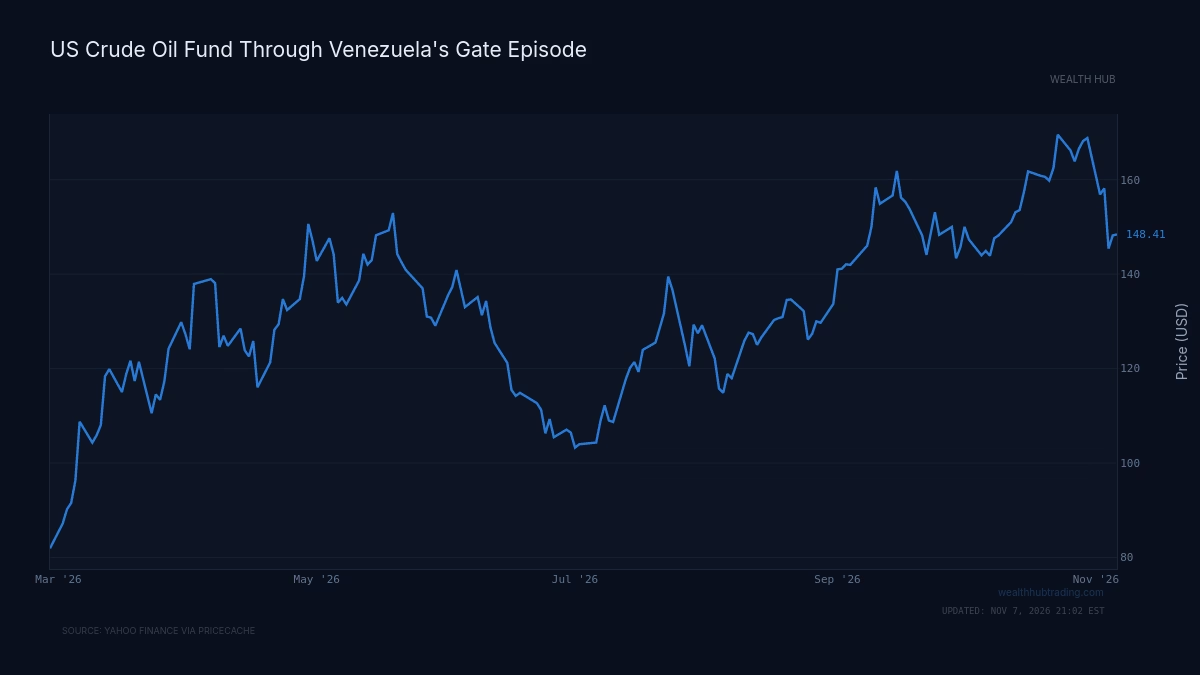
The jump in Venezuelan output from 830,000 barrels per day in December to 1.25 million after Nicolás Maduro's removal does not show a reservoir recovering. It shows how much oil one political gate had been holding back, and the oil industry has met this pattern before, each time in a different set of instruments.
A Naphtha Tanker in Venezuelan Waters
In the late summer of 2021, heavy oil production in the Orinoco Belt fell by roughly a quarter in a matter of weeks. Nothing had gone wrong underground. Orinoco crude is closer to a solid than a liquid, a black sludge that cannot travel through a pipeline or into a tanker unless it is thinned with lighter hydrocarbons called diluents. That summer, Venezuela's struggling refineries needed those same lighter grades to keep running. The light barrels went to the refineries, and the heavy barrels stayed in the ground because nothing was left to dilute them.
Years of American sanctions had produced that trade-off. Successive administrations had made it steadily harder for Venezuela to buy imported materials, capital equipment, and diluent, or to attract investors willing to pay for any of them. The country kept its geology and lost the inputs it needed to get the oil out.
In the final weeks of 2025 the sanctions acquired a naval arm. After President Donald Trump ordered a "blockade" of sanctioned tankers moving into and out of Venezuela, ship-tracking data showed owners splitting. One sanctioned tanker carrying about 300,000 barrels of Russian naphtha entered Venezuelan waters. Another turned around in the Atlantic. The blockade followed the American seizure of a tanker off the Venezuelan coast earlier in December.
That naphtha was diluent. Each cargo that turned back meant Orinoco wells that could not flow, and production fell accordingly. The low point, 830,000 barrels a day in December, came at the peak of the pressure.
In early January, the US Army's Delta Force seized Maduro. The government left behind, now led by acting President Delcy Rodríguez, was more willing to meet Washington's demands, and much of the sanctions pressure ended with Maduro's departure. Diluent began flowing in again, heavy crude began flowing out, and a report delivered to Rodríguez put production at 1.25 million barrels a day, with gains in the Orinoco Belt and in conventional fields.
The usual reading of this sequence is about geopolitics, a strongman removed and a market reopened. The more useful reading is mechanical. Venezuela added roughly 420,000 barrels a day within a few months, and no geological process works that quickly. Only removing a constraint does. Venezuelan output had been governed by a gating function, and the gate was political.
Washington's Diluent, 2019
The 2025 blockade had a predecessor, and in it the gatekeeper had been the supplier.
For years before 2019, a large share of the naphtha that thinned Orinoco crude came from the United States. The arrangement was logical. American Gulf Coast refiners were built to process heavy sour crude, Venezuela produced it, and American light ends moved south to make that crude shippable. The two economies were joined by molecules that moved in both directions.
When Washington sanctioned the state oil company PDVSA in January 2019, it closed both halves of that loop together. Venezuelan heavy crude lost its natural buyer on the Gulf Coast, and American diluent stopped flowing south. Caracas then spent years trying to rebuild the missing input elsewhere. It blended lighter domestic grades, which forced the trade-off that hit in 2021, and it turned to the suppliers that remained, Russia among them, which is why the cargo heading for Venezuelan waters in December 2025 was Russian naphtha.
The episode shows something the geology-first view of oil tends to miss. A producer's real capacity is the lowest of several limits: the reservoir, the lifting equipment, the diluent, the transport, the buyer, the financing. The reservoir is usually the largest and least likely to bind. The binding limit is more often a modest input that a foreign power can cut off with one executive order. In Venezuela's case, Washington had supplied that input before it withheld it.
Alberta's Pipes, 2018
A gate can also be built by the producer's own side.
Western Canada's oil sands produce bitumen, Venezuela's nearest geological counterpart, and it also needs diluent to move. By 2018 the limiting input in Alberta was not naphtha or condensate. It was pipeline capacity. Production had grown faster than the pipelines leaving the province, and the excess barrels filled storage tanks and rail cars, then backed up.
Prices made the gate visible before any production figure did. In the autumn of 2018, the discount on Western Canadian Select, the benchmark heavy blend, widened beyond $40 a barrel against West Texas Intermediate. Global crude prices hardly reflected the problem, because the oil was not lacking in the world. It was stranded in one location. In early December 2018 Alberta's government ordered mandatory production cuts beginning in January 2019, setting aside its free-market instincts to ration access to the overfull pipelines.
At the time, Canadian producers argued that the reservoir was fine, the demand existed, and the bottleneck was a political failure to approve and build pipelines. They were right. Alberta's case removes the sanctions and the strongmen and leaves the same structure: a heavy crude with large potential, held back by a narrow passage that politics had left too small. Geology set the potential, and politics determined what reached the market.
Alberta also shows where a gating event registers in prices. It appeared first in the heavy-to-light differential and only faintly in the flat price. Reading the world price of crude for a story about the gate is often looking in the wrong place.
London's Insurers and the Shadow Fleet, 2012 and 2022
The third version of the pattern concerns services rather than molecules or pipes, and it adds a lesson the other two do not: gates erode.
In July 2012 the European Union's embargo on Iranian crude took effect, including a ban on European insurance for tankers carrying it. The ban mattered because a large share of the world's tanker fleet was insured through a small group of protection-and-indemnity clubs connected to the London market. An uninsured tanker struggles to enter a port, so a measure aimed at insurance underwriters functioned as a limit on Iranian exports.
A decade later the G7 applied the same idea to Russia. From December 5, 2022, Western shipping and insurance services were available for Russian crude only if it sold at or below $60 a barrel. The aim was not to cut Russian supply, since a world without those barrels would have faced sharply higher prices. The aim was to use the services gate to cut Russian revenue while the oil kept moving.
Russia's response was to build its own route around the gate. An ageing collection of tankers, with unclear ownership and insurance arranged outside the Western clubs, took over a growing share of the trade. This "shadow fleet" did not make the price cap meaningless, but it shrank the cap's effect over time, as gated producers sometimes manage when the gatekeeper's control rests on a service the producer can replicate.
The episodes connect directly. The sanctioned tanker that brought Russian naphtha into Venezuelan waters in December 2025 belonged to that parallel shipping network. One sanctioned producer was supplying another's missing input through infrastructure built to get around a different gate. Washington's December blockade was an attempt to close that alternative route with warships, after financial measures had not fully done so.
Two Readings of the Same December
When Venezuelan output fell to 830,000 barrels a day, the same number supported two readings.
The first treated it as a decline curve. On this view Venezuela was an exhausted petrostate: its fields had gone two decades without investment, its upgraders were rusting, its engineers had emigrated, and 830,000 marked another stage in a slow structural decline. Any recovery would require years of capital spending and a functioning state, so an analyst holding this view would have predicted a slow, partial, uncertain rebound.
The second treated it as a gate. On this view the December low reflected the diluent supply, which was being blocked by ships and sanctions. The decay was real, but it was a slow constraint underneath a fast one, and the fast one was binding. Remove the blockade and restore the flow of naphtha, and the heavy barrels that had been shut in for lack of thinner would come back within weeks, because they had never been lost.
The second reading was correct, and the speed of the recovery shows it. A 50% gain from the low in the time it takes to reschedule tankers cannot be explained by reservoir recovery. It is the size of the gate, revealed when it opened. The decline-curve reading was not foolish. It was asking about the reservoir, which was not the input determining output that December.
The general point is that the same production figure can carry opposite meanings depending on which constraint is assumed to bind. A low that reflects a closed gate can recover sharply. A low that reflects depletion recovers only slowly. Telling them apart requires asking what stopped the oil from moving.
What the Rebound Actually Measures
Four episodes share a structure: Venezuela in 2019 and 2025, Alberta in 2018, Iran in 2012 and Russia in 2022. In each, a large hydrocarbon resource was held back by a small, controllable input, whether diluent, pipeline space, or insurance and shipping services. In each, the control point belonged to a government, often a foreign one. When the gate closed, the effect showed up first in volumes and differentials and only afterward, if at all, in the global flat price. When it opened, the rebound came quickly, because the resource had been waiting rather than depleted.
This supports the order of constraints the Venezuelan story suggests: politics ahead of geology. It also shows the changing physical definition of oil. A barrel of Orinoco crude is not a marketable barrel until it has been combined with a lighter one, which means one country's heavy oil and another country's naphtha function as a single product. Whoever controls the lighter half controls the whole.
The present episode differs from the earlier ones in one significant way. In 2019, Washington's gate separated two halves of a single system: American diluent went one way, Venezuelan heavy crude the other, and sanctions cut both. In 2018 the gate was local and self-inflicted. In 2012 and 2022 the gatekeeper wanted to restrict the gated party's income, so the gated party built ways around it. After January 2026, the gatekeeper and the gated output are on the same side. The United States has every reason to keep the gate open, and the remaining government has every reason not to provoke it. Heavy Venezuelan crude and the Gulf Coast refineries built to process it, linked by American diluent, can reconnect under a political arrangement that, for the moment, has no internal opposition.
That is what Trump's remark about the spoils of an oil victory means in practical terms. The prize is not the Orinoco reservoir, which no one could physically remove from Venezuela. The prize is control of the gate, and with it the ability to decide how much of the reservoir reaches the market and on whose terms.
Two parts of this read are inferences rather than established facts. First, a sustained return of Venezuelan heavy sour crude to the Gulf Coast would likely put pressure on heavy-crude differentials, competing with Canadian and Mexican heavy grades for the same refinery capacity. Alberta showed that heavy differentials respond to these shifts more than the flat price does, but no current differential data supports that view here, and it should be treated as a direction to check. Second, the easy recovery ends once the shut-in barrels are back. Moving from 1.25 million barrels a day toward the country's former output requires investment in upgraders, power, and wells, which brings the decline-curve view back into play just as the gate reading has been confirmed. The next limit will be capital and execution, which move far more slowly than tankers.
The final lesson concerns the gate itself. A gate opened by a political act can be closed by another one, and its openness depends on the gatekeeper's continued interest. Russia's shadow fleet showed that gated producers sometimes rebuild the missing input themselves. Venezuela now depends on a gatekeeper that has chosen to keep the gate open, and that is a different kind of exposure from depending on its own geology. The repeating sequence across these episodes is a large resource, a narrow input, a government controlling that input, and a sharp move when that government changes course. The oil that moves is less a measure of what lies underground than of who controls the input that lets it move.