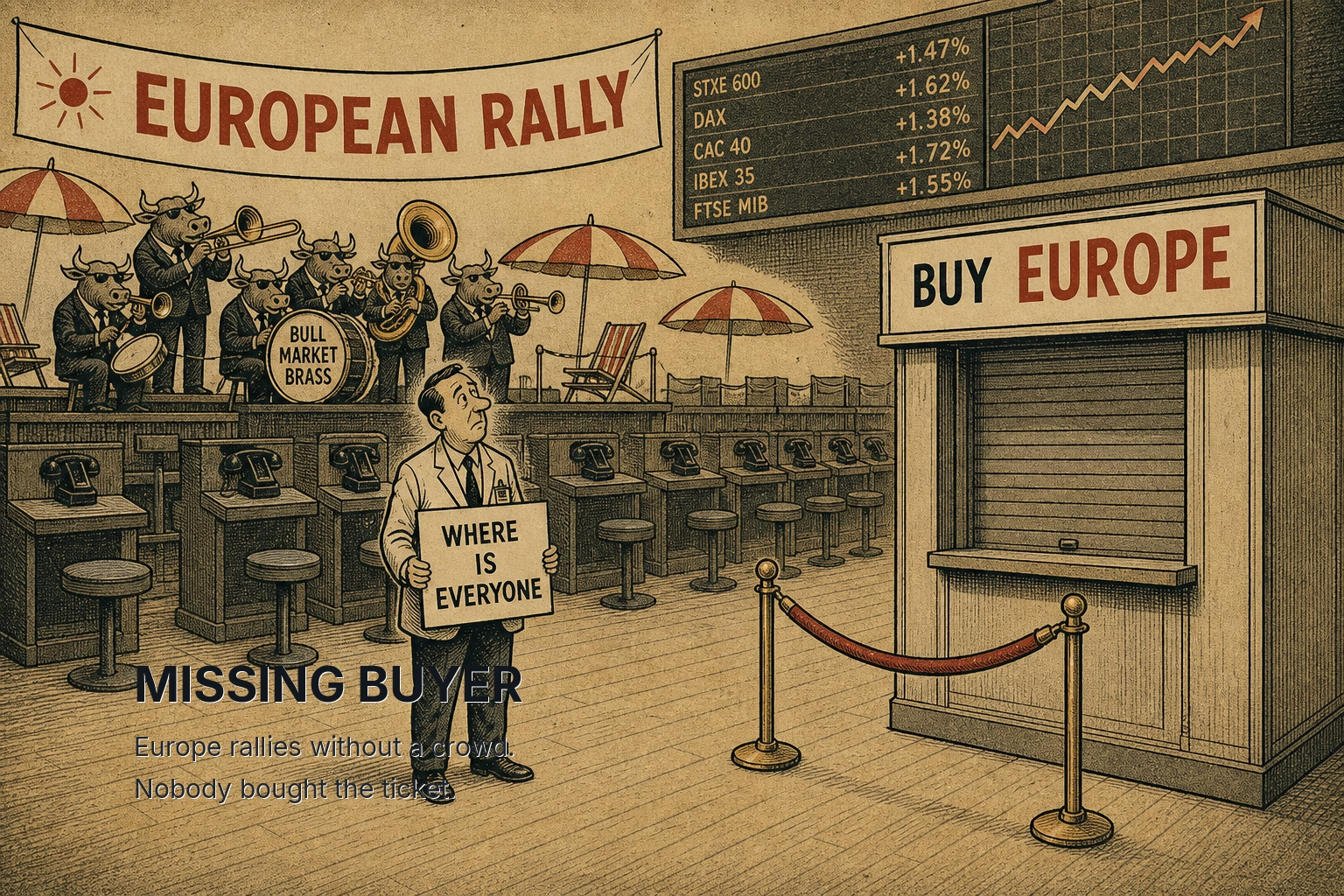
The most interesting fact about Europe's outperformance is who is not in the trade. Foreign institutions are pouring in at the fastest pace in a decade.
The most interesting fact about Europe's outperformance is who is not in the trade. Foreign institutions are pouring in at the fastest pace in a decade. The European household, meanwhile, is still on the beach. That gap is not a footnote to the rally. It is the mechanism the whole thing runs on, and it is the one place the bullish story quietly gets its own logic backwards.
Let me acknowledge what consensus has right, because it has more right than the perma-skeptic (I include myself) would like. European earnings per share grew 14% in the first half, the strongest pace in three years, with full-year consensus pushing toward 18%. Return on equity has climbed as margins and buybacks improved, banks especially. The Euro Stoxx 50 has outpaced the S&P 500 over recent months. Since 2022, European banks, the definitional value trap, have beaten US megacap technology by a wide margin. None of this is a mirage. The destination is not in dispute.
The part consensus misses is what the rally is built on, and what happens when the foundation is a buyer who can leave as easily as he arrived.
Who Is Actually Buying?
Foreigners. Almost entirely foreigners. European equities are seeing the best inflows in ten years excluding 2021, and the flows are driven, in the words of Goldman's own strategists, "almost entirely by foreign investors." The domestic retail investor, the one who was supposed to have been converted by fourteen percent earnings growth, has not shown up.
The numbers are stark enough to be a thesis on their own. In the US, households now hold more wealth in stocks than in housing, with equity forming near 50% of household wealth. In Europe, equity exposure languishes around 20%. Over 21% of US households own stocks directly. In Germany and Italy the figure is 7%. Retail accounts for roughly 20% of daily turnover in the US; in the UK, per Winterflood, less than 5%.
So the marginal buyer of European equities in 2025 is a global asset allocator running an underweight back to neutral. That is a real and powerful bid. It is also the least sticky money in the world. It came for the relative-value trade, the tariff-shock survival, the cheap 14.5 times forward multiple. It will leave for the same reason it came, on a spreadsheet, without sentiment, the moment the relative case narrows.
Why Does a Missing Retail Base Matter?
Because retail money is the ballast that lets a market survive its foreign flows leaving. This is the mechanism, and it is where intuition runs backwards.
The instinctive read is that low retail participation is bullish, a coiled spring, an untapped source of demand waiting to be released into the market. Get German households from 7% ownership to 20% and imagine the bid. That is the first-level view, and it is not wrong about the arithmetic. It is wrong about the sequence.
Retail participation is not a demand reservoir you draw down. It is a structural property of the market that either exists before the stress or does not. A domestic household base holds through drawdowns, dollar-cost-averages into weakness, and anchors valuations because its money is not comparing Europe to the S&P every quarter. It is saving for retirement in the market it lives in. That behavior dampens volatility and gives IPOs a natural audience. Sweden is the tell: it introduced the tax-efficient Investeringssparkonto in 2012, runs household ownership near 22%, and has a burgeoning IPO market to show for it. The engaged retail base is the cause, and market health is the effect.
Europe has the effect showing up in prices right now without the cause underneath it. The rally is genuine and the buyer is a tourist.
Can the Foreign Bid Convert the Domestic One?
This is the sharpest question, and the honest answer is that the causation runs the wrong way for the bulls. A rising market does not manufacture a retail base. The retail base has to be built by structure, and the structure is a policy problem, not a price problem.
Consider what actually keeps European households out. In the UK, stamp duty on stock purchases is a standing tax on participation. Pension reform steered savers away from equities rather than into them. These are not sentiment barriers that a strong tape dissolves. They are legislated friction, and legislated friction is indifferent to whether the Euro Stoxx had a good summer. Sweden did not get to 22% ownership because its market rallied. It rallied, in the durable sense, because it built the account first.
There is a stranger driver worth naming plainly, one I have floated before. Not all retail investing is patient capital allocation. Some of it is the same appetite for risk and stimulation that finds its outlet in a betting shop. In the UK, that impulse has decades of legal access to sports betting to absorb it. In the US, absent that outlet, the impulse has historically expressed itself in single stocks and options. The speculative energy that fuels an American retail base has, in Britain, been permitted a different home. You do not convert that with an earnings beat either.
So the foreign bid can lift prices. It cannot lift ownership. Those are different variables, and the rally has moved only one of them.
What Happens If the Thesis Is Right?
The setup is asymmetric, and not in the direction the "secret outperformer" framing implies. Europe is running a genuine fundamental recovery on top of a shareholder base that is overwhelmingly foreign and structurally footloose. That is a market whose upside is real and whose downside has no domestic floor beneath it.
Galbraith, in his short history of financial euphoria, kept returning to one observation: the participants in a rising market invariably mistake the leverage of their moment for their own permanence. The European bull case has quietly done a version of this. It reads record foreign inflows as validation, when foreign inflows into an underweighted market are, by definition, a position that has not yet been reduced. The flow that confirms the thesis is the same flow that reverses it.
None of this argues against the earnings. Fourteen percent EPS growth is fourteen percent EPS growth, and only slightly over 40% of STOXX Europe revenues even come from Europe, so the "stagnant economy" bear case was always half a category error. The instrument most exposed here is the large continental index the foreigners crowded into fastest, the Euro Stoxx 50 itself, where the domestic ballast is thinnest and the global-allocator ownership densest. 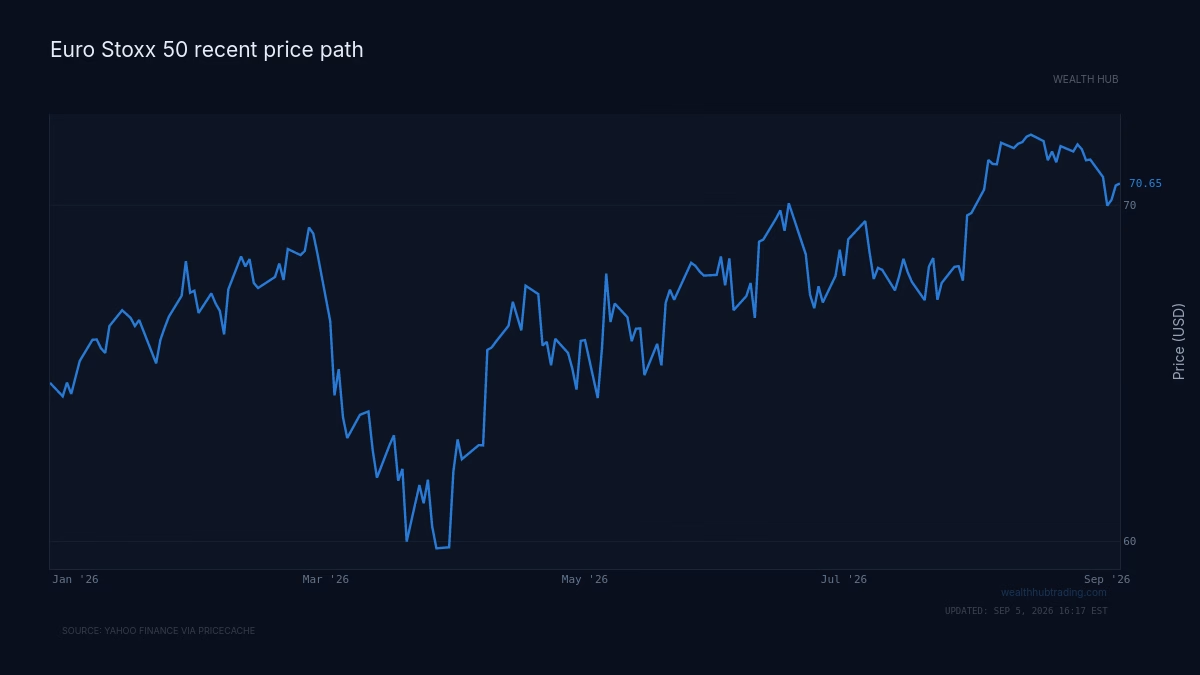
The bull case is one outcome among several, and it is not the one the flow data makes most likely. The most probable path is not a crash but a stall: the relative-value trade closes, the tourist checks out, and a market with a 20% retfor retail base discovers what it is worth without a home crowd. Build the buyer before you need him, or borrow one who leaves when you do.