The number is 65 billion barrels. The number that matters is closer to one million barrels a day, and it has been falling for fifteen years.
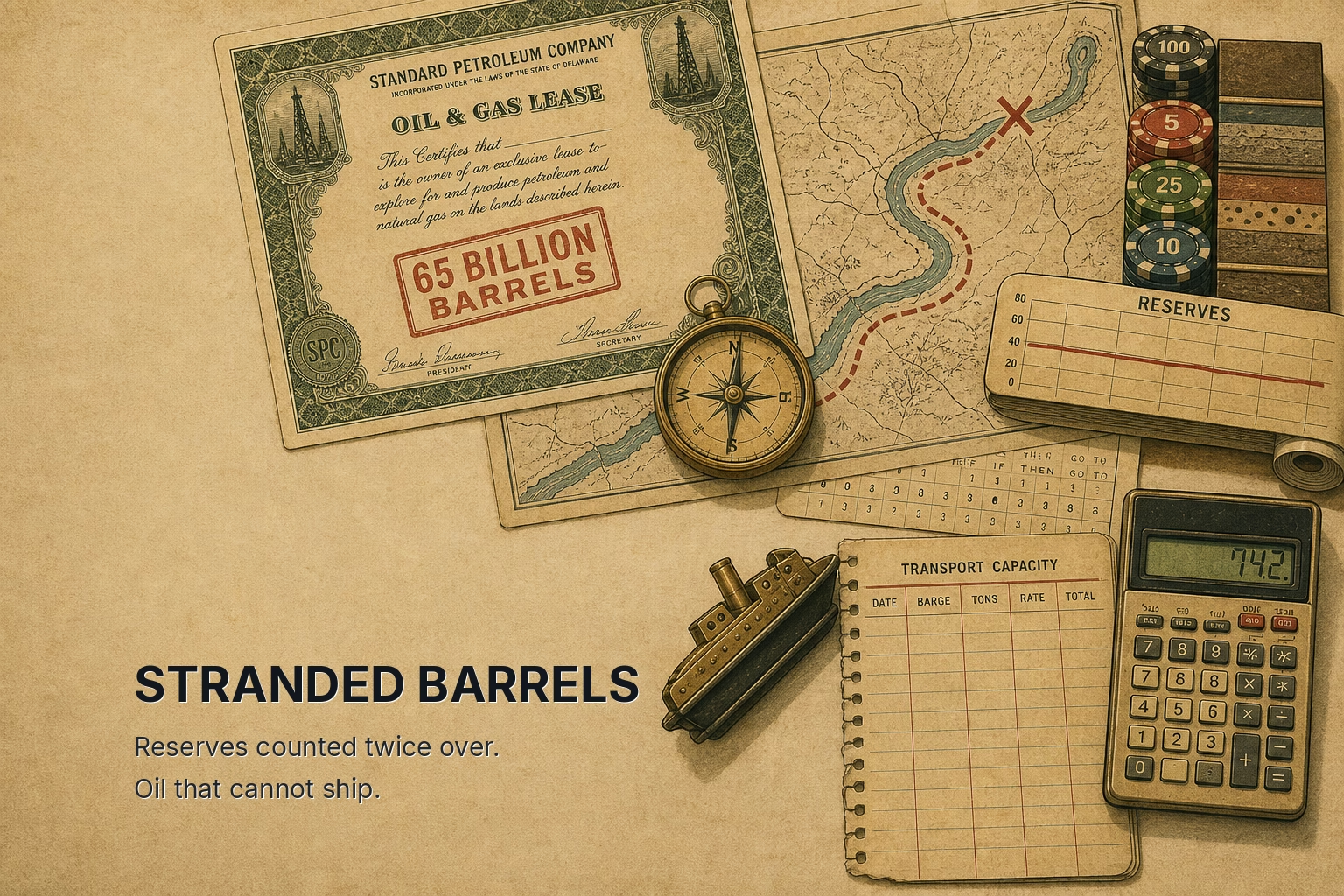
The number is 65 billion barrels. The number that matters is closer to one million barrels a day, and it has been falling for fifteen years. That is the gap between what Trump announced on Truth Social Friday evening and what the market can actually price. Consensus is trading the reserve headline. The reserve was never the constraint.
Venezuela sits atop the largest proven crude reserves on Earth. It has for years. The Orinoco Belt held its crown through the Chávez expropriations, through the Maduro collapse, through the sanctions, through the exodus of every foreign engineer who knew how to run a coker. Reserves are a geological fact. Production is an operational one. And Venezuelan production, which touched 3.2 million barrels a day at the turn of the millennium, sank below 700,000 barrels a day at its 2020 trough and has clawed back only partially since.
You do not lower American gas prices with a geological fact. You lower them with barrels on a tanker.
What Did Trump Actually Buy?
He bought a claim on the reserve, not the flow. Read the post again, past the randomly capitalized triumphalism, and the operative phrase is "majority U.S. control of more than 65 BILLION BARRELS of proven Oil Reserves." Control of reserves in the ground. Nothing in the announcement speaks to lifting cost, to upgrader capacity, to the diluent Venezuela must import to make its tar-like extra-heavy crude flow through a pipe at all.
The Orinoco crude is not the light sweet barrel a Gulf Coast refiner dreams about. It is 8-to-10-degree API bitumen that will not move without naphtha or natural-gas condensate blended in, and it will not sell without an upgrader turning it into synthetic crude first. Those upgraders; the four great facilities at Jose; have run at a fraction of capacity for a decade. The 2019 sanctions cut off the imported diluent. PDVSA, the state operator, lost the technical staff who kept the coke drums from fouling. You cannot buy that back with a Truth Social post and a Secretary of War.
So the honest reading of the transaction is narrower than either camp allows. The opposition calls it colonial extraction; the extraction requires an industrial base that no longer functions. The supporters call it a doubling of American reserves; reserves you cannot lift are an accounting entry, not a supply. The part consensus misses is that the barrels most exposed to this deal are the ones that will never reach a barge in the timeframe any trader is positioned for.
Why Is the Oil Market Not Moving?
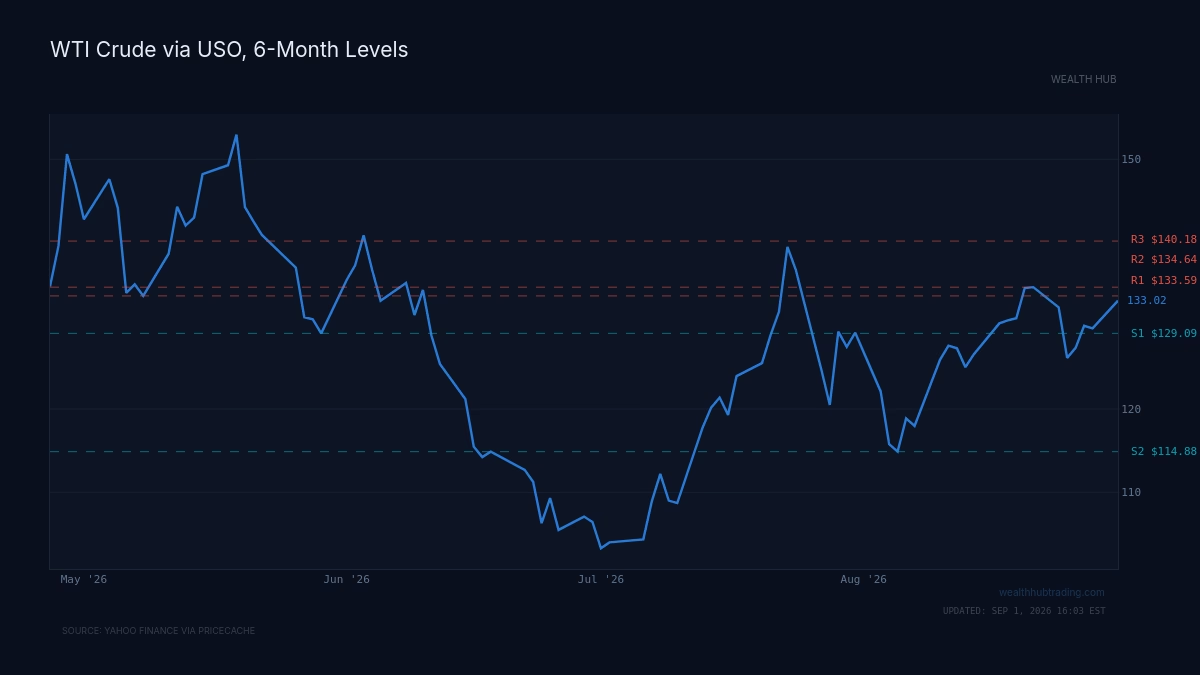
Because the oil market, unlike the political commentariat, can read a decline curve. Front-month WTI did not gap on Friday's announcement, and it should not have. The near-term physical balance does not change because a reserve title changed hands. Venezuela's incremental exportable barrels over the next two years are measured in low hundreds of thousands per day even under an optimistic rehabilitation, against a global market that moves 100 million a day. The marginal barrel is a rounding error on price.
Here is where the positioning tells a more interesting story than the headline. Commercials; the producers and physical hedgers who actually handle crude; are net short WTI at roughly 15% of open interest, while speculators sit net long. In the Williams commitment-of-traders reading, that is the configuration that has historically preceded weakness, not strength. The people closest to the physical barrel are leaning against the specs who are leaning on the momentum. When the smart money and the fast money disagree this plainly, the physical operators are usually the ones who see the balance sheet first.
I don't know whether this deal accelerates or stalls; the political variables are not the kind that yield to a probability model. What the tape says is that the constraint the announcement ignores; the multi-year, multi-billion-dollar rebuild of an upgrading complex; is precisely the constraint the crude curve is respecting. The market is pricing what can flow. Trump priced what is buried.
The instruments that would move on a real supply shock; USO on the long side, SCO on the short; have not repriced a Venezuela premium because there is no near-dated Venezuela supply to price. That is not skepticism. It is arithmetic.
Who Is the "Private Business," and What Is the Real Trade?
This is the sharper question, and it is where the deal stops being about oil and starts being about influence. The "private business" alluded to in the post is the vehicle through which Washington converts a security posture into a resource position. The oil is the ledger entry. The prize is the harbor, the terminal, the twenty-year concession, the physical foothold in a country China spent a decade financing through oil-backed loans.
Consider what Beijing built. China lent Caracas tens of billions across the Chávez and Maduro years, structured as loans-for-oil, and took repayment in crude shipped east. That arrangement made Venezuela a node in China's energy-security map and a debtor whose default risk Beijing absorbed as the price of strategic reach into America's hemisphere. A U.S.-controlled majority stake in the reserve base is, before it is ever a barrel of gasoline, a foreclosure on that Chinese position. Delcy Rodriguez's interim government is the instrument through which the collateral changes hands.
That is the trade the reserve number obscures. Not cheaper gas; the upgraders cannot deliver it on any political timeline. The trade is displacing a rival's two-decade infrastructure of leverage in the Western Hemisphere, financed through the State Department and the Pentagon's indirect resources rather than an appropriation Congress would have to vote on. "At no cost to the American Taxpayer" is the tell. Off-balance-sheet geopolitics has an American accent now.
Senator Van Hollen's charge; that service members were risked to hand oil to billionaires; assumes the oil is the object. If the object is the reserve title as a strategic asset denied to China, then the billionaire-buddy framing measures the wrong thing. It is possible to find the method troubling and still recognize that the analysts calling it a crude grab have mislabeled the transaction. Galbraith observed in his short history of financial euphoria that the world persistently mistakes the leverage of the moment for genius or for theft, when it is usually just leverage. This is leverage, applied to a rival's collateral.
What Breaks the Thesis?
The rehabilitation. Everything above holds only so long as Venezuelan production stays constrained by the collapsed upgrading base. If the "private business" and its partners actually restore the Jose complex; reimport diluent at scale, rehire or replace the technical corps, run the cokers near capacity; then the reserve stops being an accounting entry and starts becoming a flow. That is a two-to-four-year project measured in tens of billions of dollars, and it is not the near-term catalyst the announcement's tone implies. But it is not impossible, and it is the only path by which "substantially lower Gas Prices" becomes anything other than campaign cadence.
Watch the diluent imports and the upgrader utilization, not the reserve headline and not the Truth Social capitalizations. The barrel that lowers the pump price is the synthetic barrel leaving Jose on a tanker, and there is no such barrel today at anything like the scale the post implies. The historical record on nationalized-then-privatized heavy-oil complexes is not encouraging on speed; the industrial knowledge, once it leaves, does not come back on a political schedule.
The consensus is arguing about whether this was colonialism or genius. Both readings assume the oil is real in the sense that matters; that it can move. The contrarian position is duller and more durable: the reserve is real, the flow is not, and the actual asset transferred was a strategic claim on China's hemisphere, not a supply of gasoline. If that is right, the energy traders waiting for a Venezuela premium are watching the wrong instrument. The move, if there is one, is in geopolitics and Chinese credit exposure, not in the front-month crude curve.
Trump bought the reserve. The barrel stayed in the ground.