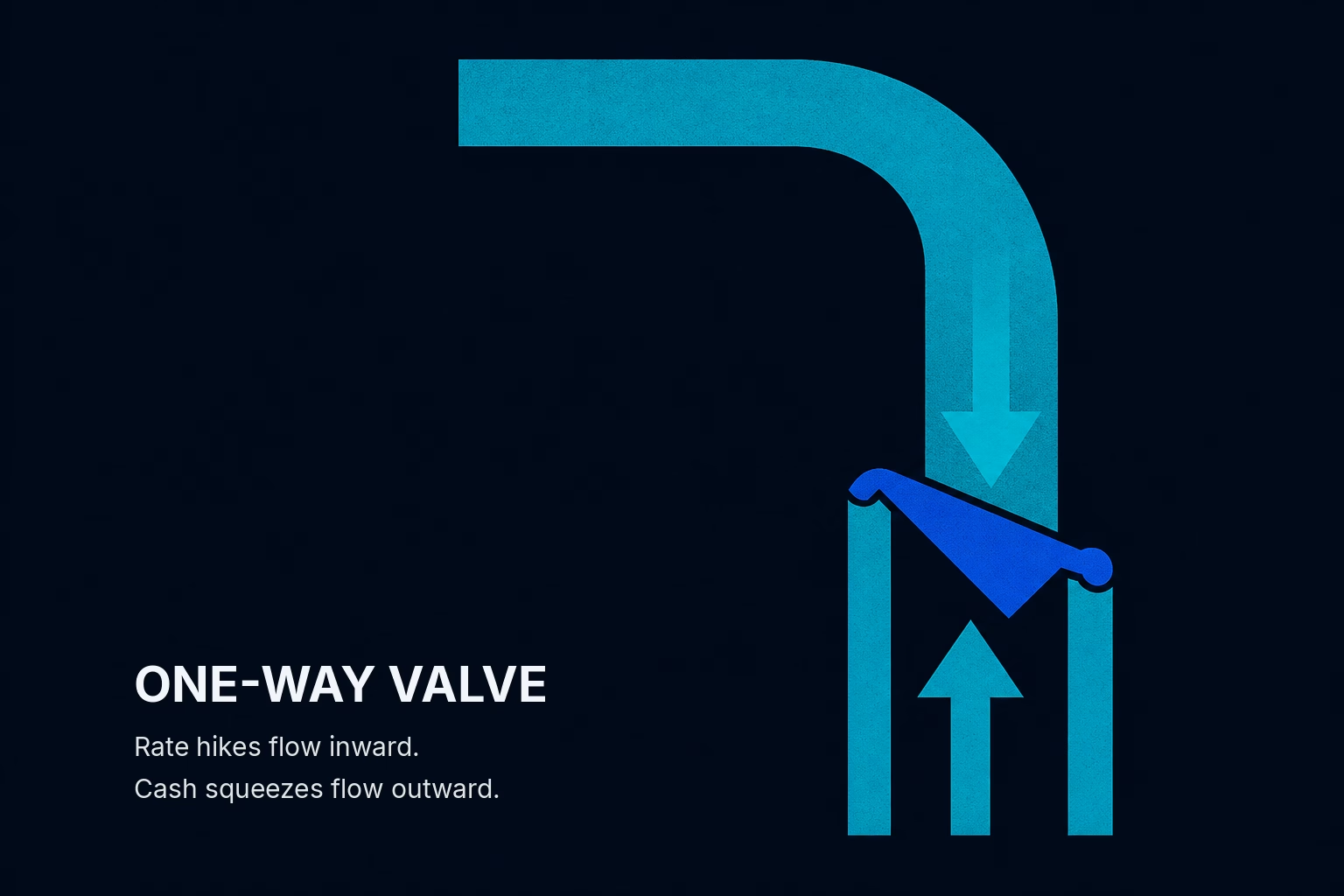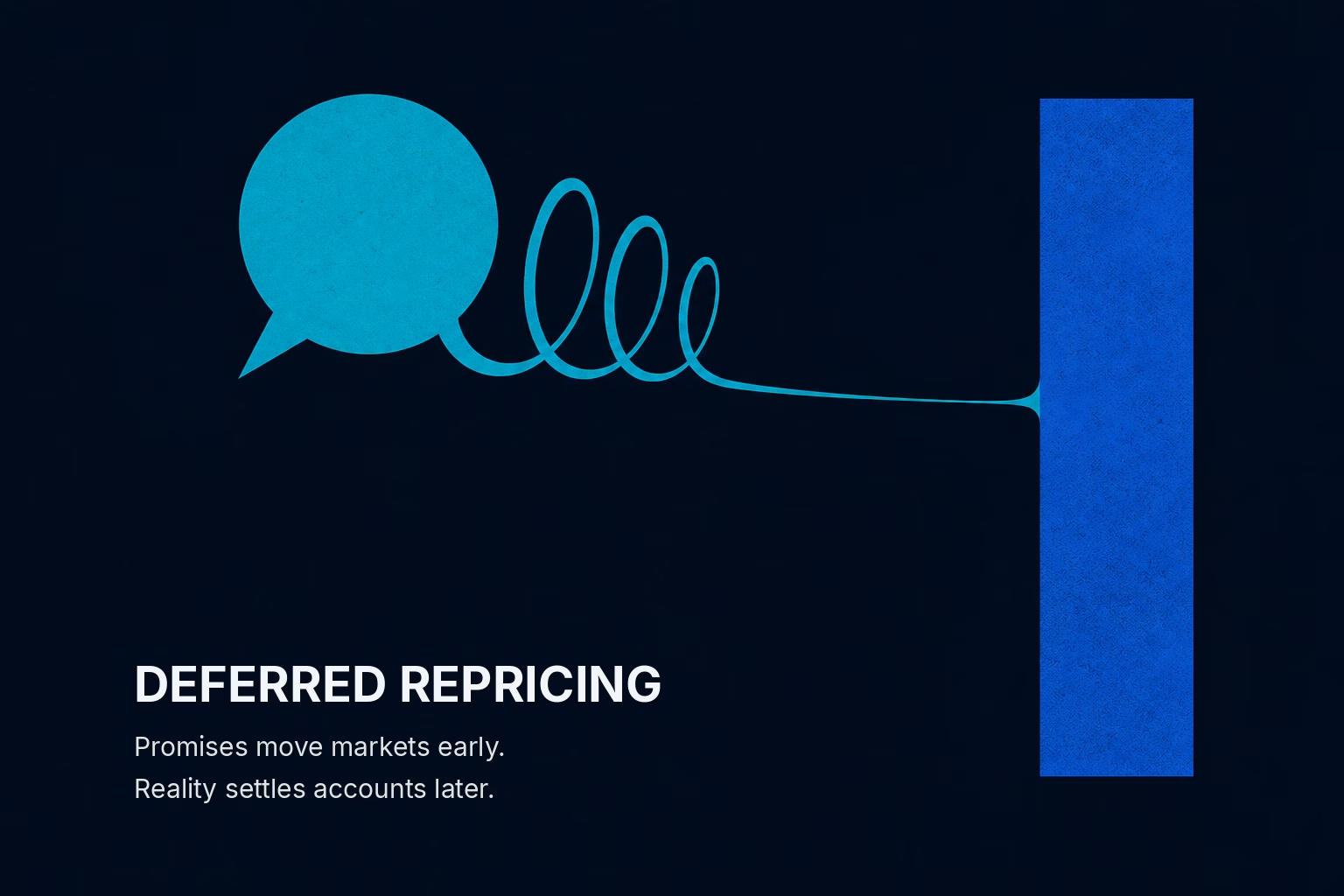
The costliest consequence of the Federal Reserve's forward guidance in 2021 was not the inflation it tolerated. It was the cross-asset repricing it postponed. That repricing arrived in 2022 as a dollar surge large enough to push Japan into the currency market for the first time since 1998.
The promise that outlasted the data
In September 2020 the Federal Open Market Committee, the Fed's rate-setting body, said it expected to hold its policy rate near zero until three conditions were met: maximum employment, inflation at 2%, and inflation on track to moderately exceed 2% for some time. It paired that with a commitment on asset purchases. The Fed would keep buying Treasuries and mortgage-backed securities, and it signaled that it would slow those purchases, or taper, before it raised rates.
That sequencing turned a promise into a cage. By February 2022, consumer prices were up 7.9% from a year earlier. Home prices were rising at roughly 20% a year, and the Fed was still buying mortgage bonds because its own guidance said purchases had to wind down before liftoff. The first hike came on March 16, 2022, a quarter point. By June the Fed was raising rates by 75 basis points at a single meeting, the largest move since 1994.
The second-order move is the part the policy headline leaves out. Markets spent 2021 pricing a slow, telegraphed exit. When the exit turned out fast, a year of repricing was compressed into a few months. The dollar index (DXY, a trade-weighted measure of the dollar against six major currencies) climbed above 114 in September 2022, its highest level in two decades. On September 22, with the dollar above 145 yen, Japan's Ministry of Finance bought yen, its first such intervention since 1998.
Guidance did not remove the repricing. It scheduled it, and the schedule ran late.
How a sentence became a policy tool
Forward guidance is public communication by a central bank about the likely future path of its policy rate. It became a tool, rather than a courtesy, because of a constraint. When the policy rate hits the zero lower bound, the point below which cutting further becomes ineffective or counterproductive, the bank loses its usual lever. It can no longer lower today's rate. It can still lower the rates markets expect for tomorrow.
The Fed's language evolved through that problem in stages. In 2003 it said accommodation could be maintained for "a considerable period." After reaching zero in December 2008, it moved to "an extended period" in March 2009. In August 2011 it went further and named a date: rates would stay exceptionally low "at least through mid-2013." In December 2012 it switched from dates to thresholds, saying no hike would come while unemployment stayed above 6.5% and projected inflation stayed no higher than 2.5%.
Each step made the promise more specific, and each step made it more binding. A vague phrase can be reinterpreted quietly. A date or a threshold cannot. Specificity is what gives guidance its power, and it is also what makes reneging costly.
For you, the practical takeaway is to read guidance by its form. Vague, date-based, and threshold-based guidance commit a central bank to very different degrees, and the market prices them accordingly.
Pricing the promise: a worked example
Why does a sentence move bond prices? The answer is the expectations hypothesis, the idea that a longer-term yield approximately equals the average of expected short-term rates over its life, plus a term premium, the extra compensation investors demand for locking money up longer.
Take a two-year Treasury and split its life into four six-month periods. Suppose the market expects the policy rate to follow this path: 0.25%, 0.75%, 1.25%, 1.75%.
Expected average rate = (0.25 + 0.75 + 1.25 + 1.75) / 4 = 1.00%
Ignoring the term premium, the two-year yield sits near 1.00%. Now the central bank issues credible guidance that the rate will stay at 0.25% for the full two years. The new expected path is 0.25% in every period.
New expected average = (0.25 × 4) / 4 = 0.25%
The two-year yield falls about 75 basis points, the same day, without any change in the actual policy rate. Mortgage rates, corporate borrowing costs, and the discount rate applied to equities all key off that repriced curve. The easing happens through the bond market, not through the overnight rate.
The currency moves too. If the US two-year falls 75 basis points while a comparable German or Japanese yield stays put, the yield advantage of holding dollars shrinks. Capital that had been parked in dollar assets for the extra yield finds less reason to stay, and the dollar tends to soften. That is the cross-asset transmission: a promise about the domestic rate path becomes a weaker currency and, through it, easier financial conditions abroad.
Run the example in reverse and you have 2022. A market priced near 0.25% that suddenly has to price 3% or 4% reprices the two-year by hundreds of basis points, and the yield gap in favor of the dollar widens just as violently.
Why markets believe a central bank's future self
A promise only moves prices if markets think it will be kept. The mechanism that enforces belief has identifiable actors and incentives.
Start with the arbitrageurs. A rates trader who thinks the two-year yield sits above the expected path of overnight rates can borrow short, buy the two-year, and earn the difference. If enough traders believe the guidance, that trade pulls the two-year down toward the promised path. The no-arbitrage link between short and long rates is what converts words into yields; guidance does not need to persuade everyone, only enough capital to close the gap.
Next come the borrowers and lenders who act on the curve. Banks price fixed-rate mortgages off longer yields. Companies time bond issuance off them. Carry traders, who borrow in a low-yielding currency to invest in a higher-yielding one, size their positions off expected rate differentials. Once guidance shifts expectations, these actors make real economic decisions, and those decisions are the stimulus.
The central bank's side of the bargain is reputational. A bank that breaks its word pays a price in future credibility, because its next promise will be discounted. That cost is the collateral that makes the current promise believable. The bank is, in effect, posting its reputation as a bond.
Here lies the paradox the signal points at. The reputational collateral that makes guidance work is exactly what makes the bank reluctant to abandon it when the data turns. In 2021 the Fed faced a choice between breaking its sequencing promise early, at a credibility cost, or honoring it while inflation ran. It largely honored it. The tool's strength and its failure mode are the same property.
The implication for you is direct. The more credible and specific the guidance, the more confidently you can price the front end, and the more violent the repricing will be if the central bank is eventually forced to break it.
When the rigidity becomes the cost
Guidance fails in a few recognizable ways, and each has a dated episode.
The first is the trap already described: guidance that binds policy behind the data. The 2021 sequencing commitment kept asset purchases running into an inflation surge, and the eventual catch-up was abrupt. The cost showed up less in domestic rates than in the dollar, which tightened financial conditions for every economy that borrows or trades in it.
The second is guidance about something the market thought was settled. On May 22, 2013, Ben Bernanke told Congress that the Fed could slow its bond purchases in coming meetings. Nothing about the policy rate changed. The 10-year Treasury yield still climbed from about 1.6% at the start of May to near 3% by September, and emerging-market currencies sold off hard as carry trades unwound. The taper tantrum, as it became known, showed that guidance cuts both ways: a hint of withdrawal reprices as fast as a promise of support.
The third is guidance tied to a market price the central bank cannot hold. The Reserve Bank of Australia targeted a 0.1% yield on its April 2024 government bond. In late October 2021, as inflation data surprised, that bond's yield jumped far above target and the bank did not defend it. It formally dropped the target on November 2, 2021. A yield target is guidance with a visible scoreboard, and when the scoreboard breaks, the loss of credibility is public and immediate.
The pattern across these cases is worth watching rather than treating as a law. Guidance sometimes ends smoothly; the Fed's threshold guidance in 2013 and 2014 was retired without a crisis. What the failures share is a gap between the promised path and the data, left open long enough that repricing accumulated.
Reading guidance in today's curve
The present curve shows where guidance has reach and where it does not. As of October 9, 2026, the two-year Treasury yields 4.80% and the 10-year yields 5.24%, a positive spread of 44 basis points.
The two-year is the instrument guidance controls most directly, because most of its life falls inside the window a central bank can credibly talk about. The 10-year is different. A large share of its yield reflects the term premium and expectations about policy years beyond any committee's horizon. A 10-year yield above 5% with a positively sloped curve is a reminder that guidance can anchor the front end while the long end prices compensation for risks no promise covers. We cannot decompose that 44-basis-point spread precisely here, but the direction is clear enough: the long end is not taking its cue solely from policy-rate talk.
That split matters for transmission. Mortgage rates and equity valuations lean heavily on the long end, so guidance that anchors the two-year while the 10-year drifts higher delivers less easing than the headline suggests.
What to do with this
Forward guidance eases policy by having markets price the central bank's future rate path today, and its power comes from the rigidity of that commitment.
Treat guidance as a stored position, not a settled fact. Compare the path the central bank has promised with what incoming inflation and labor data would justify on their own. When those diverge, the gap is repricing waiting to happen, and the two-year yield is where it starts. The move rarely ends there. Watch the dollar and the long end, because that is where accumulated repricing tends to be released, and where it forces adjustment on assets and currencies that never heard the original promise.