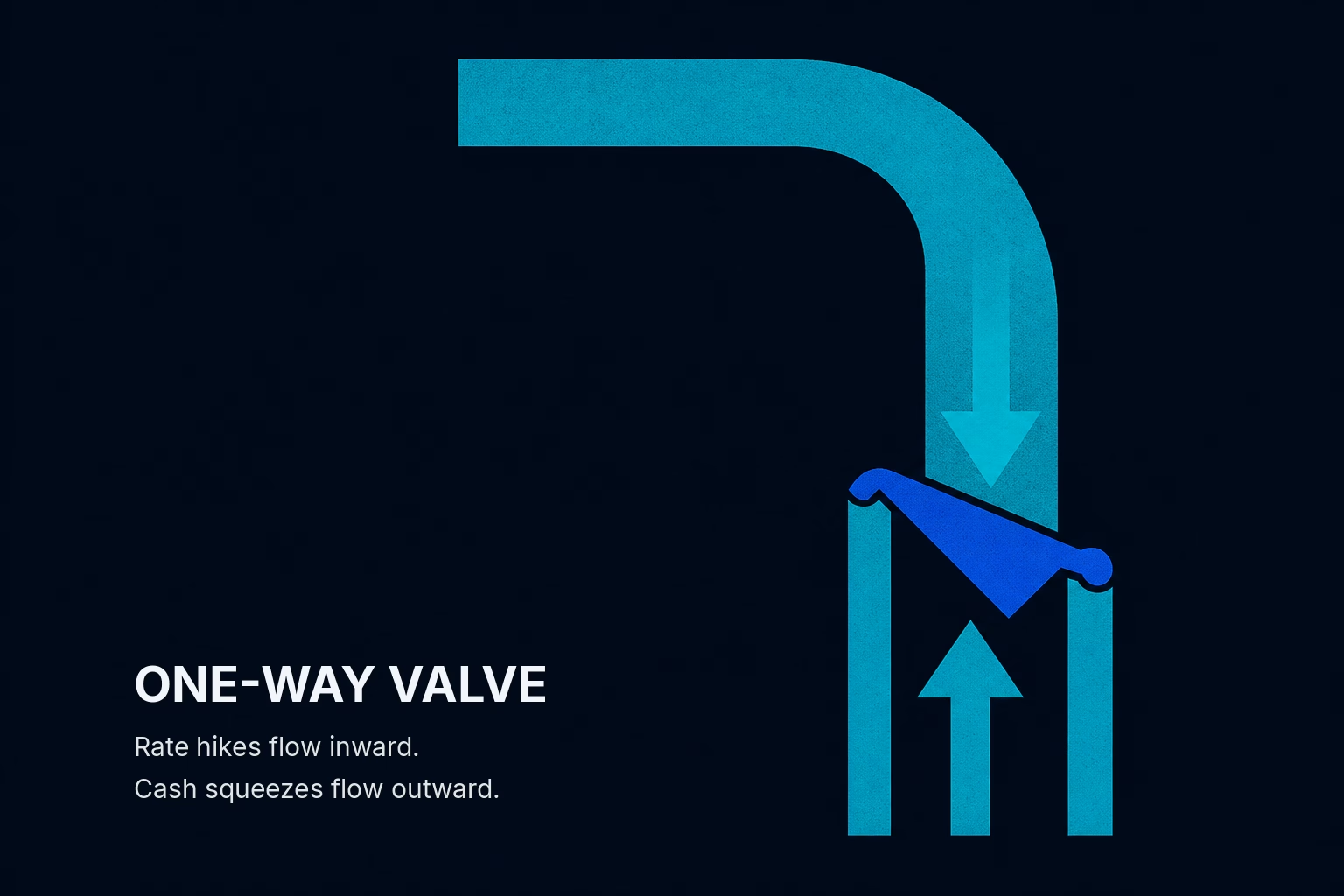
The most consequential detail in the New York Fed's account of its own repo history is a design asymmetry, and it gets one clause. The floor under overnight rates, the overnight reverse repo facility (ON RRP), is open to money market funds, banks and government-sponsored enterprises. The ceiling, the standing repo operations (SRP), is open only to primary dealers and eligible banks. Cash from the broad nonbank system can reach the floor directly. Relief from the ceiling has to pass through intermediaries whose balance sheets are capped by capital rules.
That asymmetry explains a lot about late 2025. The authors list it as the third post-crisis episode in which the banking system leaned on Fed repo, after September 2019 and March 2020, and it followed almost two and a half years of balance sheet reduction. The policy read is that standing repo has stopped being an emergency lever and become the binding constraint on how small the Fed's balance sheet can get. The parties forced to adjust are the ones who sit between the facility and the rest of the market.
A Liability Shift Before It Was a Reserve Drain
The accounting in the post is easy to skim past, and it carries the argument. When the Fed lends through repo, it buys securities and pays with newly created reserves, so both sides of its balance sheet grow. When it runs a reverse repo, it takes in reserves and books a repo payable. That changes the mix of its liabilities but leaves their total unchanged.
This sets the order in which balance sheet reduction shows up in markets. As the Fed let assets run off, it shrank its liabilities in total. The question was which liability absorbed the cut. For most of the runoff, the answer was ON RRP. Usage had peaked around $2.5 trillion in early 2023, after pandemic-era liquidity left money funds with more cash than they could place privately, and it fell steadily as the Fed shrank. That drain was close to painless. Money funds moved cash out of the Fed's facility and into Treasury bills and private repo, and bank reserves were largely untouched.
Once that buffer was mostly used up, further runoff came straight out of bank reserves. When reserves get scarce enough that some banks would rather borrow than lend at market rates, overnight rates press against the top of the corridor, and the SRP is where that pressure gets absorbed. The late-2025 usage the authors chart is what you would expect at that point. It is evidence that the reserve cushion had thinned to the level where the ceiling started doing real work. It does not, on its own, show the facility failing.
Why the Ceiling Leaks Where the Floor Does Not
The floor works through direct access. A money fund that would otherwise lend overnight below the ON RRP rate can simply lend to the Fed instead. No intermediary has to agree, and nobody's capital ratio gets in the way. That is why the ON RRP rate held as a hard floor even while trillions sat in the facility.
The ceiling depends on a chain. A dealer or bank borrows from the Fed at the SRP rate against Treasury, agency or agency mortgage collateral, then has to be willing to lend that cash onward to the market participant who is actually short of funds, often a hedge fund financing a basis position or a smaller dealer. Each step uses balance sheet. Near quarter-ends and year-ends, when banks shrink their reported footprints, that willingness tends to fade at exactly the moment it is needed.
The post does not frame it this way. The framing here is our inference from the counterparty rules it describes, and it is the part of the argument that most deserves hedging. Still, the mechanism is concrete: a ceiling routed through constrained intermediaries is softer than a floor with open access. Overnight rates can trade above the SRP rate for brief periods even when the facility has capacity left, because the rate a dealer charges onward includes the cost of the balance sheet it uses.
The operating details the authors mention target this problem. Operations now run twice daily, settle the same day on the tri-party platform, and are open to banks as well as dealers. Each of those features lowers the friction between Fed cash and the market. None of them removes the intermediary.
A Toolkit Built by Working Around Constraints
The history in the post is a record of the Fed responding to whatever constraint was binding at the time, and the pattern is worth reading as a guide to what comes next.
Fed repo started as a regulatory workaround. In November 1917, a stamp tax under the War Revenue Act made short-term advances to banks costly, so the Reserve Banks authorized repos, which did not require physical tax stamps. Repo holdings briefly topped $1 billion, about 30 percent of Fed assets in 1918. In the late 1940s and 1950s, the goal shifted from bank liquidity to money market functioning. Counterparties narrowed to primary dealers, and the rate moved from the discount rate to a Treasury bill benchmark. Maturity limits on Treasury collateral were relaxed over time and removed in 1966, the same year matched-sale purchases, the forerunner of reverse repo, first appeared.
The 1999 change is the closest precedent for the current question. Ahead of Y2K, with Treasury supply tight, the Fed expanded eligible collateral to agency debt and mortgage-backed securities. It did not have the custody infrastructure or valuation expertise to hold those securities, so it hired the two clearing banks of the time, Chase and Bank of New York, as tri-party agents and ran its first tri-party operation that October. By 2000, all Fed repos settled that way. When the existing plumbing could not handle what the policy goal required, the Fed rented new plumbing rather than shrinking the goal.
The counterparty set has moved in both directions over the century: member banks, then dealers only, then dealers and banks again. Collateral and access more often widen under stress than narrow. That is a tendency worth watching rather than a rule, since the 1950s narrowing to dealers is a clear counterexample. But the direction of recent adjustments is consistent: 2015 opened ON RRP well beyond dealers, 2021 made repo a standing facility, and the SRP now includes banks.
Who Has to Act
If standing repo now sets the lower bound on reserves, the costs and benefits fall in identifiable places.
Dealers and large banks become the transmission channel for the ceiling, which gives their balance sheet capacity policy significance. Any change to how intermediation in Treasury repo is treated for capital purposes now affects how well the corridor holds. Loosening those constraints would make the ceiling more effective without the Fed changing anything about the facility itself. That link is our inference, not a claim in the post, but the mechanism is direct.
Money market funds have lost their cushion. With ON RRP balances well below the 2023 peak, funds are back to choosing between bills and private repo on rate alone, and rate competition for their cash is a large part of what moves repo rates around month-ends.
Leveraged Treasury holders, including relative-value funds running cash-futures basis trades, are most exposed to the leak between the SRP rate and what a dealer actually charges them. They do not have direct access to the ceiling and pay the intermediary's markup on the days it matters most.
The Fed itself faces a choice the history makes plain. It can hold a larger stock of reserves so the ceiling rarely binds, or it can make the ceiling sturdier so it can run a smaller balance sheet. The 1999 approach, adding infrastructure to widen reach, suggests the second option is more natural to the institution than it might look. Possible forms include centrally clearing SRP trades so dealers can net them, or widening the counterparty list. Neither is announced in the post, and both should be treated as possibilities rather than expectations.
Term rates sit largely outside this machinery. The corridor governs the overnight end, and bills follow it closely. The 10-year yield trades on growth, inflation and term premium, which the repo facilities do not reach.
The Case That This Is Just a Backstop Working
The strongest counterargument is that nothing has broken. The SRP was built to be used under strain, and the authors present usage as clustered in three episodes rather than continuous. On this view, late 2025 shows the system behaving as designed: rates were contained by a facility that did not exist in September 2019, when the Fed had to improvise repo operations amid what the authors describe as market dislocations. Episodic usage near calendar pressure points is what a well-calibrated ceiling should look like, and calling it binding confuses a working safety valve with a structural constraint.
That case is reasonable, and the post's own framing supports it. Where it falls short is that it treats episodic usage as the same thing regardless of the reserve backdrop. The 2019 and 2020 episodes came from shocks, a sudden reserve drawdown and a pandemic dash for cash. The late-2025 episode came from steady, predictable shrinkage. Usage that shows up because the cushion has been worn down, rather than because something hit the system, is a sign of where the balance sheet floor is. It is not a one-off.
The Condition That Settles It
The deciding variable is SRP usage in ordinary weeks, away from quarter-ends, month-ends and Treasury settlement dates. If usage is mostly zero outside those dates, the backstop reading holds, reserves are adequate, and the facility is doing what it was designed to do. If meaningful take-up appears on plain mid-month days, the ceiling has become a routine funding source. At that point the Fed will be pushed toward one of its familiar responses: adding reserves, widening counterparty access, or changing settlement so dealers can pass Fed cash along more cheaply. Each of those responses has precedent in the history the authors lay out, and the 1917 stamp tax was the first.