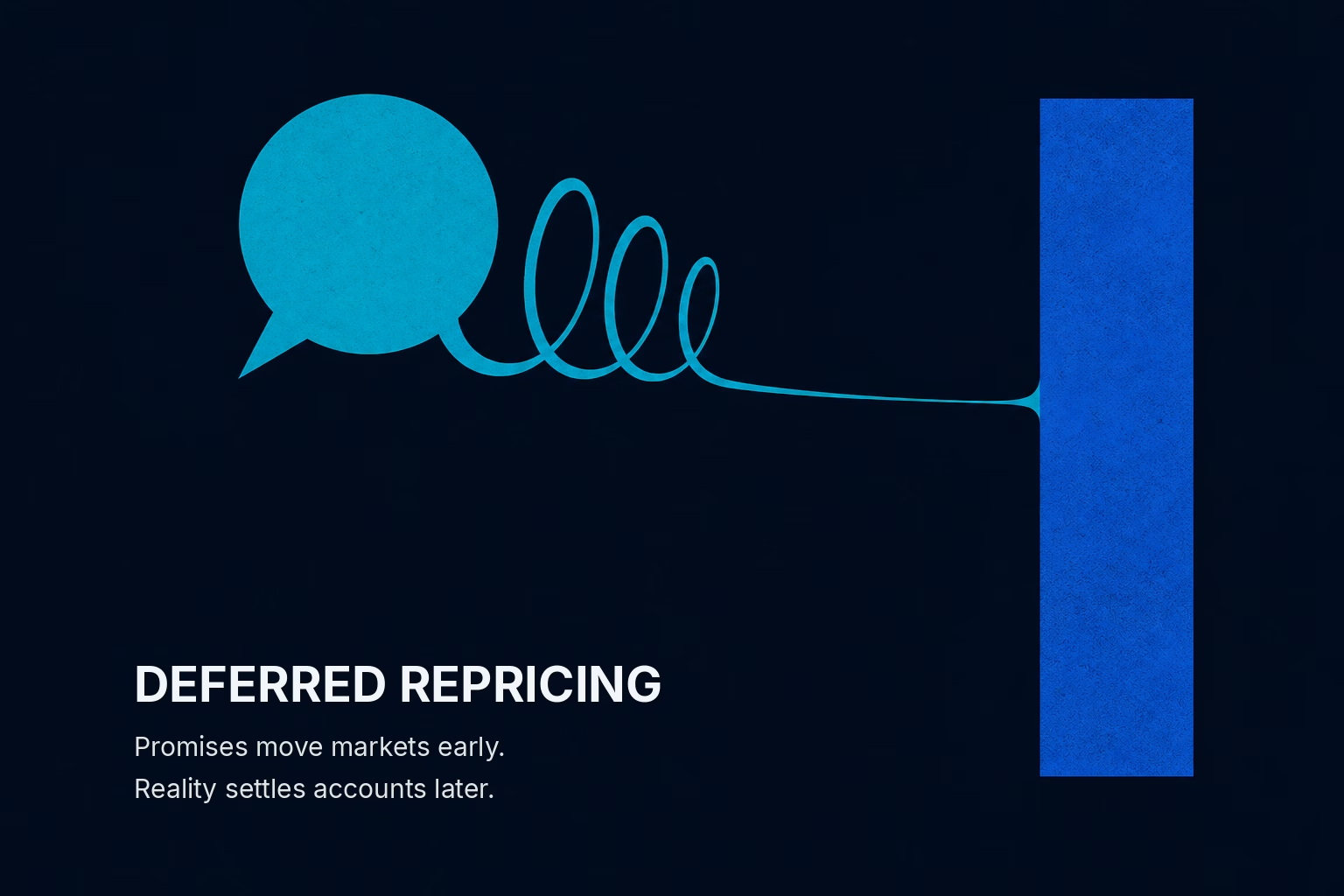
The company a tariff is designed to protect can finish the year with worse margins than the foreign rivals it was protected from. That happened to Whirlpool in 2018. It is the cleanest illustration of why a tariff is a margin event first and a policy event second.
The washing machine tariff that squeezed its own beneficiary
In January 2018 the United States imposed safeguard tariffs on imported large residential washing machines, following a petition that Whirlpool had pursued. The structure was a tariff-rate quota, meaning a lower duty applies to imports up to a volume threshold and a higher one beyond it: 20% on the first 1.2 million imported units, 50% above that. On paper, this was a gift to the domestic producer. Imported Samsung and LG machines got more expensive, which gave Whirlpool room to raise its own prices without losing share.
Prices did rise. Academic work on the episode, most prominently by Flaaen, Hortaçsu and Tintelnot, estimated that washer prices rose roughly 12%. Dryers, which carried no tariff at all, rose by about the same amount, because dryers are sold in matched pairs and retailers repriced the set. The same research put the consumer cost at roughly $815,000 for each domestic manufacturing job the tariff created.
Whirlpool's margins told a different story. Two months after the washer tariff, the Section 232 tariffs of 25% on steel and 10% on aluminum took effect. Domestic steel producers raised prices into the protection, and steel is one of the largest input costs in an appliance. Through 2018 Whirlpool repeatedly flagged raw material inflation as a drag on results, and its shares had a poor year despite the company having won the trade case it asked for.
The lesson is not that tariffs fail. The lesson is that a tariff hits every layer of a supply chain at once, and the final margin depends on which layer has the least ability to push the cost onward. Whirlpool had pricing power on finished washers and almost none on steel.
Who legally pays, and who economically pays
Why does the legal payer matter so little? Because the check and the cost are different things.
The importer of record is the entity that files the customs entry and remits the duty. For most consumer goods that is a U.S. retailer, a brand owner, or a distributor. The duty is assessed on the customs value, typically the transaction price paid to the foreign supplier, so a 25% tariff on a $100 good produces a $25 payment at the border.
What happens to that $25 afterward is a question of tax incidence, the economist's term for who ultimately bears a tax regardless of who remits it. Incidence follows relative price elasticity, which measures how sharply buyers or sellers change quantity when price moves. The party that can walk away most easily pays the least.
Three parties can absorb the cost:
- The foreign supplier absorbs it by cutting its export price, which it will do only if it lacks alternative buyers and the U.S. order book is too large to lose.
- The importing company absorbs it in gross margin, which happens when its customers are price-sensitive and competitors face a smaller tariff.
- The customer absorbs it through higher prices, which happens when the product is hard to substitute or every competitor faces the same cost.
The 2018 to 2019 evidence came down hard on one side. Work by Amiti, Redding and Weinstein, and separately by Fajgelbaum and coauthors, found close to complete pass-through of the tariffs into U.S. import prices. Foreign exporters largely did not cut their prices. The cost landed on American importers and then got split between their margins and their customers.
For an investor, this changes the first question you ask about any tariff announcement. Skip "which country is targeted" and go straight to: "which U.S. company files the customs entry, and can it reprice?"
The arithmetic of pass-through
"Full pass-through" sounds like protection for margins. It frequently is not, and the reason is arithmetic.
Take an importer that buys a product for $100 and sells it for $160.
Gross margin % = (Price − Cost) / Price
Before the tariff: ($160 − $100) / $160 = 37.5%.
Now impose a 25% tariff. Landed cost becomes $125. The company has three choices.
Absorb it. Price stays at $160. Gross margin falls to ($160 − $125) / $160 = 21.9%. Gross profit per unit drops from $60 to $35.
Pass through the dollars. Price rises by exactly $25, to $185. Gross profit per unit stays at $60, but gross margin becomes $60 / $185 = 32.4%. Management can truthfully say it passed the tariff on in full, and the margin percentage still fell by about five points.
Defend the percentage. To hold 37.5%, the price must rise to $125 / 0.625 = $200, a 25% increase on the shelf. That is the only path that leaves the reported margin untouched, and it is also the path most likely to cost volume.
This is why tariff guidance from management deserves a close read. A company promising to "fully offset" tariff costs is usually describing dollar pass-through. Percentage margins compress anyway, and if volume softens in response to the higher price, dollar gross profit falls too.
The practical point: when a company says it will pass tariffs through, assume the gross margin percentage still declines unless it explicitly commits to holding it.
Why the hit shows up a quarter late
The second-order read that markets often miss is timing. A tariff does not hit the income statement on the day it takes effect.
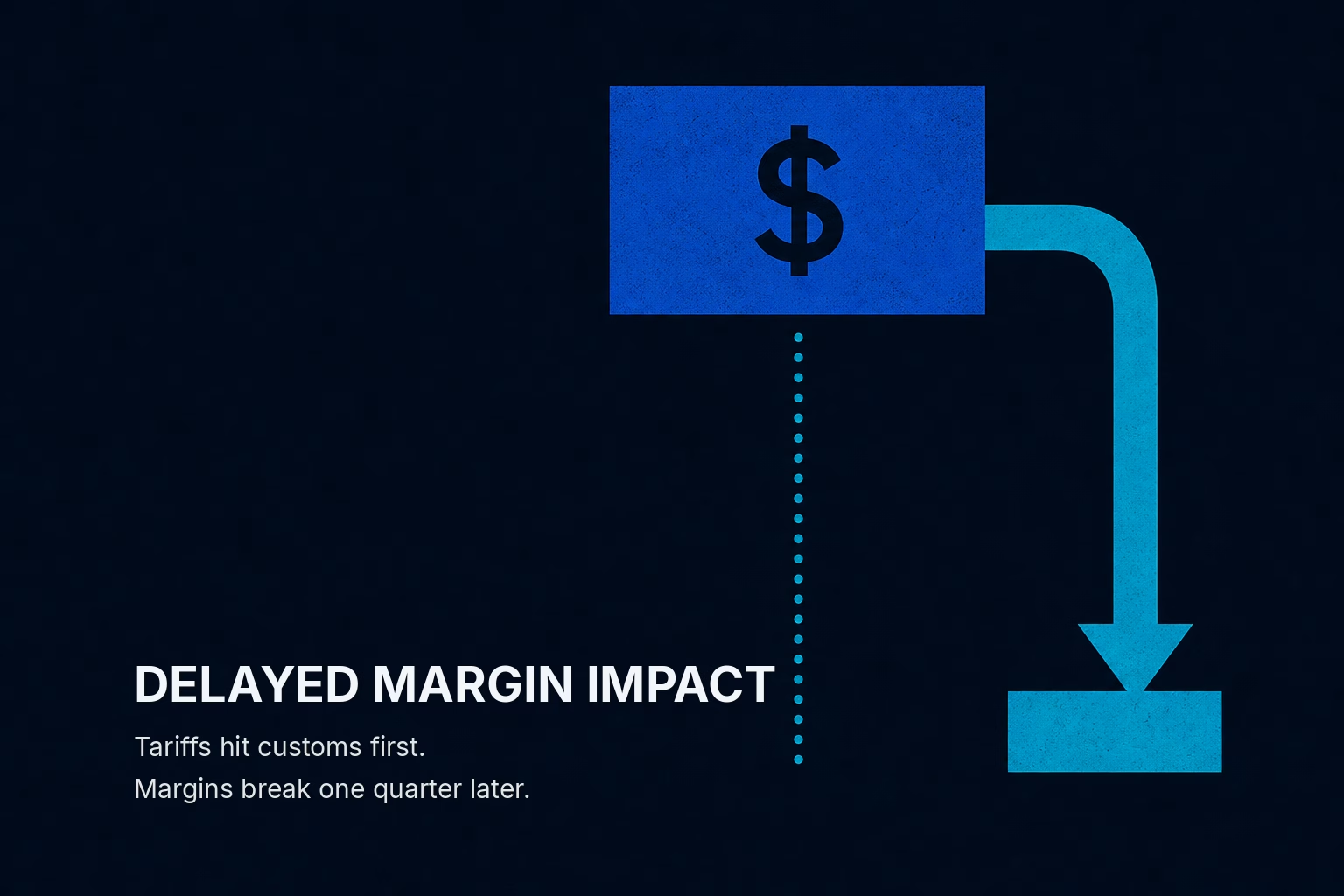
Duty paid at the border is a cost of acquiring inventory. Under standard accounting it is capitalized into inventory, recorded as part of the goods' carrying value on the balance sheet, and recognized in cost of goods sold only when those specific goods are sold. A retailer turning inventory four times a year holds roughly 90 days of stock, so tariffed goods landing in April largely reach the income statement in the following quarter.
That creates a predictable causal chain:
First-order effect: the tariff raises landed cost on new shipments immediately, which shows up as rising inventory values and higher working capital.
Second-order effect: one inventory cycle later, the higher cost flows through cost of goods sold and gross margin compresses, unless prices were raised in time.
Third-order effect: companies that front-loaded imports before the effective date report a temporarily flattering quarter, then a sharper step down when the cheap inventory runs out.
Contract structure adds a second lag. Industrial distributors and component suppliers often sell under quarterly or annual price agreements, so they cannot reprice on the day costs rise. Retailers can change a shelf tag overnight. The same tariff therefore reaches margins at different speeds in different sectors, and the slowest repricers take the deepest dip.
For a reader of earnings reports, this means the quarter in which a tariff is announced is rarely the quarter in which it bites. The inventory line on the balance sheet tends to move first.
Reading the margin line in a protected producer
Whirlpool remains a useful company to watch because it sits on both sides of the mechanism again. It is a large domestic appliance producer competing with importers, which positions it to benefit from tariffs on finished goods, and it consumes steel and components exposed to tariffs on inputs.
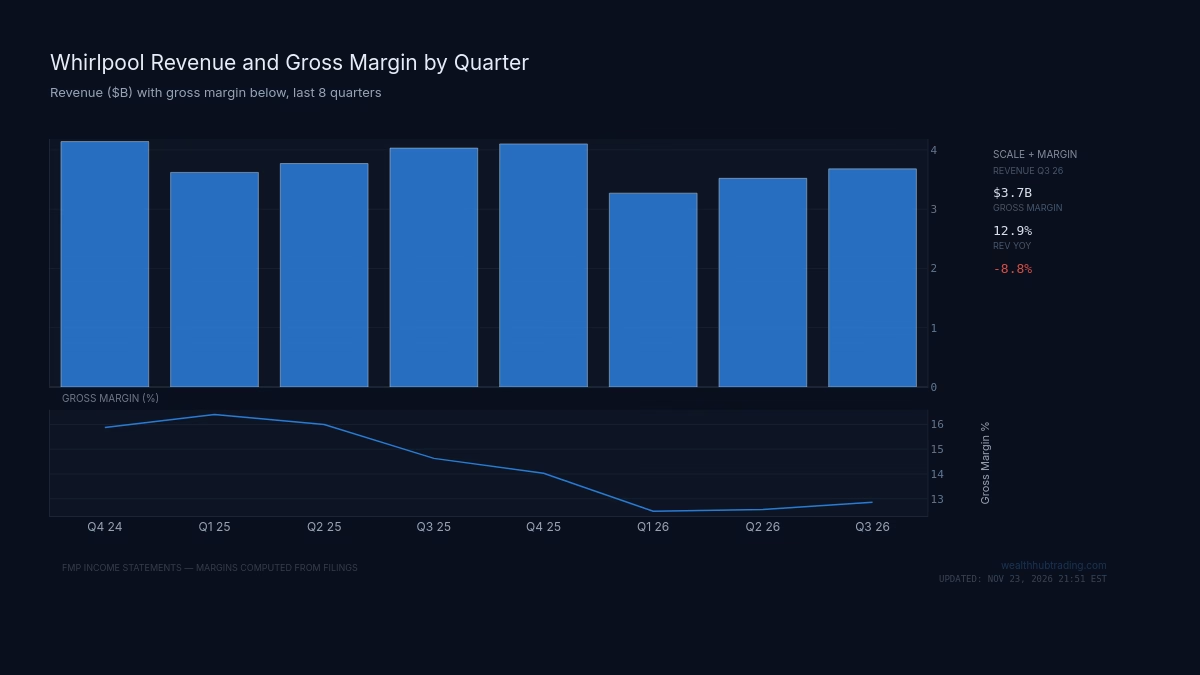
The chart pairs quarterly revenue with gross margin. Read the margin line, not the bars. Revenue tells you whether the company sold more or raised prices; gross margin tells you whether those higher prices outran the higher input costs. When a tariff regime shifts, a rising revenue bar paired with a flat or falling margin line is the signature of an input squeeze eating the protection.
When the mechanism breaks
The incidence framework is reliable, but several features of trade law and corporate behavior distort it in ways that catch analysts out.
Exclusions and exemptions. Product-level exclusions can remove the tariff for a specific importer after it has already priced as if the cost were permanent. That can produce an unexpected margin bump months later, plus refunds.
Currency offsets. When the targeted country's currency weakens, the foreign supplier's dollar price can fall without any concession at all. The yuan weakened during the 2018 to 2019 escalation, which cushioned some importers more than the headline tariff rates suggested. The offset is real but partial, and it can reverse.
Valuation strategies. Duty is charged on customs value, so companies sometimes restructure purchases to lower the assessed value, for example through first-sale valuation, which bases duty on an earlier, lower transaction in a multi-tier supply chain. Firms with sophisticated customs operations can shrink the effective rate below the statutory one.
Rerouting. Shifting final assembly to a third country can avoid a country-specific tariff, subject to rules of origin. The cost does not vanish; it shows up as relocation capex, new supplier qualification, and sometimes lower quality or longer lead times.
Retaliation. The Whirlpool case had one feature analysts often forget: the tariff on the finished good was the visible event, and the tariff on the input was the one that moved earnings. Exporters face the mirror version when trading partners retaliate. U.S. agricultural exporters in 2018 to 2019 lost access to buyers they could not easily replace, and their pricing power collapsed.
Pricing power that was never tested. A company may believe it can pass costs through until it tries. Brands with loyal customers usually can; private-label suppliers selling to large retailers often cannot, because the retailer holds the bargaining power and pushes the cost back down the chain.
The general caution: statutory tariff rates often overstate the effective cost for well-resourced importers and understate it for small ones that lack customs expertise and supplier leverage.
What this changes in practice
A tariff becomes a corporate margin event through a specific path: the importer of record pays the duty, capitalizes it into inventory, recognizes it in cost of goods sold one inventory cycle later, and then discovers whether its customers or its suppliers will take any of it back.
That gives you a concrete checklist for any company exposed to a new tariff. Identify who files the customs entry. Estimate how many days of inventory sit between the border and the income statement. Check whether the company sells on fixed-price contracts or can reprice daily. Separate tariffs on its finished goods from tariffs on its inputs, because the second kind often does more damage and gets less attention. Then read management's "full pass-through" language as a statement about dollars, not percentages.
The Whirlpool episode compresses the whole idea into one year: winning protection on the product you sell does not help much if you lose the fight on the materials you buy.