The most dangerous hedge fund position of 2021 never appeared on a 13F. Archegos Capital Management, the family office run by Bill Hwang, built concentrated exposure to ViacomCBS, Discovery and a handful of other names through total return swaps, contracts in which a bank holds the shares and passes the economic gains and losses to the client. Because swaps are not reportable on Form 13F, anyone screening filings for crowded positions saw the banks as holders and saw nothing of Archegos at all. When ViacomCBS fell sharply in late March 2021 and the margin calls came, the banks dumped blocks of stock, and ViacomCBS lost roughly half its value within days. Credit Suisse alone reported a loss of about $5.5 billion; Nomura's ran to roughly $2.9 billion.
The filings did not lie. They answered a narrower question than the one readers were asking.
What the Archegos episode exposed about the form
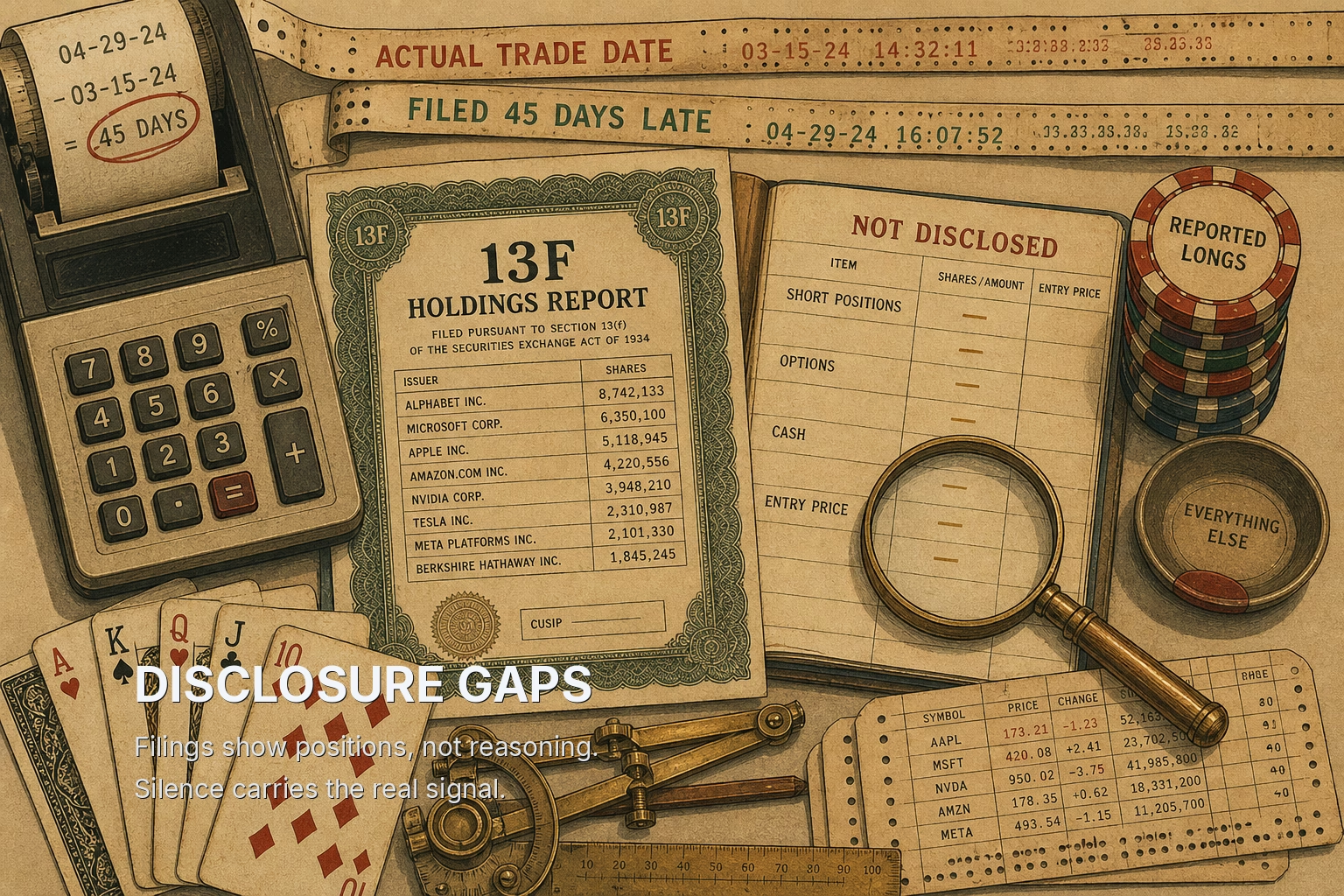
A 13F is the quarterly holdings report that Section 13(f) of the Securities Exchange Act requires from institutional managers with at least $100 million in qualifying securities. It is due within 45 days of each quarter's end. It lists long positions in US-listed equities, plus certain options and convertibles, by share count and market value as of the last day of the quarter.
Read that definition again and notice what it excludes. Short positions do not appear. Swaps and most other derivatives do not appear. Foreign-listed shares, cash, credit and most fixed income do not appear. Positions opened and closed inside a single quarter never appear at all. Managers can also request confidential treatment to delay disclosure of a position they are still building.
So the Archegos story is less an anomaly than a clear illustration of the form's design. The reported holders of ViacomCBS were real holders. The economic owner of the risk was invisible by construction. Treat every 13F you read as a list of where some of the risk is parked on one day, rather than a map of who carries it.
Why the filing is built to be partial
The rule dates to 1975, when Congress wanted visibility into how much of the equity market institutions controlled. Two incentives pulled against each other. Regulators and issuers wanted to know who owned what. Managers wanted to avoid being front-run, which means other traders buying ahead of a manager they know is still accumulating, pushing up the price the manager pays.
The 45-day lag is the compromise between those incentives. It gives the public an ownership census while making sure the census arrives after most of the trading it describes is finished. The long-only scope follows the same logic: the law was written to track control of corporate shares, and a short seller or swap holder does not vote those shares.
That design explains the persistent mistake. Readers treat the form as an investment disclosure, when it was built as an ownership disclosure. An ownership census has no reason to show hedges, sizing logic, entry prices or exit plans, because none of those affect who holds the votes. What this means for you is simple: any question about why a manager owns something is a question the form was never designed to answer.
The staleness arithmetic
Most readers know the filing is "45 days old." The real lag is longer, and it varies by position.
Take a fund that buys Stock X on January 2. The quarter ends March 31, and the fund files on the deadline, May 15. The position becomes public 133 days after the trade. If the fund sells Stock X on April 20, the filing published on May 15 shows a position that has already been gone for 25 days. The next filing, due August 14, is the first document that reflects the exit, more than three and a half months after it happened.
Now consider a trade opened on April 1 and closed on June 29. It falls entirely between two quarter-end snapshots, and no 13F ever records it. For managers who turn their books over quickly, a large share of their actual trading lives in exactly that blind spot.
The implication runs one direction: the faster a manager trades, the less a 13F tells you about them. A long-horizon, concentrated holder's filing is a reasonable portrait. A multi-strategy fund's filing is closer to a single frame from a film.
A position is not a conviction
Sizing is where 13F readers most often fool themselves, because the form invites a calculation that looks precise and is not.
Suppose a fund's 13F shows $10 billion of reported long holdings, and $500 million of that sits in Stock X. The natural reading is that Stock X is a 5% position, a high-conviction bet.
Now add what the filing omits. Suppose the fund also runs $8 billion of short positions that do not appear anywhere on the form. Its gross exposure is $18 billion, and Stock X is about 2.8% of it. Suppose further that the fund is short $450 million of Stock X's closest competitor. The economic position is no longer "long Stock X." It is a pair trade, a bet that X outperforms its rival by a modest net exposure of $50 million, roughly 0.3% of gross. Someone copying the "5% conviction long" from the filing would be taking an outright directional bet the fund never made.
Options make this worse. Filers report options by the number of underlying shares, with a put or call designation, but not the strike, expiry or premium. A large put line might be a bearish bet, or it might be insurance sitting against a long position in the same name. The filing gives you the label and withholds the purpose.
When you see a position on a 13F, translate it as "this manager had exposure of at least this size on the last day of the quarter, of unknown direction once the full book is counted." That sentence is less exciting than "conviction buy," and it is far more accurate.
Where the filings genuinely earn their keep
None of this makes 13Fs useless. It makes them useful for a different job than the one most readers give them.
The strongest use is crowding analysis: aggregating filings across hundreds of managers to see which names many funds hold at the same time. An individual filing is a partial photograph; a few hundred partial photographs of the same stock still reveal how many hands are on it. Crowding matters because funds that share positions often share risk managers' reflexes. When losses force one of them to cut gross exposure, the selling lands on names that other crowded holders also own, and the drawdown spreads.
August 2007 gave the template. Quantitative equity funds running similar long-short books started deleveraging at the same time, and strategies that looked diversified on paper suffered sharp losses together over a few days before partially recovering. Archegos was a cousin of the same mechanism, with the crowding hidden inside bank swap books instead of across fund portfolios.
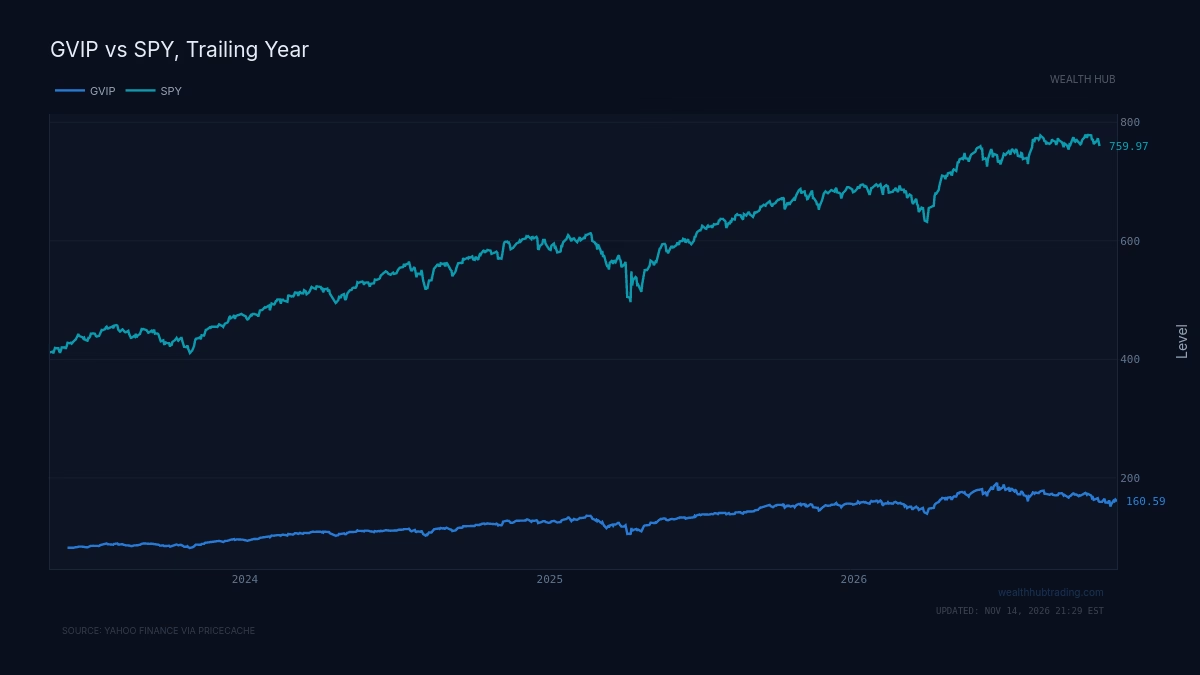
Exchange-traded products built on 13F data show the trade-off. GVIP, a basket assembled from the stocks hedge funds most often list among their top holdings, behaves largely like a more volatile version of the broad market rather than a separate source of return. That is roughly what you would expect from a portfolio made of the long legs of hedged books, stripped of their hedges.
A few other readings hold up because they lean on what the form actually measures:
- Changes in share count across many filers, which show ownership migrating toward or away from a stock over a quarter.
- New positions from concentrated, slow-turnover managers, whose filings come closest to a full portfolio because they run few hedges and hold for years.
- Holder concentration, the share of a company's float held by funds that tend to sell together under stress.
Each of these treats the filing as evidence about ownership structure. None treats it as a recommendation.
When the crowding read itself breaks
The crowding use has its own failure modes, and an honest reader should know them.
First, crowding visible in 13Fs is a census of long holdings only. If the same funds that are long a stock are also heavily short its sector peers, the net exposure across the group may be small, and forced selling may be offset by forced short covering. A crowded long on the form does not always mean a crowded net position.
Second, as Archegos showed, the most leveraged exposure often sits outside the form entirely, in swaps, foreign listings or non-filing vehicles. A name can look lightly owned by hedge funds while a single counterparty carries enormous synthetic exposure to it.
Third, crowding is a condition, not a trigger. Stocks sometimes stay crowded for years and keep rising. The unwind needs a catalyst, usually losses elsewhere in the same funds' books that force them to raise cash. The filing tells you where the fuel is stored. It says nothing about the spark.
Reading the form for what it is
The mechanism in one sentence: a 13F is an ownership census designed to arrive late and to omit shorts, derivatives and intra-quarter trading, so it describes where long exposure was parked, not what trade a manager is running.
That should change how you use it. Read filings in aggregate to map crowding and overlap, and weight the readings by how slowly each manager trades. Translate every reported position into a minimum long exposure of unknown net direction. Before acting on any name you found in a 13F, ask what the filer's short book, swap book and exit timing would have to look like for the position to mean what you hope it means. If you cannot answer that, you are holding a photograph of somebody else's trade, taken weeks ago, with half the frame cropped out.