The optics trade is no longer a contrarian idea, and that is exactly why the interesting money has moved one layer down the stack. The transceiver and c...
The optics trade is no longer a contrarian idea, and that is exactly why the interesting money has moved one layer down the stack. The transceiver and connectivity names that were trading near 52-week lows in mid-2024 have re-rated so hard that the risk-reward on the crowd favorites is now roughly symmetrical. Lumentum leading a connectivity basket up 35% year-to-date is not a reason to buy Lumentum here; it is evidence that the mispricing that made the original call work has been arbitraged away. The mechanism that generated the returns has not stopped operating, though. It has simply relocated.
Why the Bottleneck Keeps Moving Instead of Clearing
The intuition most investors get wrong is that a supply bottleneck is a one-time event that resolves when capacity catches up. In the AI buildout it behaves more like a wave that propagates through the stack. Each layer, once reinforced, stops being the constraint and hands the constraint to the layer beneath it.
The logic is straightforward once you trace the demand chain. Hyperscaler capex, running at an estimated $650B to $700B for 2026, does not buy "AI" in the abstract. It buys clusters of accelerators that must talk to each other at bandwidths copper cannot sustain over distance. That forced the shift toward optical interconnects, which is the call that worked. But solving the interconnect problem does not end the story; it exposes the next binding limit. Once you can move light between racks efficiently, the constraint moves to how much data each accelerator can feed itself from memory, and to the physical components that let optics sit ever closer to the compute die.
This is the sense in which the shortage "responds to adoption and drives new demand." A cleared bottleneck raises throughput everywhere upstream and downstream of it, which raises the load on whatever component is next-least-elastic. The optics shortage of 2024 was not the end state. It was one crest of a wave that is now arriving at photonic components, substrates, and the capital equipment that manufactures them.
The Memory Wall Is the Real Constraint Now
The phrase doing the analytical work here is the Memory Wall: the widening gap between how fast an accelerator can compute and how fast it can be fed. As compute density climbs, moving data in and out becomes the limiting factor, and the response is to pull optical connectivity physically onto the package itself. Co-packaged optics is the architectural answer, and it changes which suppliers matter.
Transceivers as pluggable modules were the last generation's solution. CPO integrates the optical engine directly beside the switch or compute silicon, which shortens the electrical path, cuts power per bit, and lets bandwidth scale without the power budget exploding. That transition does not reward the same names equally. A pluggable-module leader is not automatically a CPO leader, because CPO shifts value toward photonic components, advanced substrates, and the process equipment that can assemble optics and silicon at the required tolerances.
That is where the next asymmetry plausibly sits. The transceiver names now carry consensus ownership and full valuations. The businesses one layer down, the ones supplying the light sources, the substrate materials, and the tools to co-package them, are less crowded precisely because the market has only recently accepted that optics belong in the AI trade at all. The re-rating of the obvious layer is usually what pulls attention toward the layer that has not re-rated yet. That is a pattern worth watching rather than a law; a crowded winner does not guarantee an un-crowded successor exists, and it does not guarantee the successor is investable at scale.
What Broke the Consensus Call, and What Could Break This One
It is worth being honest about why the original optics call was uncomfortable, because the same discomfort is the tell for where the next one lives. In mid-2024 optics sat inside a telecom supply chain investors had written off. Consensus saw cyclical depression and inventory that was years from normalizing. The contrarian read was that AI connectivity demand was colliding with years of underinvestment, and that the shortage would show up before the market repriced the names. The comparison drawn at the time, Ciena's 2024 revision cycle against Nvidia's going into 2023, captured the shape: estimates that had further to climb than a depressed multiple implied.
The move one layer down inherits a different risk profile, and the counterargument is specific. The optics call worked because the names were cheap and hated. The component-and-equipment layer is cheaper on crowding but not necessarily on valuation, and its demand depends on CPO moving from roadmap to volume production. If CPO adoption slips, whether because pluggable optics keep improving fast enough to defend their socket, or because co-packaging yields stay difficult, the deeper-stack thesis loses its catalyst while the crowded transceiver names may simply keep compounding on established demand. The clean version of the bear case is that the market has already priced the entire optics wave, and the "next layer" is a search for asymmetry that the fundamentals no longer support.
That is the fact that would break the read. If component and capital-equipment order books tied to CPO fail to inflect while hyperscaler capex stays elevated, it means the bandwidth constraint is being solved without them, and the wave has skipped the layer the thesis is betting on.
Where the Confirmation Should Appear
The trade to make is not another chase of the re-rated connectivity basket. It is a rotation down the stack toward photonic components, substrates, and capital equipment, taken with the discipline to trim the crowded winners whose risk-reward has flattened. 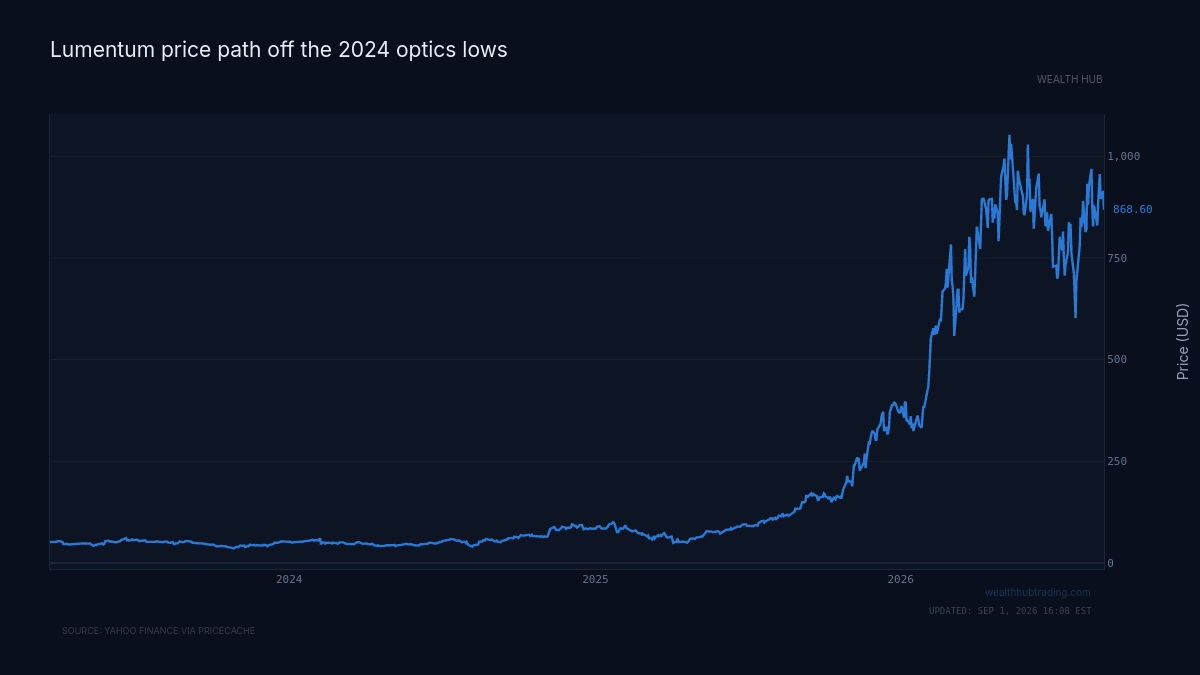
The confirmation to watch is order and revision behavior in the CPO supply chain specifically, not the transceiver names that already discount the demand. If the constraint is genuinely migrating, the next revision cycle appears in the businesses that enable co-packaging before it appears anywhere the market is currently looking, exactly as the 2024 optics shortage did. Until those revisions inflect, taking some risk off the crowded optics winners is the cleaner reading of a trade that has already paid out most of its obvious return.