The most expensive thing AMD sold in November was not a chip. When the stock rose almost 45% in the five sessions through November 12, the day Nvidia announced Jensen Huang's resignation, the penny warrants AMD granted its two largest AI customers rose with it. By The Bear Cave's count, those rights cover up to 320 million shares worth $161.1 billion at the November 17 close. That is roughly 4.7 times the $34.6 billion of revenue AMD reported in its FY2025 10-K. The market is paying about 30 times next year's expected earnings for AMD as the "clean" way to own AI compute, against about 9 times for Nvidia on Yahoo Finance consensus figures. It is paying that premium for a company whose customer relationships are increasingly financed with its own equity and balance sheet.
The headline story is a flight to safety from one cousin's scandal to the other's company. The filings tell a different story. AMD has copied the customer-financing playbook that put Nvidia under scrutiny, and it has done so with a fraction of Nvidia's margin to absorb mistakes. The disclosure the market is not pricing is the size of those promises relative to the cash that would have to honor them.
A note on provenance before the numbers. The figures on commitments, guarantees and warrants come from The Bear Cave, now owned by Hunterbrook Media, whose affiliated fund Hunterbrook Capital disclosed a short position in AMD at publication. The commitment figures are drawn from AMD's own filings. The framing is a short seller's. Both facts belong in the reading.
The Warrant That Grows With the Rally
Granting a customer the right to buy up to 16% of the company for a penny a share is a sales discount paid in stock. Under US accounting, consideration paid to a customer generally reduces revenue. When that consideration is equity, it is typically measured at its grant-date fair value. If AMD's treatment follows that pattern, a key detail follows: the November rally does not touch reported revenue or margins. The rally reaches the share count instead.
This is the gap between what the income statement shows and what shareholders bear economically. At the November 17 close, $161.1 billion across 320 million shares implies a share price near $503. Every dollar the stock gains raises the value of the discount AMD has already promised. The faster investors bid AMD up as the Nvidia alternative, the more of the company's future they hand to the customers whose orders justify the bid. The structure is reflexive.
The dilution arithmetic matters for the multiple. If the full 16% vests and consensus per-share estimates do not already reflect it, a 30 times forward multiple becomes closer to 36 times on a fully diluted basis. It is unclear whether every published estimate captures the vesting schedule, and that uncertainty is itself a reason the 30 times figure understates the price being paid. Nvidia's latest quarterly report contains no equivalent instrument, per The Bear Cave.
Contingent Promises Against a Thin Cash Line
Beyond the warrants, AMD has committed about $28 billion through guarantees, partner leases and cloud-capacity agreements, plus $5.1 billion in equity investments in customers. Together that is roughly $33 billion of support. Against it sits $15.8 billion of cash and short-term investments, so the promises run to about 2.1 times the liquid balance. The pace matters as much as the stock: The Bear Cave reports that customer and partner guarantees doubled to $8.5 billion in a single quarter.
Set that against AMD's own capacity to generate cash. Per the FY2025 cash flow statement, AMD produced $7.7 billion of operating cash flow and $6.7 billion of free cash flow after $974 million of capex. The full $33 billion support package is close to five years of FY2025 free cash flow.
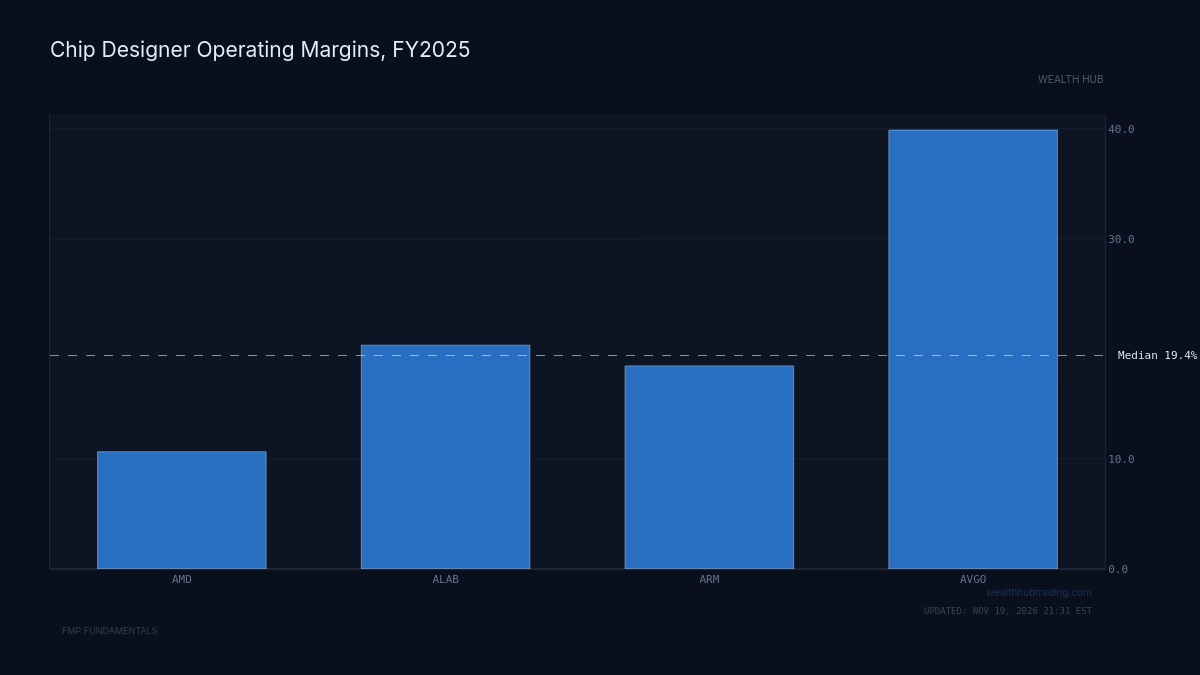
The capex line is where a standard screen goes wrong. At 2.8% of revenue, AMD looks like a capital-light designer, in the same neighborhood as Broadcom at 1.0% and well below Arm at 11.1%. That ratio measures only the capital AMD puts on its own balance sheet. When AMD guarantees a customer's lease, backstops unsold cloud capacity, or signs a data center lease on a customer's behalf, it takes on asset-like exposure that never runs through capex. A low capex intensity paired with $28 billion of contingent capacity support does not describe a capital-light business. It describes a business that moved its capital commitments off the cash flow statement and into the footnotes.
Then there is the margin cushion. AMD's FY2025 operating margin was 10.7% on $3.7 billion of operating income. Broadcom ran 39.9% on its FY2025 revenue of $63.9 billion. Part of AMD's GAAP gap reflects acquisition amortization rather than underlying economics, so the comparison overstates the difference somewhat. The direction still holds: a vendor-financing model is more survivable when every chip carries a fat gross profit that can absorb a guarantee being called. AMD runs the Nvidia financing playbook without Nvidia-scale pricing power, which is The Bear Cave's sharpest line and the one the fundamentals support most directly.
Purchase Commitments Into a Widening Supply Curve
The contingent liabilities only bite if customers stumble. The purchase commitments bite if demand merely softens. AMD's purchase obligations quadrupled in nine months, from $12.2 billion at the end of 2025 to $48.8 billion in September. That is about 1.4 times FY2025 revenue committed to supply, accumulated in less than a year.
The supply side of the market is growing at the same moment. Epoch AI estimates that shipments of Google's TPUs doubled in a single quarter, measured by computing power. On November 9, Google added two more chips and said it has nearly 100 TPU customers. Amazon says its chip business is growing at triple-digit rates and plans to sell Trainium outside its own cloud late next year. The hyperscalers AMD is courting as customers are building their own alternatives to merchant silicon, and two of them now sell those alternatives to third parties.
The less obvious supply risk comes from the Nvidia scandal itself. Culper Research has alleged that more than 20% of Nvidia's AI chip sales are driven by China through intermediaries. That allegation is unproven, and its size is the most uncertain link in this chain. If it is broadly right and Washington closes the channel, accelerators that would have gone to China get redirected to the rest of the world, where they compete directly with AMD. The event that sent AMD's stock up could add supply to the market AMD has just made $48.8 billion of purchase commitments to serve.
Export controls cut a second way. Hunterbrook Media separately reported that IEIT Systems, a Chinese server maker on a US export blacklist, incorporated at least six newer versions of AMD firmware after its listing, and that three server companies tied to IEIT offer closely matching firmware. That reporting does not establish that AMD knowingly supplied a listed entity. It does mean AMD now carries the same category of compliance scrutiny that helped bring down Nvidia's chief executive, and an enforcement process tends to move slowly and arrive at inconvenient moments.
The Case for Reading This Benignly
The strongest defense of AMD is structural, and it deserves a fair statement. The warrants are almost certainly tied to performance. The publicly disclosed OpenAI warrant from October 2025 vested in tranches linked to deployment milestones and share-price thresholds. If the 2026 grants follow similar terms, dilution arrives only alongside the orders that justify it. In that case, the warrants work as a volume discount that shareholders pay when revenue actually shows up, not a liability that comes due regardless.
The contingent commitments are, by The Bear Cave's own account, multi-year and conditional. Many require a partner to default or capacity to go unsold before AMD pays anything. Comparing a contingent, multi-year total with a point-in-time cash balance overstates the near-term call on liquidity. AMD carries only $4.5 billion of total debt against $76.9 billion of total assets, so it has room to borrow if a guarantee comes due. Rising purchase obligations are also what a supplier with real backlog would be expected to report. Unsold inventory is a risk; secured supply in a constrained market is also an asset.
The insider selling cuts less cleanly than the short case suggests. Lisa Su has sold 640,000 shares for about $248 million this year, including $35.5 million on November 17. The source does not say whether those sales ran under a pre-arranged trading plan. A chief executive diversifying after a near-50% rally is ordinary. It is evidence of nothing in particular unless the pace changes.
None of this neutralizes the core problem, which is correlation. The guarantees get called, the warrants matter less than the lost orders, and the purchase commitments turn into inventory under the same condition: AI customers pulling back on spending at the same time. The defense works in a smooth demand environment. The structure is built to hurt most in a sudden one. That is the substance of The Bear Cave's comparison to Silicon Valley Bank: solvent on paper, vulnerable to a correlated run.
What the Next 10-Q Has to Show
The thesis is testable on AMD's next quarterly filing, and three lines decide it.
First, the guarantee footnote. A third consecutive quarter of guarantees growing as fast as the recent doubling to $8.5 billion, without matching growth in cash, would confirm that AMD is financing demand rather than following it. Flat or shrinking guarantees would undercut the core of the short case.
Second, the relationship between purchase commitments and inventory. If the $48.8 billion of commitments starts converting into inventory faster than into revenue, the supply-glut mechanism is underway. Rising inventory days alongside wider availability of TPUs and Trainium would be the clearest early sign.
Third, warrant vesting disclosure. Investors need the tranche conditions and the share count at each milestone to price the fully diluted multiple honestly. Until AMD publishes that, the 30 times forward figure is a lower bound.
The read here is that AMD is not the safer way to own the AI buildout. It is the more leveraged way, with the leverage held in warrants and footnotes instead of debt. The view breaks if AMD's next filing shows guarantees stabilizing, inventory staying in line with revenue, and warrant vesting tied tightly enough to purchases that dilution only arrives with cash. If the filing instead shows commitments still compounding while hyperscaler in-house chips gain external customers, the November rally will look like the moment AMD's shareholders paid the most for the customers they were financing.