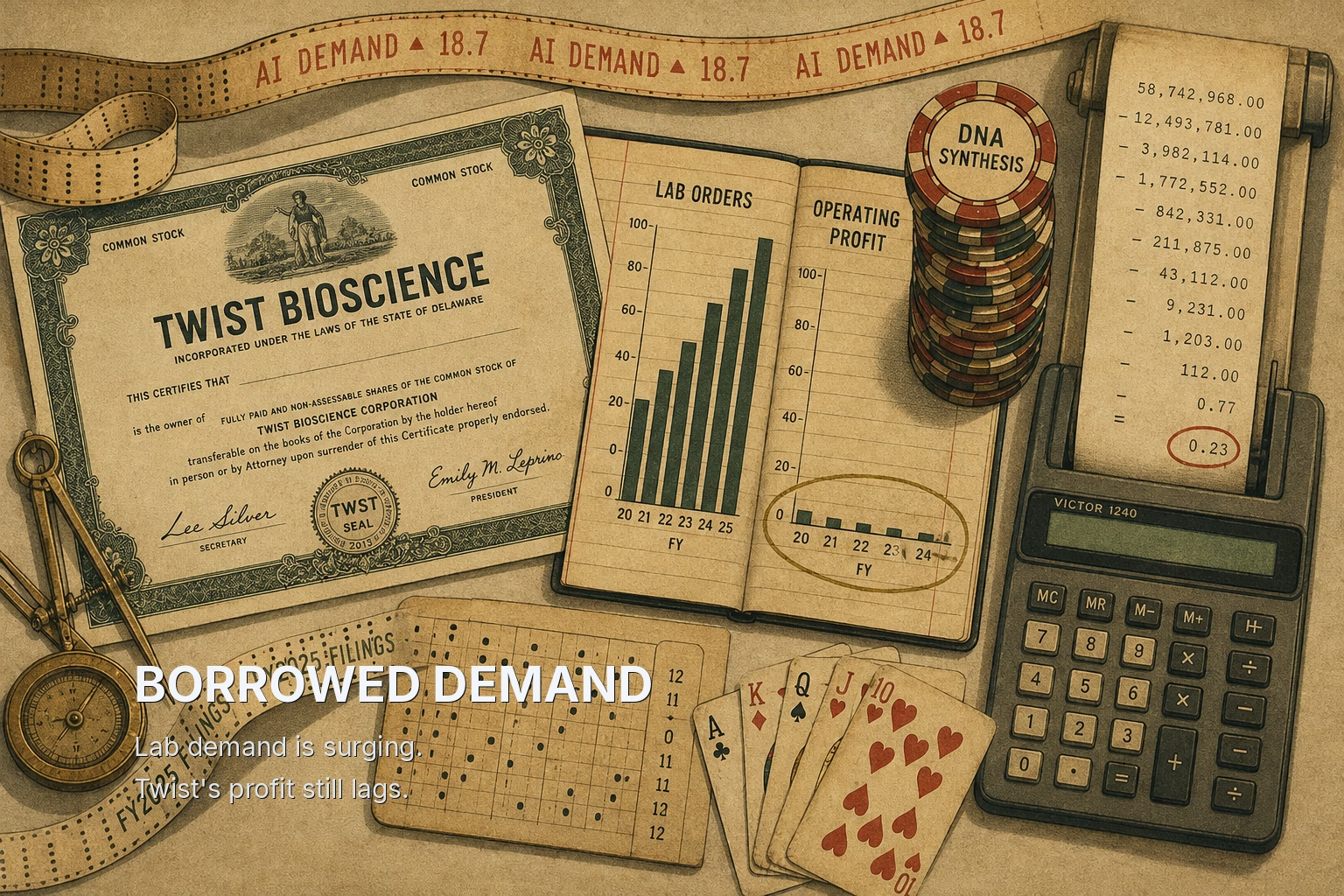
The Anthropic connection that helped squeeze Twist Bioscience back to roughly $200 a share is evidence against a premium multiple, not for one. AI protein design raises the volume of experiments the industry runs. It does not decide who runs them. In the October antivenom project that Nathaniel Horwitz co-authored with Anthropic, the AI lab sent its designs to two vendors, Twist and Adaptyv. Twist's own filings explain why that arrangement matters. Per the FY2025 10-K, Twist booked $376.6 million of revenue and an operating loss of $136.3 million, an operating margin of negative 36.2%. A company that loses 36 cents of operating income on every dollar of sales, competing for work that customers are able to split across vendors, is pricing the AI cycle as if it owned it.
That is the gap the market is not pricing. The narrative is "techbio platform." The disclosure is "lab vendor with scale it has not yet converted into profit." Horwitz's framing in The Bear Cave is careful on this point: you do not need to doubt Twist's accounting to doubt its valuation. The numbers are presumably correct. The interpretation is where the problem sits.
How a Technical Report Became a Partnership
The rerating started with a misread. A technical report in August, similar to the October antivenom work, set off a short squeeze in TWST as investors concluded that Twist had a partnership with Anthropic. According to Horwitz, who used Twist directly in that later work, the relationship looked like a procurement relationship. Anthropic's model generated candidate designs. Lab vendors synthesized and tested them. Twist was one of those vendors.
That distinction carries the whole valuation argument. A partner in AI-driven drug discovery would plausibly share in the value of the designs: milestones, royalties, preferential volume, some claim on the upside when a candidate works. A vendor gets paid per order at a competitive price, and the AI lab keeps the design value. The August squeeze priced Twist as the first kind of company. The October report, with a second vendor named alongside it, describes the second kind.
Squeezes also have their own mechanics. When short sellers are forced to cover into a rally, the price that results reflects positioning as much as fundamentals. Retaking the 2021 high reads as vindication, but some of the move came from forced buying, and that buying ends once the covering is finished.
What the FY2025 Filings Actually Show
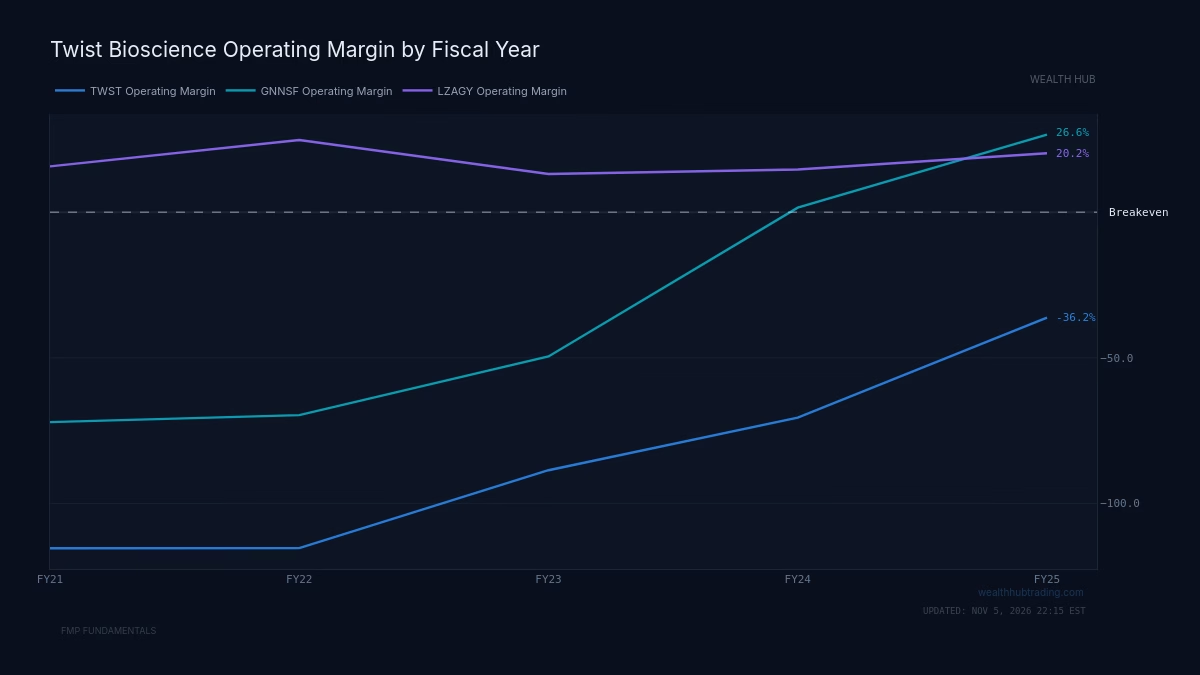
Start with the income statement. Revenue of $376.6 million is real scale for a synthetic DNA and protein services business, and the bull case built on growth and operating leverage is not invented. Leverage, though, has to show up as margin, and at negative 36.2% it has not yet shown up. The operating loss of $136.3 million is more than a third of revenue.
The cash flow statement looks better at first glance, and that is where a careful reader has to slow down. FY2025 operating cash flow was negative $47.6 million. Capex was $28.0 million, or 7.4% of revenue. Free cash flow came to negative $75.6 million. Cash burn is much smaller than the operating loss, roughly $89 million smaller, which implies that a large share of reported expense was non-cash. In tools and synthetic-biology companies that gap is often driven by stock-based compensation, depreciation and working-capital movements. Readers should check the precise mix against the cash flow reconciliation in the 10-K rather than take that inference on faith. Whatever the split, non-cash does not mean costless. If stock compensation makes up a meaningful part of the difference, shareholders pay for it through dilution rather than through the cash line.
The balance sheet takes away the urgency but not the question. Total assets were $641.9 million against total debt of $137.3 million at fiscal year-end. Twist is not a company running out of runway at this burn rate. A premium-multiple stock still needs a believable path to cash generation. This one is burning roughly $75 million a year in free cash while being priced, in Horwitz's words, at the highest multiple among its peers.
The Peer Set Twist Is Priced Against
The comparison that matters is with companies selling similar categories of work. GenScript, through its US-traded line, reported FY2025 revenue of $960.9 million, a 26.6% operating margin and $241.7 million of positive free cash flow, with capex at 8.7% of revenue. That capex intensity is roughly comparable to Twist's 7.4%, so the margin gap is not explained by one company investing more. GenScript is the closest real-world picture of a scaled molecular-biology services vendor, and it is solidly profitable. Twist is not.
Lonza is the more interesting comparison because it weakens a simple "negative FCF is bad" reading. Lonza's FY2025 free cash flow was negative $194.8 million, with capex of $1.3 billion, or 20.1% of revenue and 117.5% of operating cash flow. Negative free cash flow by itself does not disqualify a company. Lonza is spending through a capacity build. What separates the two cases is where the burn comes from. Lonza earned a 20.2% operating margin on $6.5 billion of revenue and chose to reinvest more than it generated. Twist's burn comes from operations. Its capex consumed a modest share of revenue, and its operating cash flow was negative before any investment.
So the market is placing the highest multiple on the company in this group with the weakest operating economics. That can be defended only if Twist's revenue is structurally different: stickier, more proprietary, or closer to the value of the molecules it makes. The source material points the other way. Horwitz reports that several vendors offer similar services at similar prices, and that Twist competes across essentially everything it sells.
Why AI Demand May Not Accrue to the Vendor
The mechanism linking the AI story to Twist's income statement is the weak link in the bull case. AI design models generate candidates far faster than wet labs can test them. That plausibly increases total demand for gene synthesis, protein production and binding assays. Increased industry volume becomes vendor profit only when vendors hold pricing power. When the buyer is a technically sophisticated AI lab or a large pharma group, sending standardized orders and comparing turnaround and cost across suppliers, more volume can come with more price competition.
This is the trade-off a short squeeze glosses over. A pick-and-shovel argument works when the shovels are scarce. The Anthropic projects suggest they are not: one project used two vendors for the same testing function. Twist may keep winning share on speed, quality and breadth, and its scale is a real asset. A share-winning vendor in a competitive market still earns a vendor's multiple unless margins show otherwise.
Any judgment of management credibility also carries a governance footnote. CEO Emily Leproust co-founded Twist in 2013 and later settled litigation with Agilent, her former employer, over the alleged misappropriation of the company's foundational technology. Twist paid $22.5 million without admitting wrongdoing. That history does not bear on current operating results. It does bear on how much benefit of the doubt management's forward narrative deserves when that narrative is what holds up the multiple.
The Strongest Case Against This Read
The bull case deserves a fair hearing. Twist is growing quickly, and operating leverage in manufacturing-heavy services can be nonlinear. Once fixed capacity is absorbed, incremental revenue can fall to the bottom line at high rates. If Twist is close to that inflection, a negative 36% margin in FY2025 may describe the past rather than the future, and a premium multiple would be paying for margins the filings cannot show yet. The CEO struck a bullish tone in her conversation with Horwitz ahead of earnings expected next week, and a strong quarter could extend the move.
The precedent cuts both ways. After the 2021 peak, TWST fell 95%. Bulls can argue that a company that recovered from that drawdown to its old high has proven its staying power. Bears can argue that the same setup, a hype cycle stacked on a real but competitive business, has already played out once. Horwitz notes that he once lost more than $30 million on what he describes as an alarmingly similar story. That is his experience, not evidence about Twist, and readers should weigh it accordingly.
What the bull case cannot do is point to the profitability that justifies its multiple today. It rests on a trajectory. Trajectories can be tested.
What the Next Print Has to Show
The coming earnings report is the test, and revenue growth alone will not settle it. A good quarter for a premium-multiple vendor has to show three things together: operating margin improving by a visible amount rather than holding near negative 36%; operating cash flow moving toward breakeven without capex being cut to get there; and management commentary on pricing that rules out volume being bought with discounts. Revenue growth paired with a flat margin would confirm the vendor read. Margin expansion steep enough to place GenScript-style profitability within a few years would break it.
Until the filings show that conversion, Twist is a competitive lab vendor priced like a platform. The AI tailwind describes the industry's demand, and the margins describe Twist's share of it.