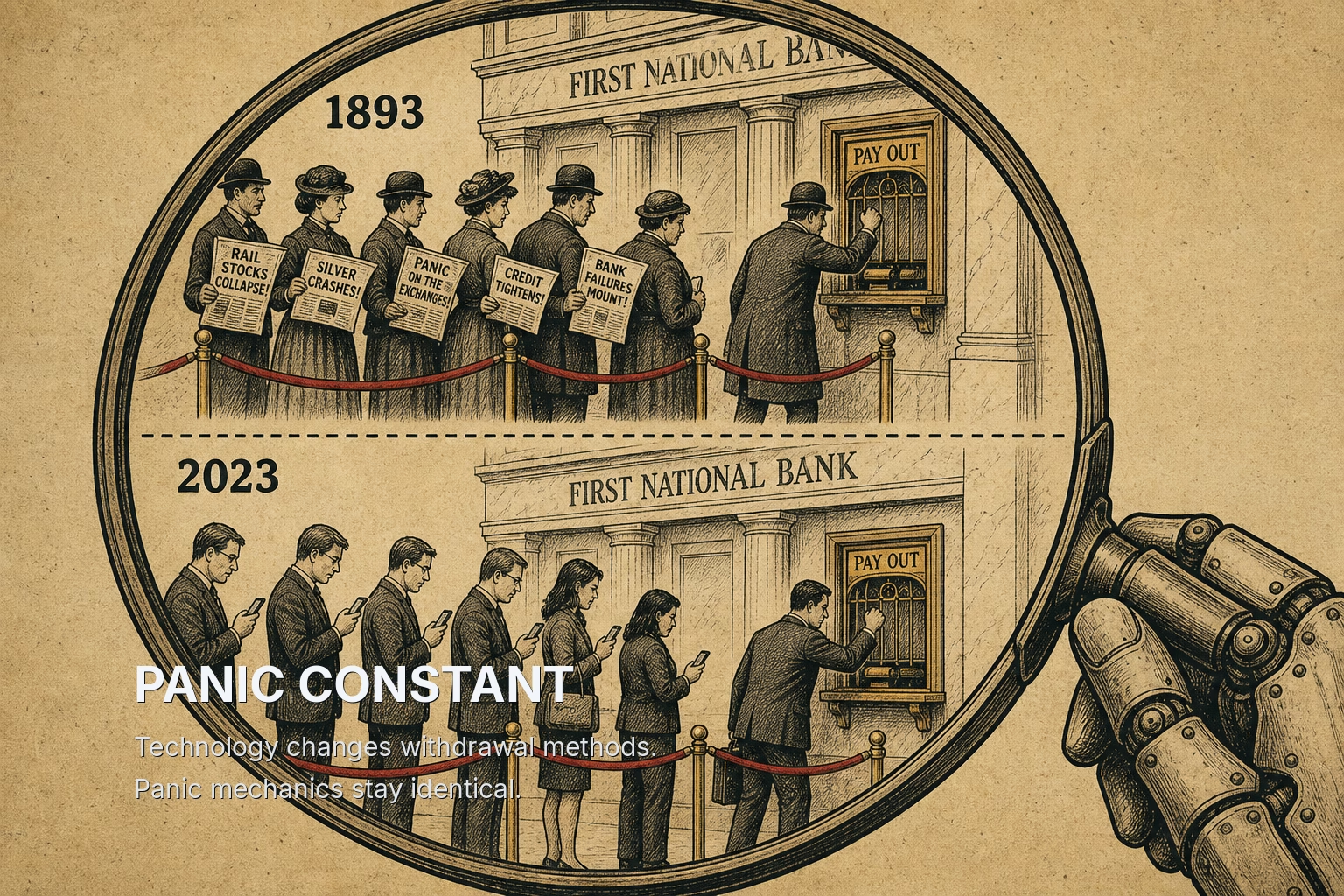
The pattern that repeats is not the blow-up. The pattern is the timing of the regulator's phone call. It arrives after the prime brokers have already be...
By the time the Bank of England's Prudential Regulation Authority and the Federal Reserve started asking global lenders how much they had lent to Jane Street and Citadel Securities, the answer no longer mattered to anyone whose money was at risk. That is the tell worth reading.
A scene already resolved by the time it was noticed
Consider what had already happened before central bankers on both sides of the Atlantic decided that something might have occurred. Leopold Aschenbrenner's Situational Awareness, the fund named after his viral essay, ran about 4x leverage through Goldman total return swaps on a long-AI-infrastructure, short-software pair. It was up 439% net through June and had reached roughly $45 billion in assets, counting Jane Street among its investors. Then July arrived. AI stocks rolled over, software rallied, and both legs of the trade lost money at the same instant.
The unwind was fast. Nebius, Sandisk and SharonAI each fell roughly half, SK Hynix dropped nearly 50%, and the margin calls came in against a fund with eight employees and no willing new capital. Within days it had exited its entire public book. Citadel bought the whole thing in under 24 hours at about a 10% discount, beating Millennium and, fittingly, Jane Street itself. The fund closed the month down about 78%. Jane Street, whose own book had leaned into the same momentum names, lost $15 billion in July, its first down month in a decade.
Goldman, meanwhile, earned more than $200 million in fees this year from financing Situational Awareness, the most of any client in its prime brokerage book. Citadel's Wellington fund rose 5.94% in July, its best month since 2022, with about half its year-to-date gains sourced from this single unwind. The intermediaries did fine. The regulator called two months later.
That gap between event and inquiry is not incidental. It is the pattern.
The same delay, in three earlier registers
The structure here is old. A large pool of capital concentrates on one side of a crowded trade, funded through leverage the prime brokers price generously because the fees are enormous while the trade is working. The historical correlations that justify the position are imputed, not observed. An exogenous move forces simultaneous derisking. The intermediaries pull collateral, get made whole, and the supervisory apparatus notices only after the losses have already been allocated to whoever was last to sell. The instruments change across cycles. The sequence does not.
In the autumn of 1998, Long-Term Capital Management held four consecutive years of returns that had made its skeptics look foolish. Its principals held Nobel Prizes; its risk models were the most sophisticated in institutional finance. The Russian default that August was not, on its own, large enough to threaten the fund. What it did was change the behavior of every counterparty at once. Spreads priced to converge widened instead, because every other holder of similar positions was reducing exposure simultaneously. The Federal Reserve Bank of New York convened the rescue in late September, after the losses were already realized. The supervisory question came after the prime brokers had already tallied their exposure. William McDonough gathered the banks in a room because the position had already detonated, not because anyone had been watching the intraday margin build.
Roll forward a decade. Through 2007 and into 2008, the prime brokerage and repo desks financed structured credit positions on terms that assumed the underlying correlations were stable. Bear Stearns funded itself overnight against collateral the market stopped trusting in March 2008. The run happened in days. The supervisory response, the emergency lending facilities, the discount-window access for broker-dealers, all of it arrived as the firm was already being absorbed into JPMorgan at $2 a share, later revised to $10. The regulator's situational awareness lagged the collateral run by the exact interval it took for the position to become unfundable.
Then March 2021, closer in texture to the present case. Archegos Capital Management ran concentrated single-name exposure through total return swaps at several prime brokers at once, and no single bank could see the aggregate book. When the underlying names reversed, Credit Suisse and Nomura and Morgan Stanley discovered their exposure at the moment the margin calls could no longer be met. Goldman and Morgan Stanley sold first and got out cleanly; Credit Suisse absorbed roughly $5.5 billion. The regulatory scrutiny of prime-brokerage swap exposure intensified afterward, in the standard sequence: after the block trades, after the losses were distributed, after the well-positioned intermediaries had already been paid.
Four episodes, four instruments, one mechanism. Imputed correlation, generous leverage priced by fee-hungry intermediaries, a forced simultaneous unwind, and a supervisory question that arrives once the outcome is settled. 
Who was actually watching the intraday margin
The regulators want to know three specific things: the firms' risk appetite, how banks' exposure to them "evolved during the day," and how the risk controls held up. Read past the procedural language and that third question is the only one that matters, and it is an admission. Asking how exposure evolved intraday is asking whether anyone at the prime brokers was watching the margin build in real time as the AI trade came apart, or whether they only looked when the call went unmet.
Ken Griffin already answered it, in a way, when he described the unwind and thanked "the trading and prime brokerage teams at the banks serving both firms" for their "extraordinary cooperation." Over the three weeks that followed, Citadel flipped more than 80% of the Situational Awareness portfolio through roughly 100 block trades worth over $4 billion, distributing the inventory to what the trade desks politely do not call dumb money. The cooperation Griffin thanked was the same cooperation the regulators are now investigating. The prime brokers were watching closely enough to protect themselves and to help the buyer move the book. Whether they were watching closely enough to protect the system is precisely the question that only gets asked afterward, because the answer only becomes legible afterward.
Jane Street's silence sits inside this. Its last public word came from partner Turner Batty, who told investors that "July was a bad month," which for a firm that lost $15 billion is a sentence doing considerable work. The firm's own book tends to sit just ahead of whale and retail flow, and it leaned into the identical momentum names: Micron, CoreWeave, Broadcom, SMCI, Dell, Bloom Energy. That is the crowding the regulator is chasing now. It was observable in the position, in the leverage, in the concentration, well before the reversal made it undeniable.
What the pattern says about the present regime
Here is the one way this cycle does not rhyme with 1998 or 2008. Those unwinds happened in a low-rate or falling-rate environment where funding was cheap and the intermediaries had every incentive to extend it. This one is unfolding with the 10Y Treasury at 5.11% and the 2Y at 4.85%, a curve that is positively sloped by only 0.26% and a funding backdrop that is genuinely expensive. Leverage priced against a 5% risk-free rate is a different animal than leverage priced against 1%. The fee that made Goldman more than $200 million on a single levered client is being earned in an environment where the cost of the collateral that funds it is materially higher, which means the concentration is being carried at a tighter margin of error than in the analog episodes. That is not a reassurance. It is the opposite: the same crowding, less cushion.
We can note what the recurrence teaches without pretending it forecasts a date. The supervisory question about bank exposure to large trading firms arrives on a fixed lag behind the event that provokes it, and the lag is not a failure of diligence so much as a property of the structure. Intraday margin at a prime broker is visible to the prime broker and to almost no one else in real time. Aggregate exposure across prime brokers is visible to no one at all until a name reverses and the calls arrive at once. The regulator cannot ask the right question until the position has told the market its own answer.
The structural observation is this. When a large concentrated book is financed through swaps that no single lender sees whole, the intermediaries closest to the collateral will be made good first, the losses will be distributed to whoever holds the inventory last, and the supervisory inquiry will follow the unwind rather than precede it. The instruments were mortgage correlations in 2008 and single-name swaps in 2021 and a levered AI momentum pair in 2026. The sequence was the same each time. The Fed and the PRA finding their situational awareness two months after Situational Awareness found the floor is not the anomaly. It is the pattern running on schedule.