
The signal in this episode is not that nonbank failures spilled into bank stocks. It is that equity markets sorted banks by NBFI exposure faster and more cleanly than any regulatory disclosure did. When researchers normalize bank returns to the day before Blue Owl's OBDC II wind-down announcement, the banks with heavy NBFI exposure underperform the low-exposure cohort, and the gap holds for days rather than snapping back. That persistence is the finding. A one-day dislocation is noise. A multi-day divergence sorted on a balance-sheet variable is the market pricing a transmission channel that the official narrative is still framing as hypothetical.
The Exposure Is Concentrated Where Capital Is Thinnest
The uncomfortable disclosure sits in the regulatory filings, not the guidance. As of year-end 2025, roughly fifty bank holding companies carried total credit exposure to NBFI obligors exceeding 100 percent of their Tier 1 capital, with the extreme cases running four to six times Tier 1. That is not a rounding error against the loss-absorbing layer. It is a multiple of it.
The composition matters more than the count. Many of these institutions are regional banks in the $10 billion to $100 billion asset range. This is the tier that sits below the enhanced supervisory apparatus applied to the largest banks and above the community-bank threshold where NBFI lending is rarely a material business line. It is also the tier that has already been repriced once this decade, in March 2023, on a different but structurally similar problem: concentrated exposure the market understood before the supervisors publicly quantified it.
The mechanism connecting NBFI stress to these banks is not a direct credit loss on a defaulted borrower. Banks generally hold the senior claim; the NBFI retains the junior exposure to the underlying borrower. The channel is the credit line. When an NBFI faces redemptions or funding stress, it draws on the committed bank facilities it has negotiated precisely for that scenario. The bank does not choose the timing. A wind-down at OBDC II, a redemption wave at a non-traded BDC, or a credit-quality scare rippling out of the Tricolor and First Brands bankruptcies all convert into drawdown risk on the senior lender's balance sheet at the worst possible moment.
What the Seniority Argument Misses
The consensus reassurance rests on seniority. Banks lend senior and hold contingent lines against junior NBFI capital, so the first-loss buffer protects them. On a static, hold-to-maturity view of a single loan, that is correct.
It misses two things the equity market does not. First, drawdowns are correlated across NBFIs by design. The same shock that pushes one private credit fund to draw its facility pushes its peers to draw theirs, because they hold overlapping exposures and face the same redemption behavior. Seniority protects against idiosyncratic default; it does nothing about a simultaneous liquidity call from a diversified set of NBFI counterparties. Second, the growth is not migration, it is transformation. Intermediation that once sat on bank balance sheets now runs through an NBFI wrapper, motivated at least in part by regulatory arbitrage, while the bank retains the senior funding and the contingent line. The credit risk looks like it left. The funding risk and the drawdown obligation did not.
This is why the exposure figure understates the linkage. On-balance-sheet loans plus undrawn commitments to NBFI obligors is the reported number. The behavioral reality is that the undrawn portion becomes drawn exactly when the bank would prefer it did not, and the correlation structure means several lines fund at once.
The Payments Franchises Are the Wrong Comparison
It is worth being precise about which financials carry this risk, because the "financial sector" label obscures it. Visa's FY2025 filings show revenue of $40.0 billion on a 60.0 percent operating margin, with $21.6 billion of free cash flow and capex at 3.7 percent of revenue. That is a toll-road franchise with almost no credit intermediation and effectively no NBFI drawdown exposure. American Express, on FY2025 numbers, runs a 17.1 percent operating margin with $16.0 billion of free cash flow, a lender but a closed-loop one, not a warehouse funder of private credit.
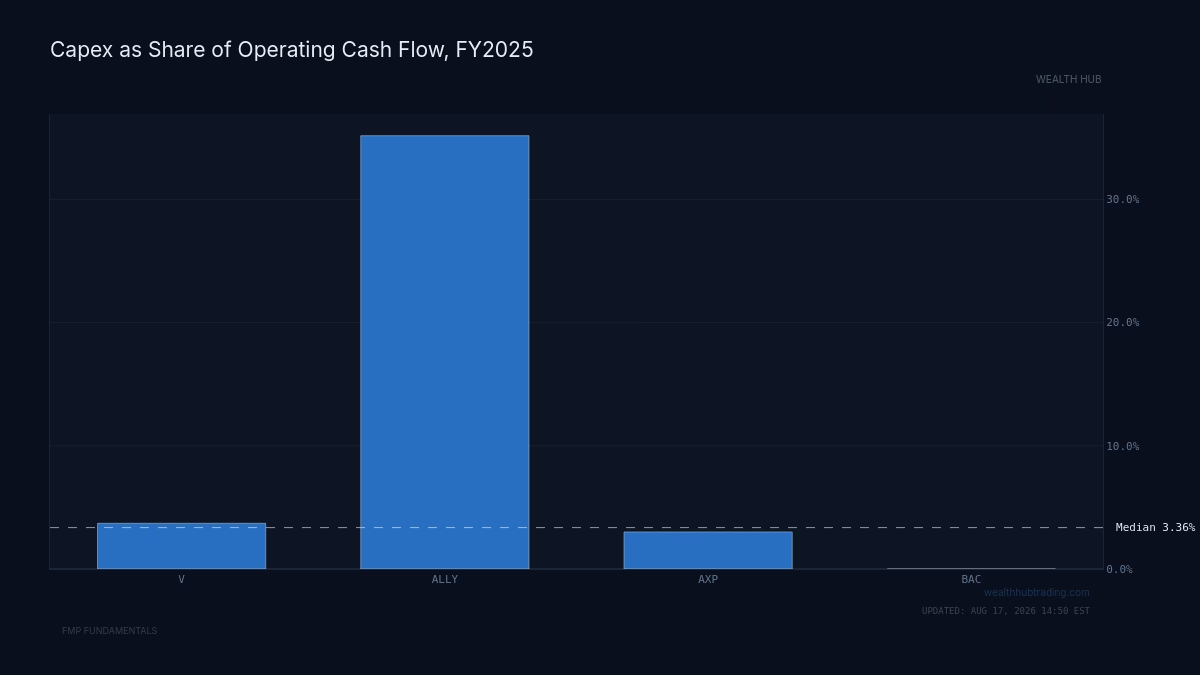
The contrast that matters is Ally Financial, whose FY2025 figures show an 8.6 percent operating margin, capex at 35.2 percent of revenue and 117.8 percent of operating cash flow, and negative free cash flow of $647 million. Ally is not the NBFI-facility problem itself, but its profile illustrates the point: the institutions doing balance-sheet-intensive credit intermediation earn a fraction of the margin the payments franchises do and generate cash that is fully consumed by their own investment. They have neither the earnings cushion nor the free cash flow of a Visa to absorb a correlated drawdown wave. Bank of America, at $191.6 billion of revenue and a 19.7 percent operating margin, has scale and supervision the regionals lack. The vulnerable cohort is neither the payments networks nor the megabanks. It is the mid-tier credit intermediary with a concentrated NBFI book and a thin margin.
Where This Read Could Be Wrong
The thesis breaks if the return divergence is a proxy for something else. High-NBFI-exposure banks may share other characteristics, commercial real estate concentration, deposit beta, regional loan mix, that drove the same-period underperformance independently of the NBFI channel. A sort on one variable that correlates with several unobserved ones is a familiar way to see a mechanism that is not there. The clean way to break the tie is drawdown data: if committed NBFI lines were actually drawn during the stress window and the drawn banks underperformed the merely-exposed ones, the channel is real. If exposed-but-undrawn banks fell just as much, the market is pricing sentiment, not mechanics.
There is also a genuinely reassuring reading of the same facts. Senior claims did hold. No large bank failed. The stresses stayed contained to the NBFI perimeter and expressed themselves in bank equities as a repricing rather than a run. On that reading, the system did what it was designed to do: push losses into the junior, non-bank layer and leave senior bank claims intact. The equity divergence is then the price of that insurance being visibly tested, not evidence that it failed.
The Condition That Settles It
The watch variable is not a bank stock level. It is the drawdown rate on committed NBFI facilities, which surfaces in bank liquidity and commitment disclosures with a lag. If the next NBFI shock, another BDC wind-down, another credit-quality scare of the Tricolor and First Brands variety, or the software-loan concern that the late-January AI-automation news sharpened, produces a measurable jump in facility utilization at the high-exposure regionals, then seniority is protecting the principal while the funding channel does the damage, and the market's early sort was correct. If facilities stay largely undrawn through the next episode, the divergence was sentiment and it will mean-revert.
Policymakers describing this as something they are "watching carefully" have already conceded the direction. The equity market has priced it. The unresolved question is magnitude, and the filings that answer it, undrawn commitments becoming drawn, are the ones the guidance language is not yet quoting.