On the third Friday of every quarter, US equity markets stage an event that looks, on a volume chart, like a wall. Trading trickles through the afternoo...
On the third Friday of every quarter, US equity markets stage an event that looks, on a volume chart, like a wall. Trading trickles through the afternoon, then the final print of the day arrives carrying more shares than the previous several hours combined. Traders call these dates "triple witching," when stock options, index options, and index futures all expire together. But the wall is not unique to those days. It appears, in smaller form, at the close of nearly every session. Understanding why it appears tells you something durable about how modern markets actually clear.
The closing auction is a scheduled meeting, not a scramble
Most of the trading day is continuous. Buyers and sellers post orders throughout the session, and the exchange matches them one at a time as prices move. The close works differently. In the final minutes, the exchange stops matching orders continuously and instead collects them into a single batch, then computes one price that clears the largest possible number of shares. This single-price event is the closing auction: every participant who trades in it receives the same price, the official closing price for the day.
That official price is the reason size gathers there. A closing price is not just the last trade; it is the number that mutual funds use to value their holdings, that index providers use to calculate where the S&P 500 finished, and that derivatives use to settle. Anyone whose job is to match an index must, by the logic of their mandate, trade at that exact number. If a fund tracking the S&P 500 buys shares at 2pm and the index is later struck at the 4pm close, the fund has introduced a tiny error between its own price and the benchmark it promised to replicate. The only way to remove that error is to trade at the close itself.
What this means for you: the volume spike at the end of the day is not sentiment. It is a structural appointment that a specific category of money is obligated to keep.
Why the largest, calmest money is forced to the close
Consider the scale of passive investing. Trillions of dollars sit in index funds and exchange-traded funds whose entire promise is to match a benchmark as closely as possible. When new money flows into an S&P 500 fund on Tuesday, the manager does not get to pick a clever entry point. The fund's job is to hold the index, and the index is defined by closing prices. So the manager routes the buy to the closing auction, where it will execute at the same price the benchmark records.
Now multiply that by every index fund, every ETF rebalancing its basket, and every institution reweighting a portfolio to match a model. All of them face the same constraint, and all of them arrive at the same moment. Size meets size at the close by construction, not by coincidence. This is the mechanism the title points to: the last minutes carry the volume because the close is the one guaranteed liquidity event of the day, the single point where enormous, price-insensitive orders can find enough counterparties to fill without moving the market against themselves.
Continuous trading during the day cannot offer that guarantee. If a fund tried to buy a billion dollars of stock at 11am, it would push prices up as it consumed available sellers, and its average price would drift away from any clean benchmark. The auction solves this by pooling all the day's residual buy and sell interest into one batch and clearing it at a single fair price. Liquidity that would be scattered and thin across the afternoon becomes concentrated and deep for one minute.
What this means for you: if you want to trade alongside the deepest liquidity of the day with the least price impact, the close is where it lives, and it lives there for a reason you can predict in advance.
The imbalance is real information, not noise
Here is where intuition usually gets it wrong. Because the closing volume looks chaotic, many observers treat the late-day move as random, a burst of last-minute positioning with no signal in it. The opposite is closer to the truth.
Before the auction prints, US exchanges publish an imbalance feed: a running tally, in the final minutes, of how many more shares want to buy at the close than want to sell, or the reverse. If that feed shows two million more shares seeking to buy than to sell in a given stock, the auction cannot clear at an unchanged price. To attract enough additional sellers, the clearing price must rise. The imbalance is a preview of pressure that has not yet been resolved.
This information is real precisely because of who generates it. The imbalance is dominated by the index and passive money described above, orders that are being placed to satisfy a mandate rather than to express a short-term view. A buy imbalance often reflects genuine inflows into a fund or a scheduled rebalance, not a trader's guess about tomorrow. That makes it a cleaner reading of forced demand than almost any intraday signal, and it is why professional desks watch the imbalance feed in the final minutes rather than dismissing the late move as froth.
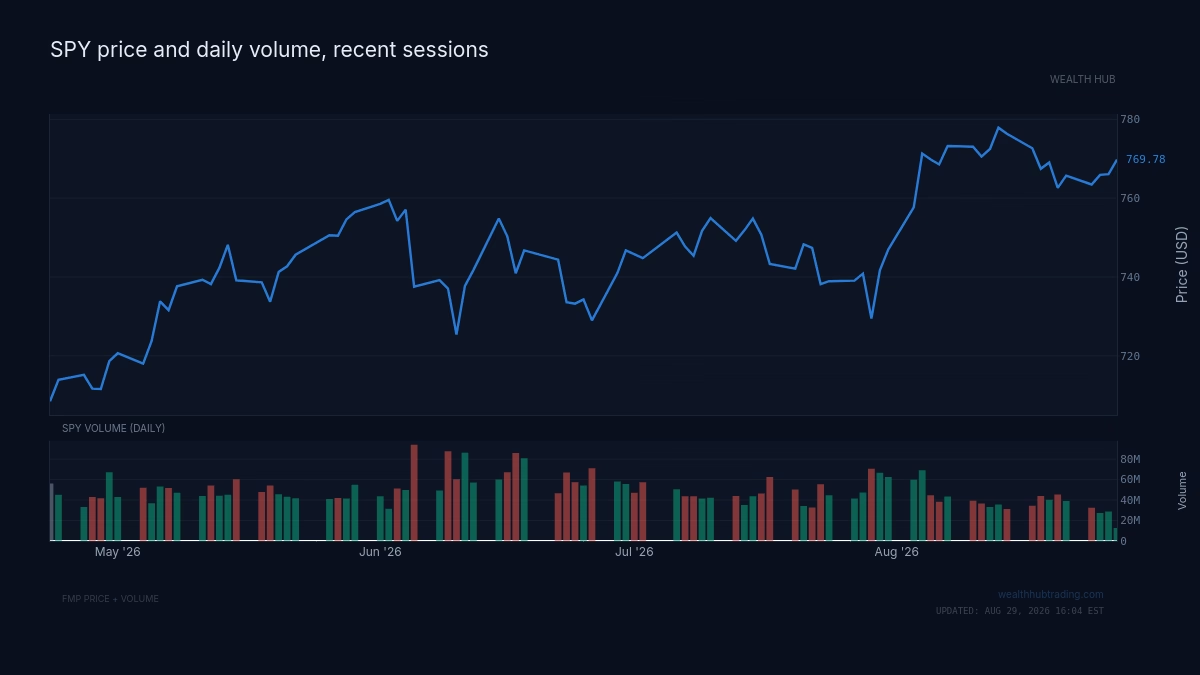
The clearest demonstration comes on index rebalancing days, when providers add or remove names from a benchmark. On those closes, funds tracking the index must buy the additions and sell the deletions at that day's official price. The imbalances in the affected stocks can run to tens of millions of shares, and the closing auction absorbs them in a single print. The event is entirely foreseeable from the published index changes days earlier, yet the volume still concentrates at the close, because that is the only price the mandated money is allowed to use.
What this means for you: the imbalance feed in the last few minutes is one of the few late-day signals that reflects obligation rather than opinion, and obligation is more predictable than opinion.
When the mechanism misleads
The auction is a clean mechanism, but reading it carelessly produces two mistakes.
The first is treating the imbalance as a market forecast. A large buy imbalance tells you the closing price must rise to clear the pool; it does not tell you the stock will keep rising tomorrow. Much of the pressure is a one-time flow, a fund putting new cash to work, and one-time flows do not repeat the next morning. Prices frequently give back part of a rebalance-driven move in the following sessions, once the forced buyer is done. The imbalance is information about the close, not a prediction about the future.
The second mistake is assuming the close is always the most liquid moment for every stock. For the largest, most heavily indexed names it usually is. For a thinly traded small-cap with little passive ownership, the closing auction may be shallow, and a large market order dropped into it can move the print sharply. The depth of the close is a function of how much mandated money must trade that specific name, and that varies enormously across the market.
What this means for you: the auction concentrates liquidity where index money concentrates, so its usefulness scales with how indexed a stock is, and its imbalance describes forced flow, not the next day's direction.
The one thing to remember
The close carries the volume because it is the day's only guaranteed single-price meeting, and the money that must trade at a benchmark has no choice but to meet there. That structural obligation is what makes the closing auction, and the imbalance that precedes it, a reading of forced demand rather than a reading of mood. Watch the last minutes not because they are dramatic, but because they are where the most disciplined money in the market is required to reveal its hand.