The impossible trinity is less a rule about exchange rates than a rule about where pain goes: when US yields rise, a pegged economy pays in its banking system and property market, a floating one pays in its currency and import prices, and a controlled one pays in the returns its own savers are denied. A crisis is what happens when a government claims to have skipped the bill.
Black Wednesday and the leg Britain pretended to keep
On 16 September 1992, the British government tried to hold three positions at once. Sterling was locked inside the European Exchange Rate Mechanism, a band against the Deutsche Mark. Capital moved freely across British borders. Ministers also insisted that interest rates would be set for British conditions, and Britain was in recession.
Germany, meanwhile, was running tight policy to contain the inflation that followed reunification. That put the Bundesbank, not the Bank of England, in charge of the floor under British rates. Speculators saw that the UK could keep the peg only by importing German-level rates into a weak economy, and they bet it would refuse.
The Bank of England raised its base rate from 10% to 12% that morning and announced a move to 15% for the next day. Neither held. By evening Britain had suspended ERM membership, and sterling fell roughly 15% against the Mark over the following weeks. The episode is usually told as a story about George Soros. The more useful reading is that markets simply forced Britain to admit which leg of the trinity it had already given up. It had chosen the peg and open capital on paper while acting as though it still had monetary independence, and the rate hikes proved it did not.
The trinity, stated plainly
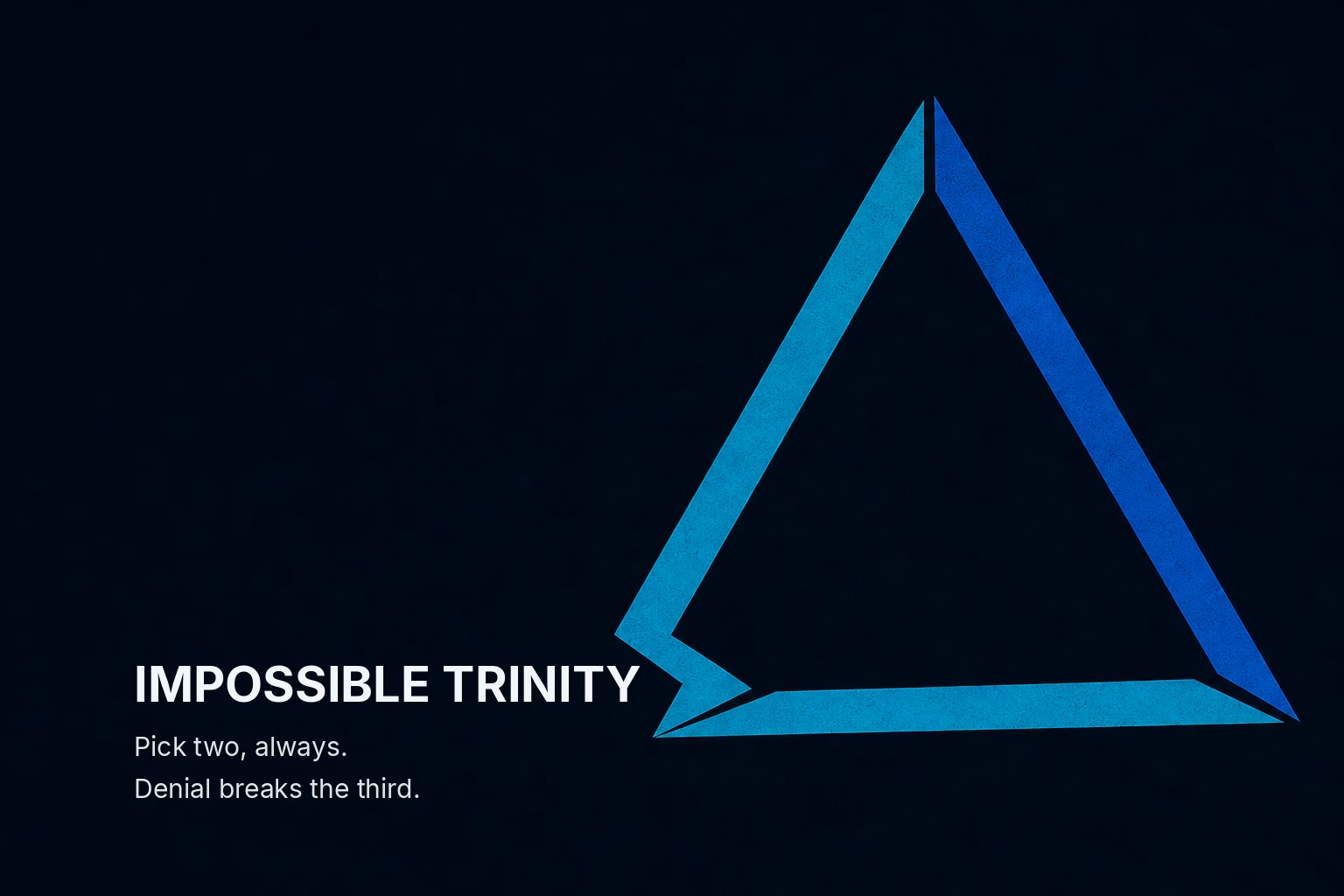
The impossible trinity, also called the trilemma, says a country can have at most two of three things: a fixed exchange rate (the currency is held at a set price against another), free capital mobility (money moves in and out without restriction), and independent monetary policy (the central bank sets interest rates for domestic conditions). Pick any two and the third is gone.
Why does this matter? Because the three choices are not equally visible. A peg is announced, capital rules are written in law, but monetary independence is a behavior, and governments can claim it long after they have lost it.
The logic runs through arbitrage. If capital is free and the exchange rate is fixed, a domestic interest rate below the anchor country's rate invites investors to borrow at home, convert, and hold the higher-yielding anchor currency. That sale of the local currency pressures the peg. The central bank defends it by buying its own currency with reserves, which removes local money from the banking system and pushes domestic rates up until the gap closes. The peg is defended, but the interest rate was set by the anchor, not by local conditions.
Run the same logic with a float instead and the currency absorbs the gap. Run it with capital controls and the arbitrage is blocked by law, so the rate gap can persist. Each pairing is internally consistent; the third leg is what you pay with. What this means for you: when you read a central bank's statement, first identify which two legs its regime actually has, because the third leg's promises are not worth pricing.
The economic mechanism: who enforces the trilemma
The trinity is not a mathematical identity. It is enforced by specific actors with specific incentives, and knowing them tells you when the rule bites hard and when it bends.
The first enforcer is the carry trader, anyone who borrows in a low-yielding currency to hold a higher-yielding one. Banks, hedge funds, corporate treasurers, and households shifting deposits all act this way when the spread is large and the currency risk looks small. A credible peg makes the currency risk look small, which is exactly why a peg with a rate gap attracts so much hot money.
The second enforcer is the central bank's balance sheet. Defending a peg means selling foreign reserves and buying back local currency. Reserves are finite. Markets watch them the way a lender watches a borrower's cash, and the attack accelerates as reserves fall, because each sale signals that the defense has a visible end date.
The third enforcer is the domestic banking system. When the central bank absorbs local currency to defend a peg, interbank liquidity shrinks and short-term rates rise. That is the transmission channel that turns a currency defense into a credit squeeze: mortgage rates reset higher, property valuations compress, and leveraged borrowers feel the anchor's policy whether or not their economy needed it.
Thailand in 1997 shows all three at work. The baht was pegged to a dollar-heavy basket, capital was open, and domestic lending had boomed on cheap foreign funding. When the carry reversed, the Bank of Thailand spent reserves defending the peg, much of it committed through forward contracts, until it floated the baht on 2 July 1997. The currency's collapse then hit every borrower who had taken dollar loans against baht income, which is why the crisis spread from the exchange rate into the banks within weeks.
What this means for you: the risk in a peg is rarely in the currency first. It shows up in reserves and interbank rates, and those are the gauges that move before the headline does.
A worked example: why a narrow band makes the carry almost free
Hong Kong is the clearest live case of a regime that chose its two legs honestly. The Hong Kong dollar is held between 7.75 and 7.85 per US dollar, capital is open, and the Hong Kong Monetary Authority gives up independent rates. Hong Kong interbank rates are pushed toward US rates by the mechanism above.
Put numbers on it. Suppose Hong Kong short rates sit 1 percentage point below comparable US rates. A trader borrows HK$7.85 billion, converts at the weak end of the band into US$1 billion, and earns the spread.
- Annual carry: 1% × US$1 billion = US$10 million
- Worst-case currency loss if the HKD strengthens to the strong end of the band: (7.85 − 7.75) / 7.85 = 1.27%, or about US$12.7 million
Break-even horizon = maximum band loss / annual carry = 1.27% / 1% ≈ 1.3 years
A trade whose worst plausible currency loss is recovered in about fifteen months of carry, with the weak-side boundary defended by the authority itself, is close to a one-way bet. That is why the gap never survives long. Capital flows out, the HKMA buys Hong Kong dollars at 7.85, the banking system's aggregate balance shrinks, and local rates rise toward US levels until the trade stops paying.
Now apply today's anchor. The US 10-year Treasury yield stood at 5.28% and the 2-year at 4.77% on 7 October 2026. A peg to the dollar means importing that rate structure regardless of local growth, property prices, or credit conditions. The cost does not appear in the exchange rate, which stays inside its band. It appears in mortgage resets and real estate valuations, the second-order assets that carry the bill for keeping the peg intact. What this means for you: in a credible dollar peg, the trade on a US rate shock is not the currency; it is the local banks and property names.
The live map: three regimes, three shock absorbers
The trinity gives three honest configurations, and each one is visible in the market today.
Fixed rate plus open capital, no independent policy. Hong Kong is the textbook case. Denmark is another, holding the krone close to the euro under ERM II and moving its policy rate with the European Central Bank. The shock absorber is the domestic credit market.
Open capital plus independent policy, floating currency. Japan, the United States, and most large economies sit here. The central bank sets rates for its own conditions, and the exchange rate moves to absorb the difference. When the Bank of Japan keeps rates far below US levels, the arbitrage that would break a peg instead lands in the yen, and the shock absorber is the currency itself, followed by import prices and Japanese households' purchasing power.
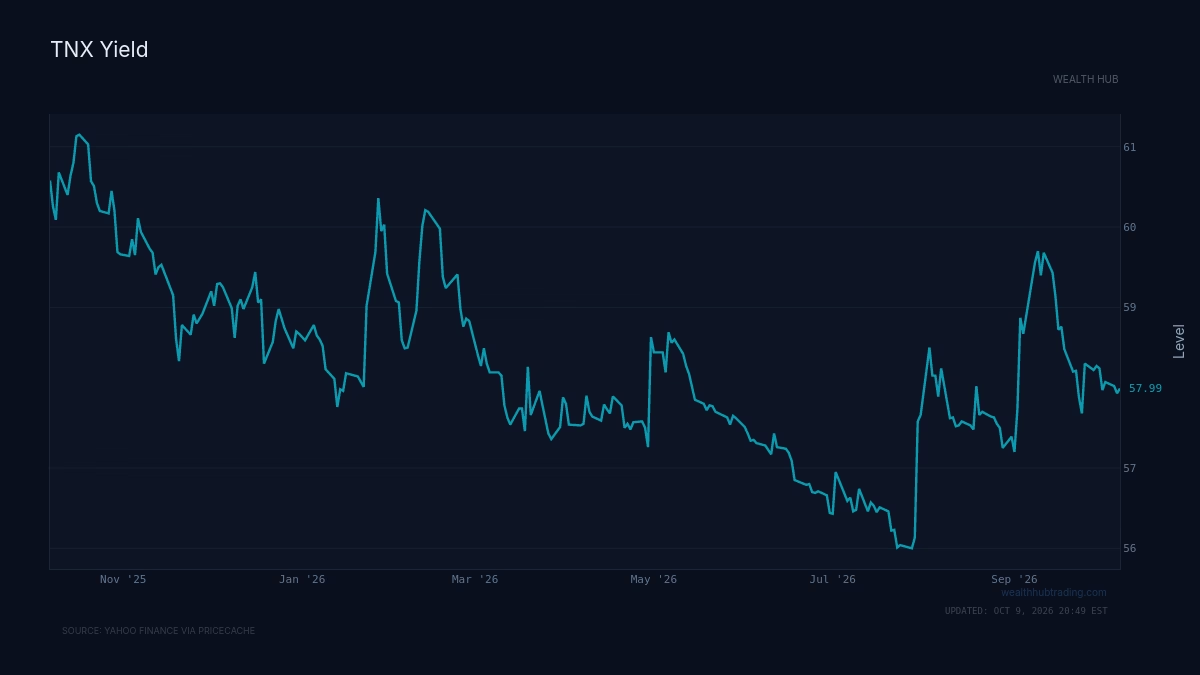
The chart pairs the US 10-year yield with the yen ETF over the trailing year. Read it as the floating-rate version of the Hong Kong worked example: the rate gap Japan declines to close shows up as yen weakness rather than as a reserve drain. Treat the precise co-movement as the chart's job, not a law; other forces move the yen too.
Independent policy plus a managed rate, restricted capital. China runs this configuration, managing the renminbi against a reference rate while limiting cross-border flows. Controls let the People's Bank of China cut rates without an immediate carry-driven currency collapse. The shock absorber is domestic savers, who are fenced into lower local returns, and the authorities' tolerance for gradual leakage through trade invoicing and other channels.
What this means for you: when US yields jump, check each country's regime before you decide what to watch. In Hong Kong, watch interbank rates. In Japan, watch the yen and import inflation. In China, watch the official fixing and signs of capital leaking around the fence.
Where the trinity bends and where it breaks
The trinity is often taught as three crisp corners, but most real regimes sit somewhere between them, and that middle ground is where both the subtlety and the danger lie.
The first failure of the clean version is leaky controls. Capital restrictions are rarely watertight. Exporters can delay converting receipts, importers can prepay, and multinationals can shift transfer prices. A government that relies on controls to protect monetary independence often finds the protection eroding precisely when the rate gap is widest, because that is when the incentive to evade is greatest.
The second failure is a peg that is defended until it is not. Switzerland held a floor of 1.20 francs per euro from 2011, then abandoned it without warning on 15 January 2015. The franc jumped sharply against the euro within minutes, and several currency brokers were wiped out by client losses. The lesson is uncomfortable: a peg's credibility is what makes the carry trade look safe, and that same credibility is what makes the break so violent when it comes.
The third failure is more recent and more structural. The economist Hélène Rey argued in 2013 that a global financial cycle, driven largely by US monetary policy and risk appetite, moves capital flows and credit across countries regardless of their exchange-rate regime. On this view the trilemma is often closer to a dilemma: with open capital, even a floating currency may not fully insulate domestic credit conditions from US rates. A float gives a central bank the right to set its own rate, but it does not guarantee that domestic borrowing costs will follow that rate rather than global ones.
None of this overturns the trinity. It sharpens it. The three-way choice describes what a regime can promise; the failure modes describe how far reality drifts from the promise under stress. What this means for you: treat a floating regime as partial insulation, not immunity, and treat any peg's stated band as a boundary that holds until the reserves or the politics run out.
Reading the next crisis before it reaches the headline
The mechanism in one sentence: with open capital, a country that fixes its currency imports the anchor's interest rates, a country that sets its own rates surrenders its currency, and a country that wants both must close its borders to money, so every regime routes a US rate shock into some asset.
The practical use is to stop asking whether a central bank will defend its currency or its rates, and start asking which asset its regime has already designated to take the hit. With US 2-year and 10-year yields at 4.