On the morning of September 17, 2019, the interest rate that banks charge each other to borrow cash overnight against Treasury collateral, the repo rate...
On the morning of September 17, 2019, the interest rate that banks charge each other to borrow cash overnight against Treasury collateral, the repo rate, jumped from roughly 2% to nearly 10% inside a few hours. Nothing had broken. No bank had failed. No crisis had been declared. The plumbing of the world's most liquid market simply seized, and the Federal Reserve, which had spent years believing the banking system held plenty of spare cash, was forced to inject billions in emergency loans to force the rate back down.
That single morning taught a lesson the Fed has been living with ever since: the level of reserves the system needs is invisible until you fall below it, and when you do, you find out fast.
What repo is and why the rate matters
The repurchase agreement, or repo, is the mechanism through which cash and Treasury securities trade places overnight. A firm holding a Treasury bond but needing cash sells the bond and agrees to buy it back the next day at a slightly higher price. The difference is effectively an overnight interest rate. This market moves hundreds of billions of dollars a day, and it is the funding layer beneath almost everything, from dealer inventories to leveraged bond positions.
When the repo rate is stable, it means cash is plentiful relative to the Treasuries that need funding. When it spikes, it means the opposite: too many parties are chasing too little available cash, and they bid the price of that cash upward until someone with spare reserves is tempted to lend.
For the reader, the takeaway is that the repo rate is a real-time gauge of cash scarcity in the banking system. A quiet repo market is a sign the plumbing is fine. A loud one is a warning that reserves have grown thin.
The two drains that met on one date
The September 2019 spike did not have a single cause. It had two ordinary events that happened to land on the same day, and the coincidence is the whole point.
The first drain was a corporate tax deadline. On quarterly tax dates, companies move large sums from their bank accounts to the Treasury's account at the Fed. When money leaves the banking system for the Treasury's account, bank reserves fall, because the Treasury's cash sits outside the commercial banking system entirely.
The second drain was the settlement of a large batch of newly issued Treasury securities. When dealers pay for the Treasuries they bought at auction, cash flows from their accounts to the Treasury, again pulling reserves out of the banking system on the same afternoon.
Neither event was unusual on its own. Tax dates happen every quarter. Treasury settlements happen constantly. What made September 17 different was that the two drains stacked, and they drained reserves that had already been quietly declining for two years as the Fed shrank its balance sheet. The system had been walking toward the edge without anyone knowing exactly where the edge was.
For the reader, this is the mechanism worth remembering: reserve scarcity is not caused by one dramatic event. It is caused by ordinary flows meeting a level of reserves that has fallen too low to absorb them.
Why intuition gets reserve scarcity wrong
Here is the place almost everyone, including the Fed at the time, misreads the mechanism. The natural assumption is that as reserves decline, the cost of overnight cash rises gradually, giving ample warning. Reserves fall a little, repo tightens a little, and the central bank has time to react before anything breaks.
That is not how it works. The relationship between the quantity of reserves and the price of overnight cash is not a smooth slope. It is closer to a hockey stick. Across a wide range, adding or removing reserves barely moves the repo rate at all, because there is comfortable slack. Then, at some threshold, the curve bends nearly vertical. A small further drop in reserves produces an enormous jump in the rate.
The problem is that no one can see the threshold in advance. "Ample" reserves and "scarce" reserves look identical from the outside right up until the moment the market prices the difference. The system gives no gradual signal because the gradual region is exactly the region where nothing appears to be wrong.
Think of it as the difference between a dimmer switch and a tripwire. Intuition expects a dimmer, where scarcity fades in slowly. The reality is a tripwire, where you feel nothing until you cross the line, and then everything happens at once. September 2019 was the tripwire being crossed in real time.
For the reader, the practical implication is direct: you cannot forecast a reserve shortage by watching reserves drift lower and assuming there is room. The only honest statement is that the floor is unknowable until it is touched.
What the Fed changed, and what remains true
After September 2019 the Fed stopped trying to guess where the threshold was and instead built a standing backstop. It resumed growing its balance sheet, and it eventually created a permanent facility, the Standing Repo Facility, that lets eligible firms borrow cash against Treasuries at a fixed rate whenever they want. The purpose is to put a hard ceiling on the repo rate so that a tax date and a settlement can never again stack into a 10% print.
This changed the market's behavior but not its underlying physics. The backstop does not tell anyone where scarcity begins. It only guarantees that when the system reaches the edge, there is a lender of last resort standing there to absorb the shock. The Fed has effectively conceded that it cannot know the ample level in advance, so it defends against the consequences of guessing wrong.
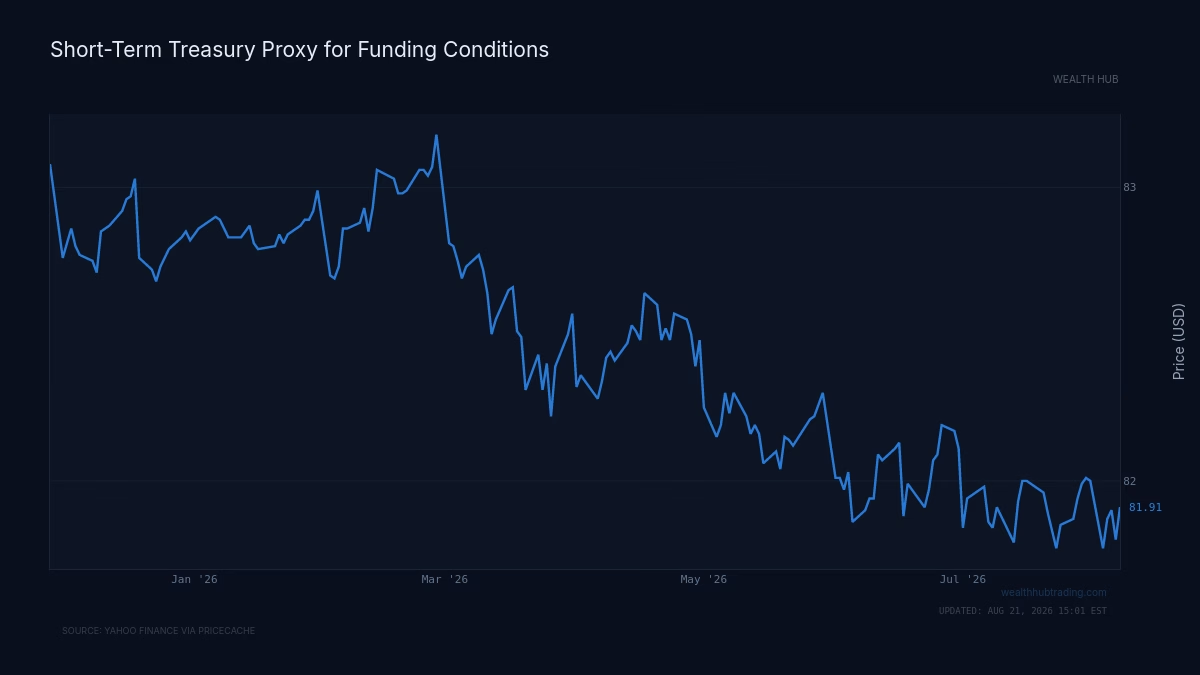
That distinction matters for how you read the market today. When the Fed shrinks its balance sheet, it is once again walking the system toward an unknown floor, and the repo rate, along with usage of the standing facility, is the instrument that reveals proximity to the edge. A rising cost of overnight cash and heavier reliance on the backstop are the signals that reserves are approaching scarcity, even when official commentary still calls them ample.
The mechanism in one sentence: bank reserves behave like slack in a rope, invisible until the rope goes taut, at which point the price of cash snaps upward with no warning. That is why the repo market, not the Fed's reassurances, is the honest reading of how much room the system actually has left.