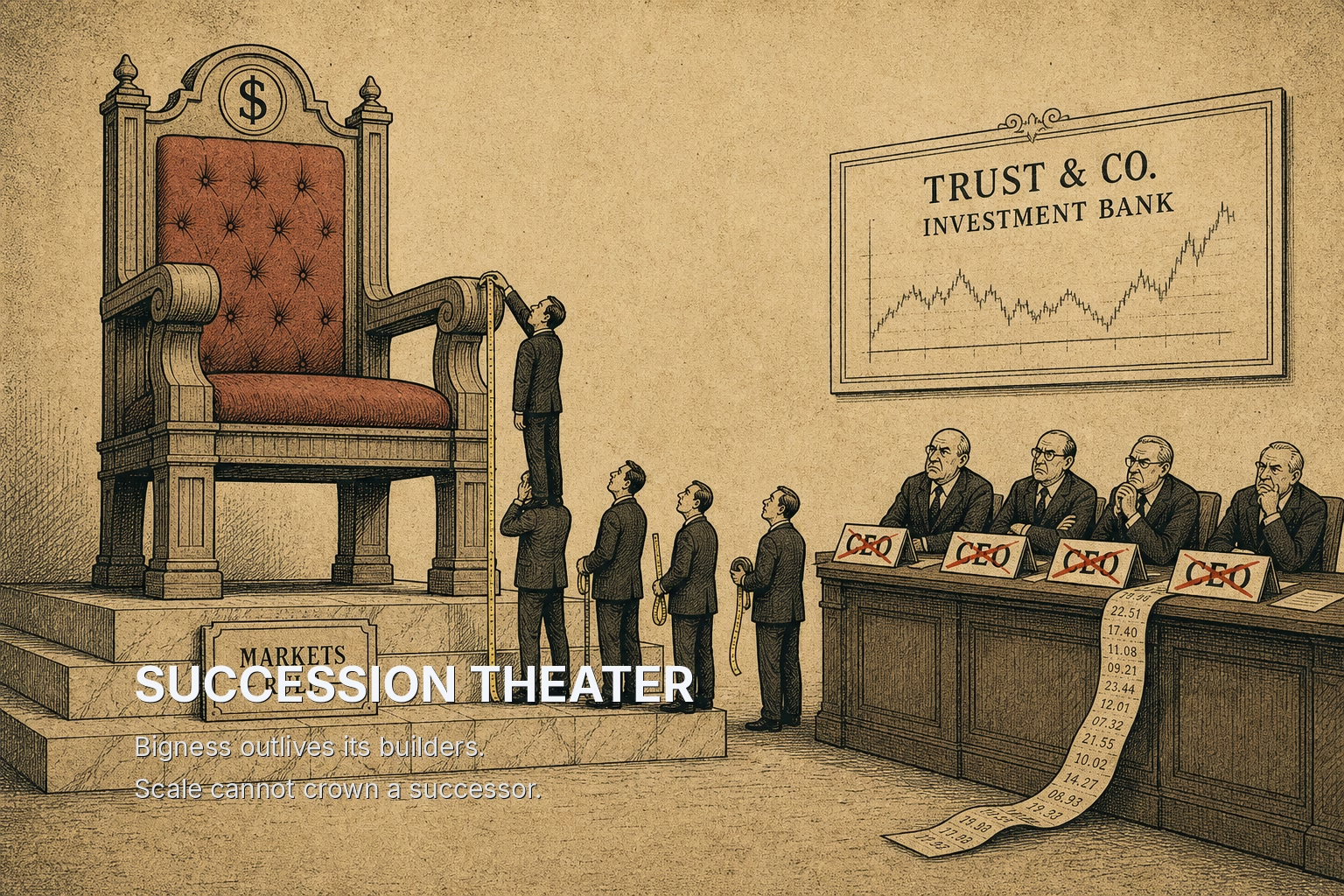
Jamie Dimon's list of the qualities his successor needs, twenty-odd virtues from grit to soul to the stamina for prime ministers, is the wrong document to read. The revealing document is the balance sheet he handed the person who must carry those virtues. The list describes a saint. The balance sheet describes a machine that no saint could operate, because the machine was not built to be operated by one person; it was built to be grown by one person, over twenty years, while he watched every seam.
That distinction is the whole thing. Consensus reads the succession story as a search for a rare individual. The problem is not that the individual is rare. The problem is that the institution has become legible to exactly one man, and legibility is not transferable.
Is this a people problem?
Read Dimon's list again and notice what it is doing. "You want to be good at management, you want to be good at people, you want to be analytical, you want to be detailed, you want to be a culture carrier." It reads like a wedding toast. Nobody objects to any single item. Nobody can meet all of them. That is the point of such lists; they are not job specifications, they are ritual acknowledgments that the job cannot be specified.
The consensus takes the list at face value and goes hunting for the mortal who scores high on all twenty axes. This is the first-level read: succession is a casting problem, and JPMorgan, the most valuable bank on earth, will simply hire the best actor.
The part consensus misses is that Dimon himself told you the disqualifying variable, and it wasn't a personality trait. It was the balance sheet. When he took over, JPMorgan carried $1.2 trillion in total assets. This past quarter it crossed $5 trillion, nearly five times larger. The annual report grew from 144 pages to 364. Headcount went from 168,847 to 320,560. The successor does not inherit the bank Dimon inherited. The successor inherits the bank Dimon built, and there is a difference between the two that no amount of grit closes.
What did Dimon actually accumulate?
He accumulated understanding, not just assets, and understanding is the asset that does not appear on any statement.
Consider the mechanism. JPMorgan carries $63.7 trillion in derivative notionals. The bank is right to caution that notionals overstate exposure; a $63.7 trillion figure is not $63.7 trillion at risk. But the Bank for International Settlements does not rank complexity by risk. It ranks it by three inputs: those derivative notionals, illiquid level-3 assets ($29 billion at the end of the first quarter), and trading and available-for-sale securities ($549 billion). On that measure JPMorgan is the most complex bank on the planet, ahead of Barclays, HSBC, BNP Paribas, and Goldman Sachs.
Level-3 assets are the tell. These are the positions with no observable market price, valued by model rather than by quote. Twenty-nine billion dollars of them. A model is only as trustworthy as the person who can explain why its inputs are the right inputs, and that person, at JPMorgan, learned the inputs one crisis at a time over twenty years. Chris Hohn tells the story of putting Credit Suisse's balance sheet in front of Brady Dougan before the financial crisis and asking to walk the line items. Dougan answered, "I don't either." An honest man, and the honesty was the whole warning.
Dimon can walk the line items. That is not a boast about intelligence; it is a description of tenure. He did not read the $5 trillion balance sheet cold. He watched each trillion arrive, absorbed each acquisition as it happened, sat through each quarter where a new business line was bolted onto the last. The knowledge is path-dependent. You cannot hand it over; you can only re-live it, and no successor has twenty years to re-live it before the next crisis.
Why is size the risk rather than the moat?
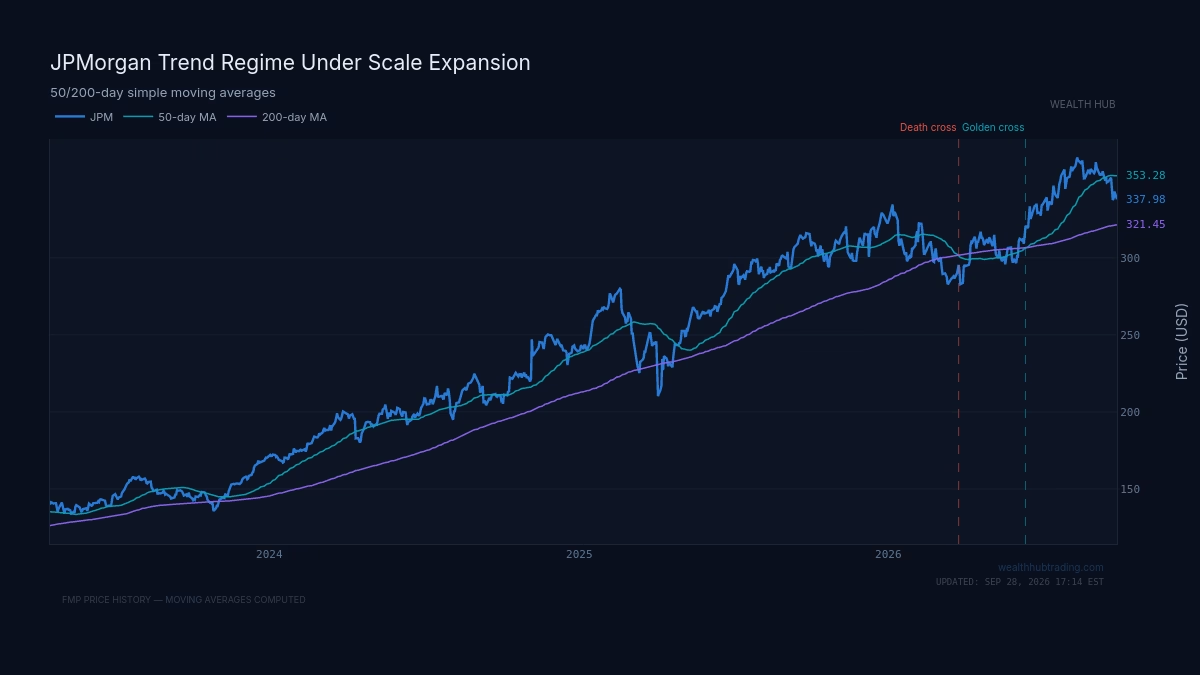
Because the thing that makes JPMorgan formidable in calm markets, its scale and integration, is the same thing that makes it illegible in a crisis, and crises are the only moments when legibility matters.
First-level thinking treats size as pure moat. The bigger the bank, the more diversified the revenue, the more able it is to absorb shocks that would kill a smaller institution. There is truth in this. JPMorgan came through 2008 and 2020 not merely intact but enlarged, hoovering up Bear Stearns and Washington Mutual and, later, First Republic. Scale bought optionality when everyone else was forced to sell.
The second-level question is different: what happens when the person who understands the integrated whole is replaced by someone who understands only the parts? A bank is not a portfolio of independent businesses whose risks you can sum. It is a network of positions that correlate in ways that only reveal themselves under stress. Dimon's edge was never that he could read the derivatives book or the level-3 marks or the securities portfolio in isolation. It was that he could hold the interactions in his head. That is the faculty that does not survive the handoff.
This is the recurrence worth naming. Every large financial institution that failed in the modern era failed not because its individual businesses were unsound but because no one at the top could see how the businesses combined until the combination detonated. Long-Term Capital Management held positions each of which looked hedged. Lehman's real-estate book looked like a slice of a diversified franchise. The failure mode is not bad assets; it is unmapped correlation, and the map lives in one person's tenure. When that person leaves, the map does not transfer to the plaque on the new office door.
Can the machine be made legible again?
Sometimes it can, if the institution deliberately trades scale for comprehensibility, but that is the one move the market will punish before it rewards, which is why it rarely happens until forced.
The honest answer is that I don't know whether JPMorgan will do it, and I would not bet on it. The incentives run the other way. A successor who spends year one simplifying the balance sheet, shrinking the derivatives book, exiting level-3 positions, shedding the businesses that add complexity faster than return, will report lower assets, lower fees, and a narrative of retreat. The share price will not thank them. The consensus rewards the growth that produced the illegibility and treats the cure as weakness.
Yet the alternative is a bank whose central risk-management asset is a 70-year-old man's memory of twenty years he cannot download. Dimon survived a heart scare and throat cancer, and the board is right to plan. But planning for succession is not the same as planning for the transfer of understanding, and the second is far harder than the first. You can name two lieutenants. You cannot name two decades.
Galbraith observed in his short history of financial euphoria that the memory of financial disaster lasts about twenty years, roughly the working span of one generation of decision-makers, after which the lessons are forgotten and the mistakes repeat. Dimon's tenure is almost exactly that span. He is the institutional memory of the last crisis. The successor arrives with the memory reset to zero, holding a list of virtues and a balance sheet neither of them fully authored together.
The list of qualities was never the hard part. Grit and soul and the stamina for operating centers can be found. What cannot be found on short notice is a person who watched $5 trillion accumulate one decision at a time. The bank did not get too big to fail. It got too big for its next steward to understand in time.