The most liquid hour in the U.S. Treasury market is no longer set by the Treasury, by the Fed, or by anything happening in the economy. It is set by an ...
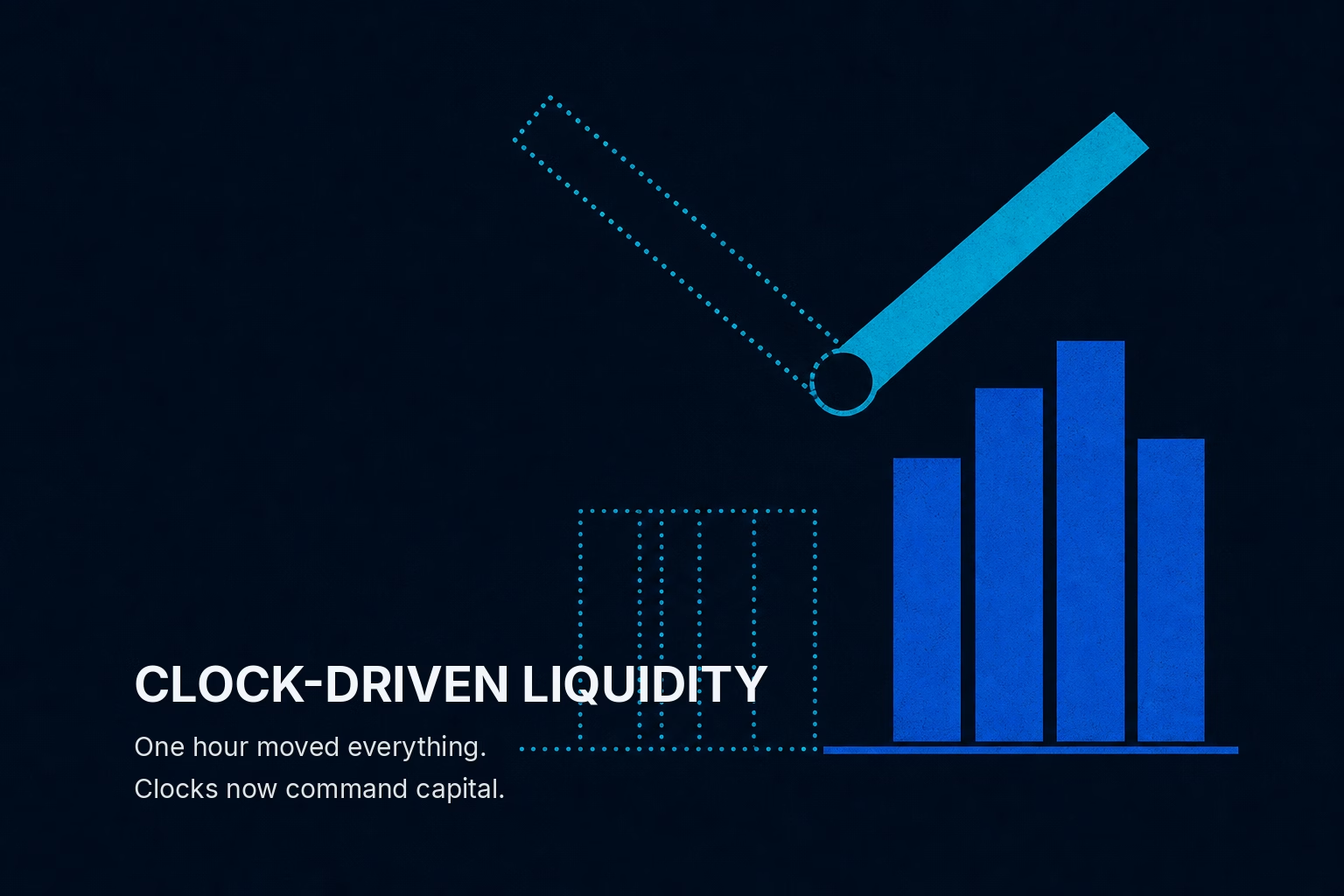
When Bloomberg moved the strike time for its dollar-denominated fixed-income indexes from 3 p.m. to 4 p.m. Eastern in January 2021, the concentration of interdealer trading followed almost immediately, draining volume out of the 3 p.m. window and stacking it into the 4 p.m. window instead. That is the whole story, and it is stranger than it sounds: the market's busiest minutes now track an administrative convention rather than any fundamental event.
The intuitive reading gets this backwards. Most people assume trading clusters at the close because that is when new information has fully arrived and participants want to act on the day's complete picture. In equities that framing is roughly right, because the exchange mandates a closing auction and the closing price is a real, contested, discovered number. The Treasury market has no such mechanism. It is over-the-counter, it trades around the clock across venues, and there is no exchange-appointed moment when the day officially ends. The clustering therefore cannot be explained by information arrival. It is explained by index construction.
Why the Close Exists at All in an OTC Market
The reason a "close" exists in Treasuries is that trillions of dollars are managed against fixed-income benchmarks, and those benchmarks have to be struck at some price at some time. Index providers hold the discretion equities never grant a single actor: they choose the strike time. Historically that was 3 p.m., a convention inherited from the era when open-outcry Treasury futures stopped trading at 3 p.m. and mutual funds needed a lead time before their 4 p.m. net-asset-value calculation.
That 3 p.m. anchor was already pulling volume toward it well before 2021. The share of daily trading volume executed in the ten minutes around 3 p.m. climbed from an average of 2.3 percent in 2016 to 3.4 percent in 2020. On the last trading day of the month, when indexes rebalance, the effect was far larger: the 3 p.m. window carried 8.1 percent of the day's volume in 2016, rising to 12.1 percent by 2020. The mechanism was already visible. What January 2021 provided was a clean natural experiment to prove it.
The One-Hour Shift That Moved the Liquidity
When Bloomberg Barclays, one of the largest fixed-income index providers, moved its strike from 3 p.m. to 4 p.m. on January 14, 2021, the 3 p.m. share of volume plunged and the 4 p.m. share surged. The 4 p.m. window, which had itself been building from 2016 to 2020, went on to climb from an average of 2.5 percent in 2021 to 3.5 percent in 2025. Traders did not migrate because 4 p.m. became a more informative moment. Nothing about the economy or the auction cycle changed on January 14, 2021. They migrated because that is where the benchmark now got priced, and being priced at the benchmark is the entire point for anyone managing tracking error.
This is the mechanism stated plainly: index-tracking capital must transact at or very near the price its benchmark uses, because any deviation between the fund's execution price and the index strike shows up as tracking error. When the strike moves, the demand to transact at that instant moves with it. The liquidity is not chasing information. It is chasing the reference price. One report on the change cited exactly this motive, that funds required to price portfolios at 4 p.m. were carrying avoidable tracking error against a 3 p.m. index strike.
The month-end amplification is the tell that confirms the read. If the clustering were about information, month-end days would not be dramatically different from any other day, because macroeconomic news does not preferentially arrive on the last calendar trading day. But month-end is precisely when index rebalancing forces the largest volume of benchmark-referenced transactions, and that is exactly when the concentration around the strike is most extreme. The pattern lines up with the rebalancing calendar, not the news calendar. 
Where the Read Could Be Wrong
The honest counterargument is that correlation around a strike time does not, by itself, prove that index rebalancing is the driver rather than a coincident cause. Dealers hedge futures positions, options expire, and end-of-day risk management naturally pushes some activity toward the afternoon regardless of any index. A skeptic could argue the 4 p.m. surge reflects a broader migration of afternoon liquidity that would have happened anyway.
The Bloomberg strike change is what defeats that objection. A general migration of afternoon liquidity would not produce a sharp, dated reallocation from one specific ten-minute window to another specific ten-minute window on the exact day a single index provider changed its convention. The abruptness and the timing are difficult to reconcile with any explanation other than benchmark-referenced flow. The volume did not diffuse across the afternoon. It jumped one hour, on schedule, to the new strike.
What the evidence does not settle is magnitude attribution. These figures come from the on-the-run interdealer market as observed on one major platform, which is a clean but partial view of total Treasury activity. The share concentrated in the strike windows is real and rising, but the dataset cannot tell us how much of the entire market's benchmark-driven flow is captured here versus executed elsewhere, in off-the-run issues, or through other venues. The direction of the finding is secure; the full size of the effect is not.
What This Changes for Anyone Trading the Afternoon
The practical consequence is that the deepest, most reliable liquidity of the Treasury day has a schedule, and that schedule is administrative rather than economic. Execution around 4 p.m., especially at month-end, benefits from the crowding: more counterparties, tighter effective spreads, and the market liquidity improvement documented alongside the earlier month-end concentration work. That is a genuine benefit for anyone who needs to move size and can time it to the strike.
The corresponding risk is fragility around a coordinated moment. When a large share of the day's flow compresses into ten minutes for reasons unrelated to price discovery, that window becomes structurally sensitive to any disruption in the plumbing, from a venue outage to a rebalancing shock, precisely when the most capital is trying to transact at once. The concentration that supplies the liquidity is the same concentration that concentrates the risk.
The condition that would change this reading is straightforward and observable: watch the next strike-time change by a major index provider. If another large benchmark moves its clock and interdealer volume once again reallocates to the new window on the announced date, the mechanism is confirmed beyond reasonable dispute. If the volume stays put after such a move, the index-driven explanation would need serious revision. Until then, the cleaner reading is that in the Treasury market the close is not a moment of discovery. It is a scheduled appointment, and everyone is required to show up.