Investment-grade AI chip financing is being underwritten on the wrong risk. The rating attaches to the lessee. The loss, if one comes, attaches to the silicon. The likeliest failure is not a wave of defaults but a liquidity gap: the vendors and sponsors now financing chip demand are also the only natural market-makers in the paper that demand creates. Equity investors read Broadcom's $42 billion loan to Anthropic and Nvidia's offer to backstop $125 billion of buyer debt as proof that demand is real. A credit desk reads the same facts differently. The suppliers have become the dealers, and that is the configuration that took down the junk market in 1990. Bad paper did not do it.
Patrick Feeley's Substack essay frames this week's deals through Michael Milken. The comparison is sharper than it first appears, because Milken's own record argues against the trade now being sold. His central lesson, drawn from W. Braddock Hickman's 1958 study of corporate bonds from 1900 to 1943, was that ratings and risk are different things. Hickman showed the market overpriced the risk of lower-rated paper. The AI chip trade may be making the mirror-image error: underpricing the risk of paper that carries a borrowed high rating.
The Rating Belongs to the Lessee
Start with the cleanest structure on the tape. According to the Financial Times on October 2, Amazon is marketing a special purpose vehicle that would own roughly $8 billion of installed Nvidia Grace Blackwell chips, borrow against them, and lease them back to Amazon. Buyers expect the debt to price investment grade on the strength of Amazon's double-A. That rating opens the deal to insurers and pension funds.
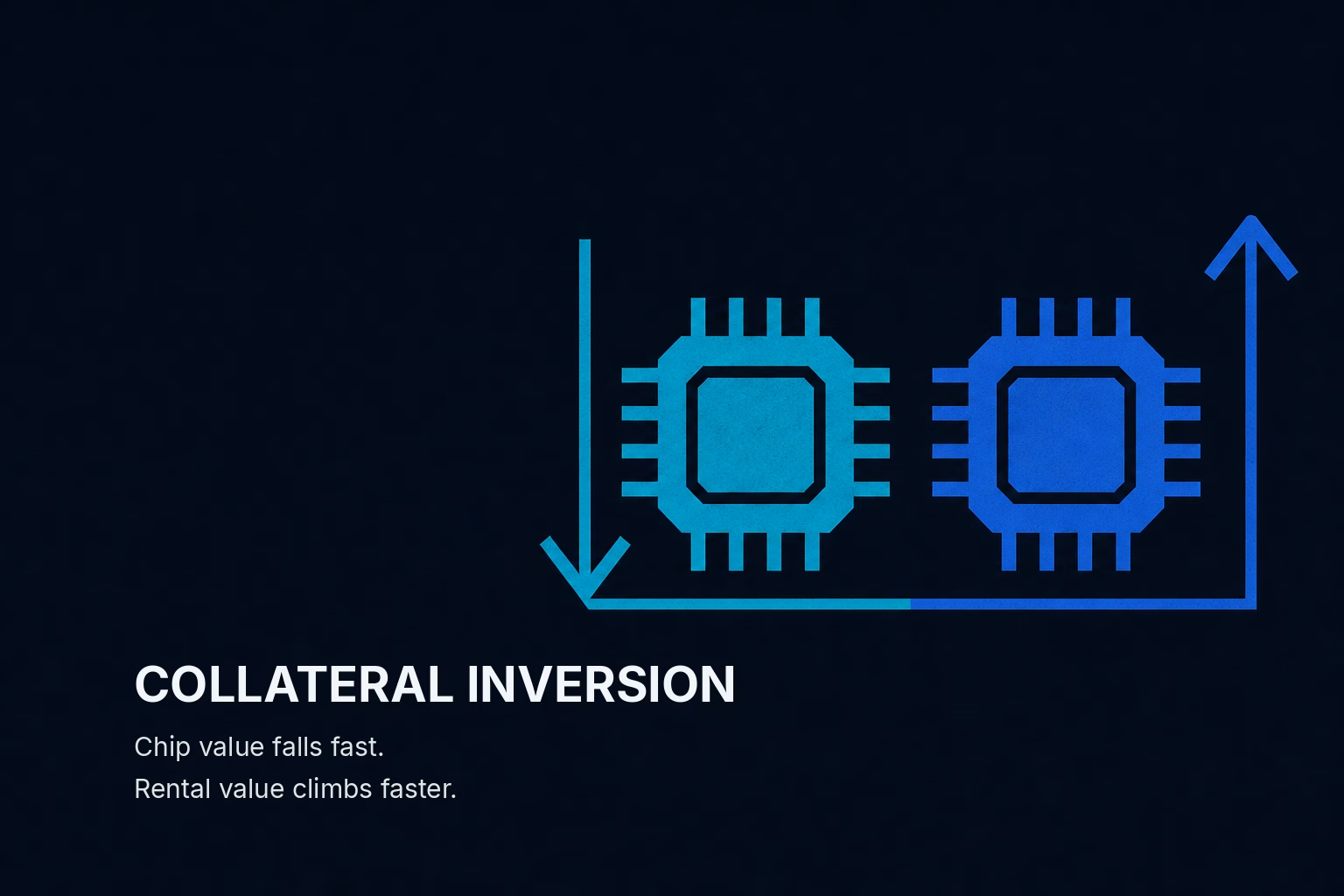
Decompose the bond and it splits into two legs. The first is Amazon credit, because the lease payments are what service the coupon. That leg is liquid and easy to price against Amazon's own curve. The second is a residual claim on what a Blackwell-generation GPU is worth when the lease ends or is not renewed. Nobody can hedge that leg cleanly, because there is no meaningful forward market in used accelerators. The FT ran Amazon's claim of at least five years of useful life in the same story that noted Vera Rubin will soon supersede Grace Blackwell.
The pricing test follows. If the spread over Amazon's senior unsecured curve is thin, the buyer is being paid for Amazon risk and is writing the collateral option for free. The rating cannot tell you whether that happened, because it was never assessing the chips. The Meta-linked Hyperion financing shows the pattern most explicitly. It raised $27.3 billion through Blue Owl's Beignet vehicle at 6.581%, rated A+, one notch below Meta, and stayed off Meta's balance sheet. A one-notch gap tells you the agencies treated the vehicle largely as Meta. Whether 6.581% compensates for anything beyond Meta depends on where Meta's own comparable debt traded at pricing, and that comparison has not been made public in the reporting.
Debt That Outlives Its Collateral
The second structural problem is duration. CoreWeave closed a $2.6 billion loan in August with a maturity of roughly five years, secured against customer contracts averaging about three. The lenders described themselves as comfortable underwriting renewal risk. That is an honest description of what they bought, and it is not a term loan. It is a fixed coupon on top of a bet about what hyperscaler and model-lab demand for a specific chip generation looks like two years after its successor ships.
Useful-life assumptions are moving in only one direction. Amazon cut the depreciable life of some servers from six years to five in 2025, and short sellers are arguing the true economic life of current accelerators is shorter. The precise number is unknowable today. The asymmetry is not. The coupon is fixed, the collateral value floats, and the gap between them belongs to the lender whenever recovery depends on the asset.
Rates make the mismatch more expensive to carry. The 10-year Treasury closed at 5.24% on October 1, with the 2-year at 4.78% and a 2s10s spread of +0.46%, per Treasury data. That is a positively sloped curve with a long end above 5%, which means term funding is costlier than front-end funding. Five-year debt against three-year contracts is exactly where a lender takes that term premium on the chin. Any lessor that priced its book when the 10-year sat in the 4s is now refinancing into a higher floor, against collateral that has aged a generation.
Insurers on the Far Side, Again
The detail from the Milken era that matters most is about the buyer, not the issuer. GAO figures cited in the essay put insurers at more than 30% of junk bonds outstanding in 1987. Executive Life, seized by California regulators in April 1991, held 62.7% of its general account in junk. That institution had long liabilities, a capital charge set by the rating rather than the asset, and a board that believed it owned bonds.
The 2026 marginal buyer has a similar profile. Investment-grade chip vehicles are built to clear insurer and pension mandates. They look like corporate bonds on a capital schedule and behave partly like equipment leases in a workout. Concentration is already visible. Pimco reportedly took about $18 billion of the Hyperion deal, roughly two thirds of a single issue in one manager's hands. Cliff Asness's line covers the tranching argument: the lion does not care whether the ostrich is first loss. The Broadcom-related financing Bloomberg described, $42 billion senior and $18 billion junior with Blackstone leading the junior piece, reallocates who absorbs a collateral shortfall. It does not shrink the shortfall.
Scale turns this from a niche concern into a portfolio-level one. JPMorgan expects $4.1 trillion of AI-related debt issuance through 2030. The entire public junk market Drexel built peaked at roughly $200 billion. Even a modest residual-value error, spread across that much paper sitting in rating-driven balance sheets, would drive capital charges well before it drove defaults.
When the Supplier Is the Dealer
This is where the credit read and the equity read diverge most sharply. Drexel filed for bankruptcy on February 13, 1990, after defaulting on roughly $100 million of loans. The Los Angeles Times described the cause as a staggering liquidity problem. Most issuers were sound and most of the paper performed. What vanished was the one institution that consistently took the other side of trades, and the market seized because of that absence.
Map that onto the current structure. Broadcom lends to Anthropic so Anthropic can lease TPUs Broadcom helps design, and Anthropic's own filing flags the conflict of interest and warns that certain defaults could accelerate "a substantial portion of its lease obligations." Nvidia's August platform with Apollo, BlackRock, Blackstone, Brookfield, Goldman Sachs and KKR targets more than $500 billion of outside capital, with Nvidia holding an option to backstop $125 billion. Several of those sponsors also appear in the Broadcom financing. Each deal is defensible alone. Together, they mean the suppliers and a small club of private-credit sponsors are both originators and the deepest pockets for secondary liquidity.
Equity holders tend to read vendor financing as a demand signal. In credit, vendor financing often signals that third-party capital will not take the whole risk at the price the vendor needs. That pattern does not hold in every case: sometimes vendor financing is simply efficient balance-sheet use by a cash-rich supplier. The question for a bondholder is narrower and harder. If one large sponsor decides to sit out a quarter, who bids for GPU-backed paper? Today the honest answer appears to be the same handful of institutions, and the Anthropic IPO, which people close to it have floated at up to $2 trillion, would pull public equity into that circle without adding an independent dealer.
The Strongest Case Against the Worry
The countercase deserves full weight, because it is strong at the top of the stack. Counterparties with contracts from Amazon, Meta or Anthropic have absorbed every rate increase so far. One executive put it to CNBC bluntly: if you have a deal with Anthropic, 50 basis points will not stop you. Demand for compute is not speculative in the way 1980s takeover leverage sometimes was. The chips will almost certainly be used, and for the double-A-backed leasebacks, the lessee's credit genuinely does carry the bond for as long as the lease runs.
That argument is largely correct for the senior, hyperscaler-wrapped tranches. It is weakest exactly where the residual-value and refinancing risks concentrate: the smaller neoclouds that lenders are already turning away, second-tier chip lessors without investment-grade anchors, and junior tranches whose recovery depends on the hardware rather than the guarantor. Credit cycles frequently begin in that layer, two tiers below the names on the headlines. A further point cuts against the bull case even at the top. Anthropic is committing $100 million to train 10,000 engineers to deploy its models inside customers. A model company paying out of pocket to close the adoption gap suggests the bottleneck sits on the demand side, with people, while the debt is financing supply.
Milken himself supplies the deepest objection to the structure. He argued technology should finance growth primarily with equity, and that when business risk is rising, even a dollar of debt can be too much. A rapidly obsolescing asset class financed with fixed-rate, long-dated debt is close to the case he warned against.
What Would Change the Read
The thesis is falsifiable, and the evidence will arrive in credit markets before it shows up in chip-maker earnings. Three observations would confirm it. First, new-issue concessions widening on non-hyperscaler GPU deals while hyperscaler-wrapped paper holds, which would show the market finally pricing the collateral leg separately. Second, any sponsor in the Nvidia or Broadcom circles declining to anchor a deal, followed by weaker execution on that deal, which would expose the dealer problem directly. Third, lease rates on Blackwell-generation capacity falling as Rubin ships, because that sets the recovery value every five-year lender is quietly assuming.
The read breaks if a genuine secondary market for used accelerators emerges with observable forward prices, or if GPU-backed paper starts trading actively among buyers outside the originating club. Either would turn the residual from an unpriced option into a hedgeable exposure and give the market a dealer that is not also the vendor. Until then, a meaningful share of this week's buyers own Amazon or Meta credit with used-chip risk attached, inside a market whose liquidity providers are also its sellers. The spread should pay for both. The structures do not yet show that it does.