The interesting claim in a list of fifty "AI losers" is not which names are on it. It is the underlying mechanism that binds a tutoring company, a call center operator, a travel aggregator, and a mid-tier software vendor into the same trade. The mechanism is margin compression through substitution, and the place intuition gets it wrong is timing. Investors assume disruption arrives as a collapse in revenue. It usually arrives first as a collapse in pricing power, while revenue still looks fine.
The Cost Curve Moves Before The Revenue Line
Consider what The Bear Cave is actually screening for: businesses "deteriorating at a reasonable price." That phrasing matters. A business that is already cratering trades cheap because everyone can see it. The screen is aimed at names where the income statement has not yet caught up to the technology, so the multiple still reflects the old economics.
The clearest case is customer service. Decagon raised $250 million at a $4.5 billion valuation in January 2026 to build AI customer support, and added more than 100 enterprise customers in a year, including Avis Budget Group, Block, and Deutsche Telekom. Parloa raised $350 million at a $3 billion valuation the same month. Wonderful AI took $150 million at a $2 billion valuation in March 2026. These are not science projects. They are funded specifically to automate the exact interactions that business process outsourcers charge by the seat to handle.
The mechanism here is not that AI fires every human agent overnight. It is that AI resets the reference price for a resolved customer ticket. Once an enterprise buyer has a quote from an AI vendor at a fraction of the per-interaction cost, the incumbent BPO cannot hold its rate card. Volume can stay flat while price per unit falls. That is margin compression, and it hits operating income long before it shows up as a revenue cliff.
Why The Non-Obvious Names Are The Real Trade
The report concedes that "some are obvious AI losers; many are not." The obvious ones, call centers, low-end tutoring, are already priced for trouble. The alpha, if there is any, sits in the non-obvious names: web traffic monetization, travel, software.
Take web traffic monetization. The threat is not a competitor; it is disintermediation of the click itself. When an AI assistant answers a query directly, the user never lands on the page that carries the ad or the affiliate link. The business can retain its content, its brand, and its audience metrics for a while, and still watch the monetizable event, the click through, quietly disappear. Travel aggregators face a version of the same problem: the value they captured was assembling and comparing options, and that assembly is precisely what a language model does for free.
The software names are the hardest to read, because software is supposed to be the winner in an AI wave. But a large share of mid-market software earns its keep by being the system of record for a workflow that was tedious to do by hand. If the workflow itself gets automated end to end, the tool that organized the manual version loses its reason to exist. The moat was the friction, and AI removes friction.
The Substitution Channel, Stated Plainly
Strip away the sector labels and the same three conditions define every genuine loser on a list like this: A name that fails any one of these is probably safe. High-touch services with genuine relationship lock-in survive because condition two breaks. Businesses with variable, low-cost delivery survive because condition three breaks; they can cut price and keep margin. The dangerous quadrant is the company selling standardized information work into a price-sensitive buyer while carrying a fixed human cost base. That is the profile the screen is really hunting.
What Would Break This Read
The thesis has a clear failure mode, and it is worth stating fairly. AI substitution has repeatedly underdelivered against its own hype on the timeline that matters for a short. Enterprise adoption is slow, procurement is conservative, and regulated or reputation-sensitive interactions, the kind where a hallucinated answer creates real liability, keep humans in the loop far longer than a demo suggests. A BPO that looks doomed on a spreadsheet can hold its contracts for years because its clients are more afraid of an AI mistake than of the invoice.
There is a second, subtler counterargument. Incumbents are not passive. The same technology that threatens a call center's pricing also lets it deliver the service at radically lower cost. If the incumbent adopts the AI stack faster than its price erodes, disruption becomes margin expansion rather than margin collapse. When a disruptor rebuilds the very thing it disrupted, the market has sometimes already decided the moat was leaking, but the outcome is not guaranteed either way; several past disruptions ended with the incumbent absorbing the tool.
The list also carries an ownership signal worth noting without overreading it: The Bear Cave is now owned by Hunterbrook Media, whose affiliate states no positions related to this article at publication. That is context, not a causal tell.
The Condition That Confirms The Trade
The read resolves on one observable, and it is not revenue. Watch gross and operating margins in the affected names, quarter over quarter, against roughly flat top-line growth. Margin erosion on stable revenue is the signature of price compression from substitution, and it is the earliest hard evidence that the moat is being repriced rather than merely questioned. If margins hold while AI vendors keep raising at the valuations Decagon and Parloa just printed, the incumbents are adapting and the short thesis is wrong. If margins slip while revenue looks calm, the deterioration the screen is betting on has begun, and the market has not yet finished discounting it.
Because these fifty names span sectors with no clean traded proxy, the honest way to watch the theme at the index level is the broad software complex, where multiple compression from an AI reset would show up first.
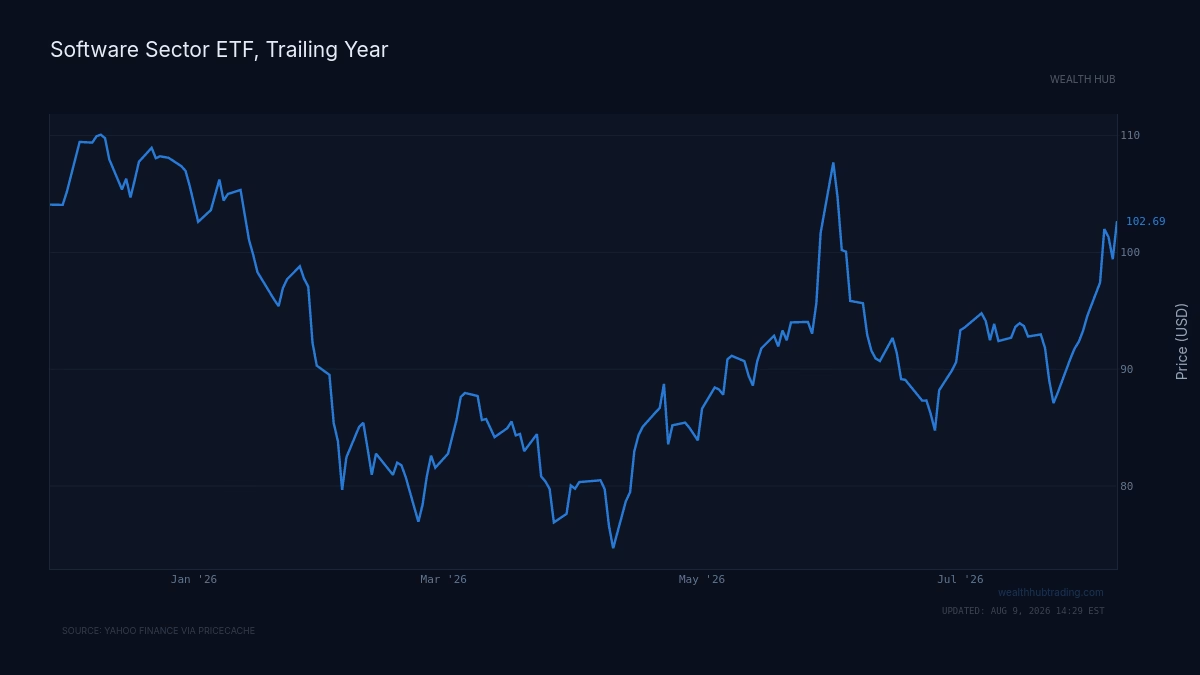
IGV over the thesis window.
The trade, if it is one, is a bet on the sequence: price before volume, margin before revenue, and disclosure before decline. Get the sequence right and the "reasonable price" in the report's own framing is the whole point. Get it wrong on timing, and a cheap deteriorating business simply stays cheap while its clients keep signing renewals.