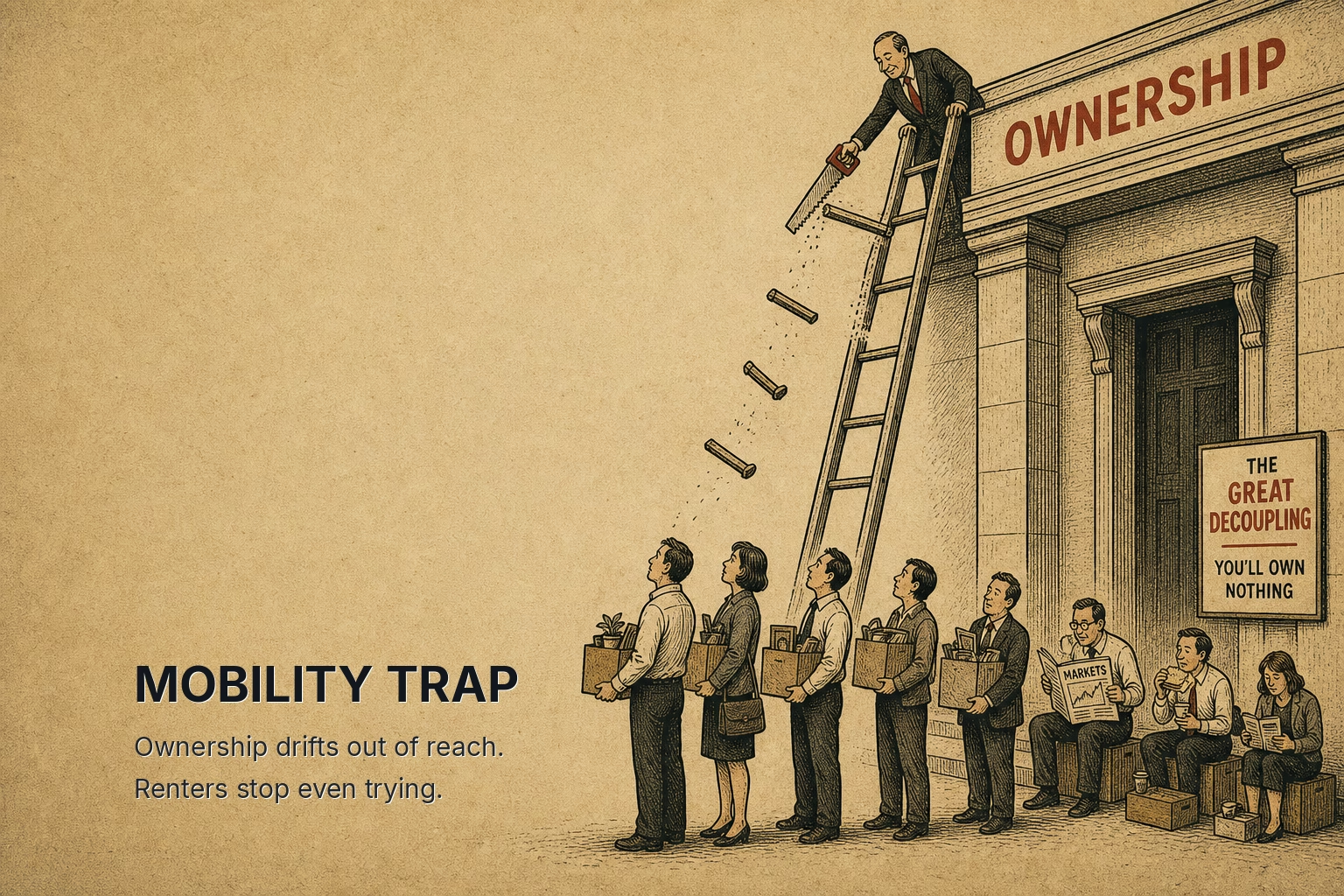
When the New York Fed's housing survey reported in early 2026 that renters put their odds of moving within three years at roughly 37 percent, down from about 57 percent in 2014, the number read as a curiosity about American restlessness fading. It is something more specific than that. The renters who no longer expect to move are, almost exactly, the renters who no longer expect to buy. Expected homeownership among renters fell from around 52 percent in 2015 to about 35 percent by 2025, and the two curves bend together because they describe the same thing: a household that has quietly concluded the next rung is out of reach stops planning to climb.
That is worth sitting with before reaching for the usual explanations about remote work or an aging population. The interesting fact in the data is the spread across the distribution. Renters who rate their chance of ever owning a home at 20 percent or below report a three-year moving probability of about 25 percent. Renters nearly certain they will own put their moving odds near 76 percent. More than fifty points separate the two. Mobility, in other words, is not primarily an expression of preference. It is a function of whether the household still believes the ladder exists.
The pattern is older than the survey
The instinct to read declining mobility as a lifestyle shift misses what the pattern actually belongs to. When ownership drifts out of reach for a widening share of households, mobility falls not because people want to stay but because staying is the only move the price structure allows. This dynamic has appeared in several forms, and the American renter of 2026 is standing inside a familiar mechanism rather than an unprecedented one.
The clearest recent analog sits on the other side of the tenure line. American homeowners after 2021 became famously immobile, and the cause was mechanical rather than cultural. Households that had locked thirty-year mortgages near 3 percent faced a market where the 10-year Treasury sat at 4.63 percent by August 2026 and mortgage rates ran well above that. Moving meant surrendering a below-market rate and financing the next house at prevailing cost. The rational response was to stay, and homeowners' expected three-year mobility fell from about 21 percent in 2014 to roughly 14 percent by 2026. Nobody described this as a fading taste for new neighborhoods. It was understood immediately as a price-lock, a financial trap dressed as a preference.
The renter decline is the same trap seen from below. The homeowner is locked in by the rate on the mortgage he already holds. The renter is locked out by the rate and price on the mortgage he cannot get. Both are responding to the gap between the cost of their current housing and the cost of the housing they would move into, and in both cases the gap has widened until the rational choice is to not move. The survey shows the renter version accelerating after 2021, precisely when the homeowner lock-in was hardening, because both are downstream of the same shift in financing costs and price levels.
Britain built the same loop by design
The deeper historical rhyme runs through the United Kingdom of the 1990s and 2000s. British house prices rose across two decades faster than incomes, and the share of younger adults who owned their homes fell sharply through the 2000s. The word that entered common use was not "immobile." It was "trapped." A generation of renters watched the deposit required for a first purchase climb faster than they could save, and the response was observable in behavior: fewer household formations, longer tenancies, adults in their thirties still renting in arrangements that a prior cohort would have exited by twenty-five.
What made the British case instructive was the feedback loop it exposed. As the probability of ever buying fell, the renters affected reorganized their lives around permanence in the rental market rather than transition out of it. They stopped treating the current flat as a way station. And a household that has stopped treating its home as temporary stops moving for the reasons renters historically moved, which is to say, in pursuit of a purchase, a better neighborhood tied to a purchase, or a job in a market where a purchase seemed reachable. The expectation of ownership was the engine of mobility. When it stalled, mobility stalled with it, and no amount of survey questioning about "preferences" could disentangle the two, because the preference and the constraint had fused.
The American data now shows the fused version. When the survey authors ask whether renters simply want to own less than they once did, they are asking a question the British episode already answered: by the time you can measure the preference, the constraint has already reshaped it. A renter who has spent five years watching the deposit recede does not report enthusiasm for a purchase he has priced as impossible. The stated preference adjusts to the perceived constraint, which is exactly why declining "desire" to own is a poor place to look for the cause.
Japan and the immobility of foreclosed expectations
A third instance, further afield and further back, sharpens the mechanism. Japan after its early-1990s asset collapse spent a long stretch with housing that was, on paper, more affordable than it had been at the bubble's peak, and yet household mobility and new formation stayed depressed for years. The prices had fallen, but the expectation of gain from ownership had fallen further, and expectations proved stickier than prices. A generation that had watched property go from a certain path to wealth to a certain path to loss did not resume buying the moment the arithmetic improved.
The lesson there is not about the direction of prices. It is about the durability of a foreclosed expectation. Once a cohort concludes that ownership is not for people like them, the belief outlasts the conditions that created it. This is the piece the affordability framing tends to underweight. The American renter's collapsing expectation of ever owning, sharpest after 2021, is not a real-time readout of mortgage rates. It is a belief forming, and beliefs of this kind have shown a tendency to harden into something that survives the next easing cycle.
The one way this time is not the same
Here the parallel has to be held honestly, because the American setup carries a difference the historical cases did not. Renters, unlike the locked-in homeowner, are not held by a mortgage rate. They carry no below-market financing they would forfeit by moving. In principle, the renter is the free agent of the housing market, the household that can respond to a job opening across the country without surrendering anything but a lease. That is the ordinary reason renter mobility has always run far above owner mobility, and it is why a decline in renter mobility should trouble anyone who cares about how well the labor market clears.
The macro backdrop reinforces the point rather than softening it. With the 10-year Treasury at 4.63 percent, the 2s10s spread at a positive 0.43 percent as of early August 2026, and the yield curve no longer signaling the kind of imminent rate relief that might reopen the ownership ladder, the financing gap that drove the renter's expectation down is not obviously about to close. The homeowner's lock-in will ease as rates drift and as the low-rate mortgages age out of the stock. The renter's lock-out has no equivalent mechanical release; it eases only if prices, rates, and incomes realign, or if the foreclosed expectation somehow reopens on its own, which the Japanese case suggests it does slowly and late.
So the difference cuts against comfort. The renter is structurally the most mobile household in the economy and therefore the one whose immobility should be least expected and most consequential. When the free agent stops planning to move, the constraint doing the work is not a lease or a rate on an existing loan. It is the closed door to the next tenure, and a closed door does not clear as a mortgage rate falls.
We can note the shape the pattern takes across all three episodes and into the present. When ownership drifts out of reach for a widening share of households, the affected group first stops expecting to buy, then stops expecting to move, then reorganizes its stated preferences around the constraint until the constraint and the preference are impossible to separate in a survey. Sometimes this loop unwinds quickly when conditions reverse; the Japanese and British cases suggest it more often unwinds slowly, because a foreclosed expectation is a belief and beliefs lag prices. The renter mobility decline is an early reading of that loop, and expected mobility predicts actual moves, which means the freezing is already underway rather than merely forecast.
The structural observation, then, is not about renters or about 2026. It is that mobility is a downstream symptom, and the disease is the perceived reachability of the next rung. Measure the expectation of climbing, and you have measured the movement before it fails to happen.