The most important number in Monday's tape is not $6.23 diesel. It is the 4%. McGlone's own note buries it: gasoline at $4.30 sits roughly four percent ...
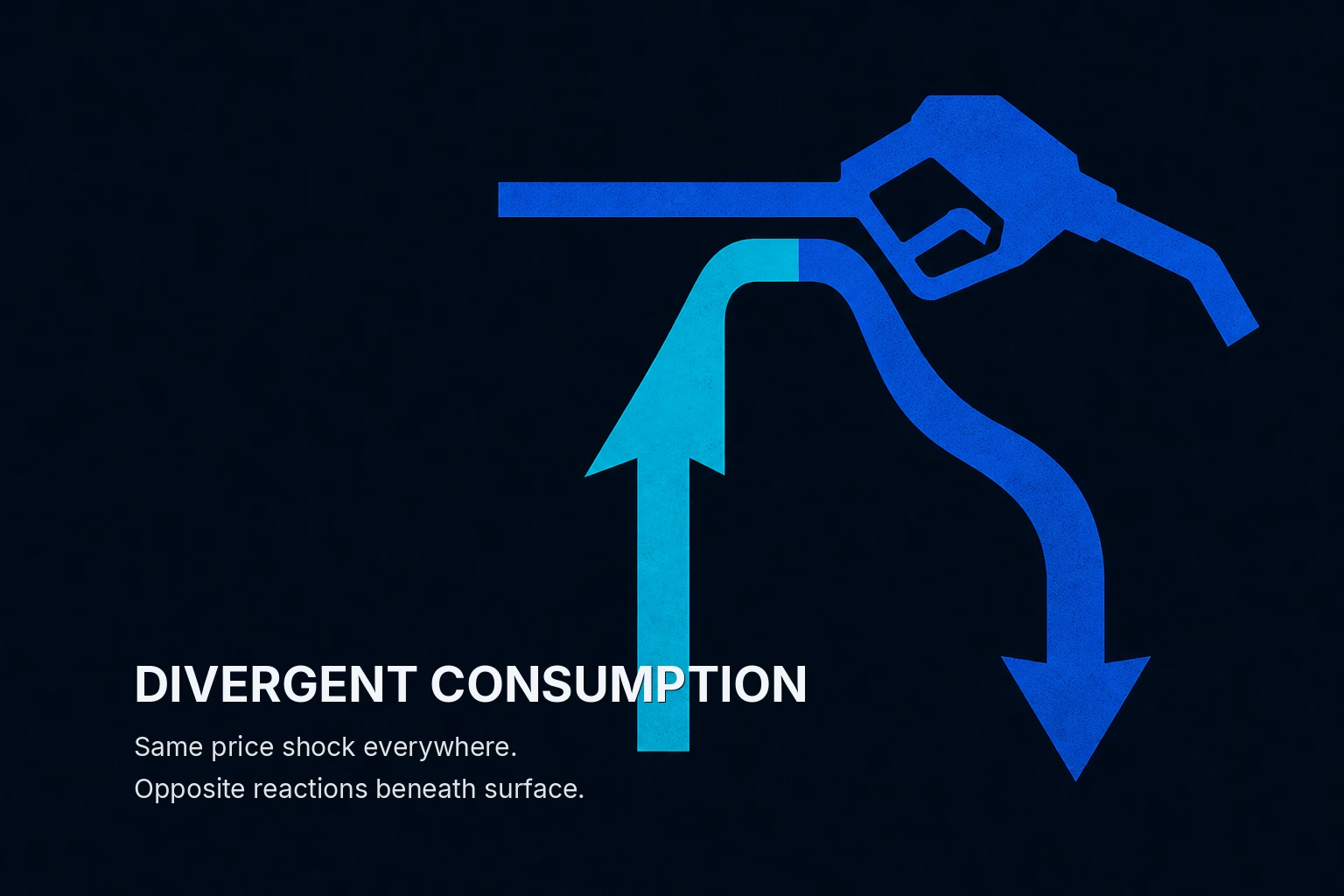
The most important number in Monday's tape is not $6.23 diesel. It is the 4%. McGlone's own note buries it: gasoline at $4.30 sits roughly four percent above its 2008 peak, the level that helped break the consumer and drag the economy into the Great Recession. The market read that line as a warning about inflation. It is actually a warning about reversal. Commodity spikes at this altitude do not persist. They destroy the demand that created them, and then they collapse. The people selling semiconductors this morning on "AI slowdown fears" are selling the exact assets that benefit most from the disinflation that a diesel spike this violent almost always precedes.
That is the contrarian read, stated plainly. Let me defend it question by question.
Is $6 Diesel an Inflation Signal or an Exhaustion Signal?
Consensus has this half-right, and it is worth saying so. A sustained diesel shock is stagflationary. Freight costs feed into everything with a truck attached, which is everything. Citi's coverage note is not wrong that energy-based inputs, resins, freight, and diesel will pressure margins into the first half of 2027. That is real, and companies with thin gross margins and long supply chains will eat it.
The part the consensus misses is the word sustained. Diesel's first-ever print above $6 a gallon is not a plateau. It is a spike, and spikes have a specific physics. The IEA published a report last week warning of demand destruction in industrial fuels. The US diesel crack spread sits above $110 a barrel. When a crack spread runs that hot, refiners maximize distillate output, and every marginal ton of demand gets rationed by price. California pumps hitting the $9.999 dispenser ceiling is not a sign of durable strength. It is the auctioneer's chant. Edward Chancellor, writing in "Devil Take the Hindmost," observed that manias climax not when fundamentals peak but when the price itself becomes the only remaining argument. A pump that has run out of digits is the price making the argument.
Brent at $109 with the crack spread over $110 is a structure that punishes the industrial economy so severely it cannot last two quarters. The 2008 analog McGlone reaches for is precisely the point, and precisely against him. In July 2008 crude touched $147. By December it was $32. Gasoline's four-percent overshoot of its old peak did not sustain inflation. It broke the consumer, demand collapsed, and the following year delivered the deepest disinflation in a generation.
A commodity spike this steep is not the beginning of an inflation regime. It is the end of one.
What Is the AI Selloff Actually Pricing?
Tech slid Monday on "AI slowdown fears" stacked on top of the fuel shock. First-level thinking sees two bearish inputs and sells the highest-multiple names first. Semiconductors lead down because they led up. NVDA, AMD, SMCI, MSFT are treated as the funding source for a risk-off morning.
Second-level thinking asks a sharper question. What does the AI capex cycle actually consume? Electricity and silicon. It does not consume diesel. A hyperscaler building a data center is not sensitive to the freight cost of a can of tomatoes. The diesel shock is a tax on the physical-goods economy, the trucking economy, the refining-and-logistics economy. It is very nearly orthogonal to the marginal dollar of compute demand.
So the selloff is conflating two unrelated stories. One is a genuine energy shock hitting margins in the consumer-staples and industrials complex. The other is a sentiment wobble in AI infrastructure that has no mechanical link to the price of a barrel. The market is selling the semis to pay for a fear that lives in a different sector entirely. That is how correlated selloffs manufacture their own mispricings: everything goes down together on the way out, and only later does the tape distinguish what actually deserved to fall.
The Philadelphia Semiconductor Index is the instrument where this confusion is most visible. When SOX sells off on a diesel headline, the correlation is doing the work, not the causation.

Why Does the 2008 Comparison Cut Against the Consensus?
McGlone's own framing contains the reversal he is warning about. "Commodity spikes tend to sow the seeds of their own reversal." He wrote that sentence himself, then used it to raise a stagflation flag. Read it forward instead of sideways.
The 2008 sequence ran in order. Energy spiked into July. Demand cracked through the autumn. The consumer broke. And then, in the wreckage, the assets that survived were the ones whose demand did not depend on cheap freight or a healthy household balance sheet. The 2022 analog rhymes: the fastest Fed tightening in four decades, CPI at 9.1%, a 425-basis-point cycle that inverted the curve and knocked equities down roughly twenty percent. Long-duration bonds had their worst year in decades. But the current cycle began at lower starting inflation, which constrains how far the response has to go. That difference matters, and I will not pretend it doesn't. The parallel is imperfect. But the direction of the mechanism is the same: a violent energy spike is a disinflationary event dressed up as an inflationary one, because the demand destruction arrives on a lag the tape has not yet priced.
Trump is already pulling the levers. He publicly asked Zelenskyy to stop striking Russian diesel infrastructure. The administration is weighing the Defense Production Act to expand refining capacity. JPMorgan's Natasha Kaneva laid out six policy tools in March; Jones Act waivers and SPR releases are already spent, but export restrictions and a federal fuel-tax waiver remain loaded. Policy is bending toward killing the spike, not sustaining it. When the White House treats a price as a national emergency, that price is closer to its top than its bottom.
The consensus is positioned for a soft landing, long risk, pricing a coordinated recovery across assets. A diesel shock that resolves as demand destruction is not the soft-landing scenario. It is the scenario where the goods economy slows, inflation rolls over faster than the Fed expects, and the discount rate on long-duration growth assets falls. That is bullish for the exact names being sold this morning.
Where Does the Asymmetry Actually Sit?
The probability shape here is not symmetric, and it is not in the bear's favor for semiconductors. The most likely path is the slow-moving one: the spike persists a quarter, margins compress in the goods complex, and then the demand-destruction physics asserts itself. The scenario where this diesel spike becomes a durable multi-year inflation regime is the minority case, not the base case, and it requires the policy response to fail and crude to hold above $100 through 2027 despite S&P Global's own note that Middle East production stays impaired. That is possible. It is not the way to bet.
The asymmetry: if diesel is an exhaustion signal, the disinflation that follows compresses discount rates and rewards long-duration compute assets. If diesel is a durable inflation signal, the goods-economy names get hurt and the semis get hurt too, but the semis were already sold this morning on a fear with no mechanical channel to their earnings. The downside is partly priced; the upside is not priced at all. When two scenarios out of three run against the crowded consensus, the long that has already been dumped is where the reward sits.
Klarman's discipline in "Margin of Safety" was never about predicting the catalyst. It was about buying the thing whose price already assumes the bad outcome. The semis this morning are being priced as if the diesel shock hits their cost structure. It does not. Their marginal input is a kilowatt-hour, not a gallon.
The instruments most exposed to this thesis resolving are NVDA, AMD, SMCI, and MSFT, with SOX as the benchmark. No short leg is warranted here; the shock is real but self-limiting, and shorting a spike into its own demand destruction is the losing side of history.
I never want to claim certainty about the timing. The demand-destruction lag in 2008 ran months, not days, and it can run longer than patience allows. What I will claim is the structure. A diesel spike this violent is a countdown, not a plateau.
The market sold the silicon to pay for the price of a barrel. The barrel does not go in the machine.