Amazon's unusually long-dated AWS guidance is best read as a funding document, not a growth forecast. The company that rarely looks past the next quarter told investors in its 3Q'26 call that AWS will grow more than 40% in each of 2027 and 2028. Andy Jassy added that Amazon "may have two of them," meaning trillion-dollar revenue businesses in AWS and stores, within five to ten years. That talk arrived in the same quarter that long-term debt reached $173.1 billion, up from $65.6 billion at the end of last year. The 10-Q also disclosed a facility letting Amazon borrow up to roughly $80 billion between early 2027 and 3Q'28 specifically for servers and other data center equipment.
Put those together and the change is in the type of company, not just its size. Amazon is turning from a self-funding compounder into a leveraged issuer whose equity now carries a rates exposure it did not have a year ago. The guidance is what that issuer has to offer creditors and shareholders who are being asked to underwrite the bridge.
A Duration Trade Dressed as Guidance
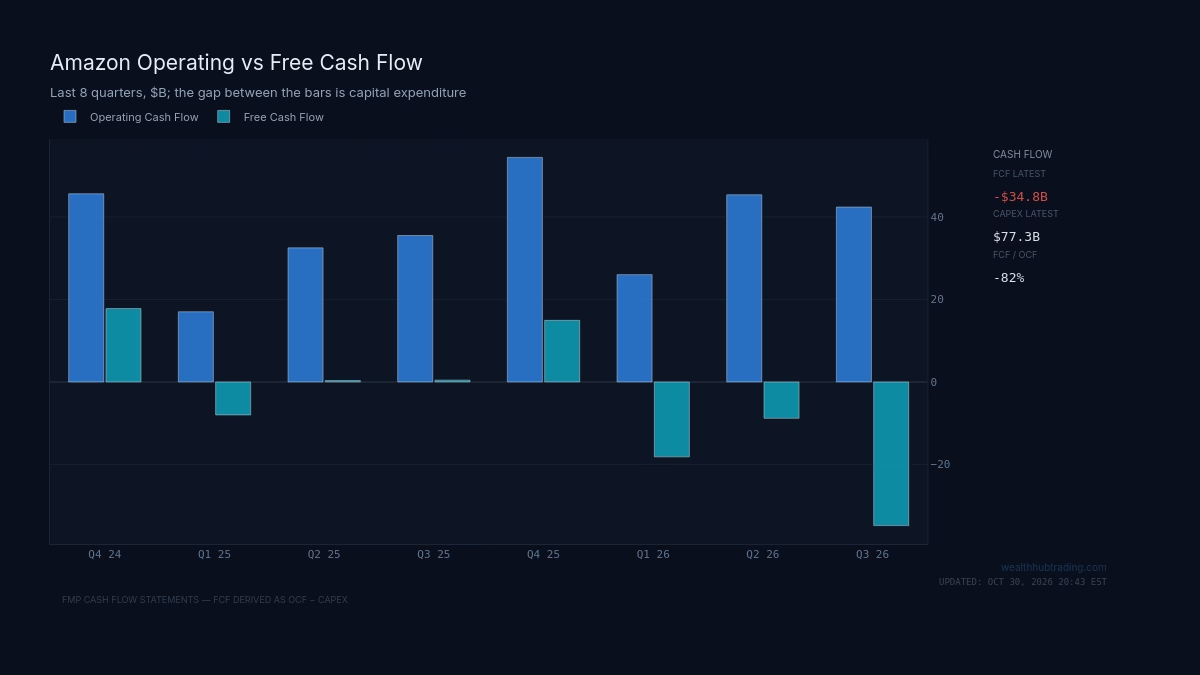
The core mechanism is simple. Cash capex will be about $220 billion this year and, by management's own words, "meaningfully more" in 2027. Trailing twelve-month free cash flow is already negative $42.4 billion. A company with negative free cash flow and rising capex has to fund the gap externally. Amazon has chosen debt.
That choice ties the AWS buildout to the price of money in a way the equity narrative mostly ignores. As of October 28, the 10-year Treasury yielded 5.05% and the 2-year 4.67%, a 2s10s spread of +0.38%. The curve is positively sloped again, so term funding costs more than short funding. The new facility is structured around 2027 to 2028 draws, which concentrates Amazon's incremental borrowing in exactly the window when AWS has to deliver those 40%-plus growth rates.
Jassy's own framing sharpens the point. He acknowledged it might be "more convenient" if the opportunity unfolded over 25 years so capex could be spread out, but "that's not the world that we live in." Compressing a generational buildout into a few years, and funding part of it with borrowed money during a 5% long-rate regime, is a duration decision. The payoff sits years out. The cash cost sits now. Equity holders in this setup are effectively long a long-dated cash flow stream financed with current debt, and that position is sensitive to the discount rate in a way that Amazon's 2015 to 2021 profile, funded from retail and AWS operating cash, was not.
From Self-Funded to Borrowed
The balance sheet move is large enough to stand on its own. Long-term debt rose by roughly $107.5 billion in under a year, which more than doubles the starting stock. The equipment facility could add another $80 billion on top of that.
What the facility finances matters as much as its size. Servers and data center equipment are short-lived assets. If the borrowing tenor runs longer than the useful life of the hardware it pays for, Amazon will still be servicing debt on equipment that has been depreciated, replaced, or made obsolete by the next accelerator generation. The pricing, tenor, and covenants of the facility are not described in the excerpted disclosure, so the size of any mismatch is unverified. The structural risk is still visible: equipment-specific credit is the part of the funding mix where the asset can lose value faster than the liability amortizes.
There is a cross-asset consequence here that equity coverage tends to skip. When the largest corporate balance sheets start issuing at this pace, they compete for the same long-duration buyers as Treasuries and other investment-grade issuers. Whether hyperscaler supply is already widening high-grade spreads or pressuring the long end is an inference, not something established by the evidence here. The direction of the pressure is clear, though. Amazon is now a price-taker in the credit market, and the price it takes is set partly by a 10-year sitting above 5%.
The Retail Cash Engine Is Doing Less of the Lifting
If the bridge is debt, the retail business is the internal cushion that decides how much debt is needed. That makes the third-quarter retail numbers more important to the funding story than their headline weakness suggests.
The weakness is mostly timing. Prime Day moved from Q3 last year into Q2 this year in most large markets, which Amazon estimates took about 400 basis points off consolidated growth. That is why first-party sales, online plus physical stores, grew just 1.6% year over year. Taking Q2 and Q3 together, online stores grew about 8% and third-party seller services about 13%. Those are steady numbers, not a collapse.
Margins tell a more modest story than the chart suggests. North America posted a 7.7% operating margin against 4.5% a year earlier, but 3Q'25 included a $2.5 billion FTC settlement. Excluding it, last year's margin was 6.9%, and the segment also absorbed part of a $1.8 billion severance charge whose split Amazon did not disclose. The like-for-like expansion is probably well under 100 basis points. International came in at 3.7%.
The unit economics are improving. Paid units grew 12% while shipping plus fulfillment costs grew about 10%. Excluding fuel and linehaul inflation, shipping costs grew 8%, roughly 400 basis points slower than units. Management flagged that those cost pressures will be somewhat higher in Q4. One accounting change also flatters 2027: Amazon expects to begin capitalizing some Amazon Leo production and launch costs in Q1 next year, later than the CFO had earlier indicated. That will lift reported margins without changing cash out the door, a distinction a lender cares about more than an equity screen does.
Read through the funding lens, retail is growing its cash contribution slowly and doing so under fuel-cost drag. It is not on track to close a $42 billion free cash flow hole. The debt carries that.
Ads, Disclosure, and the Credibility Discount
Advertising is the highest-margin cash stream inside the non-AWS business, so its trajectory bears directly on how much borrowing the buildout needs. Here the quarter was weaker, and the disclosure pattern adds a second problem.
Ads grew 12% year over year on an FX-neutral basis in 3Q'26, down from 26% in 2Q'26. Management cited three drivers. The Prime Day shift was an 850 basis point sequential hit to Q3 growth. Q2 included the first season of NBA on Prime, while Q3 had none. And Amazon began lapping a 3Q'25 change to its search engine marketing programs that drove more traffic to its own search pages and monetized it at higher rates.
That last item had not been mentioned on any of the 3Q'25, 4Q'25, 1Q'26 or 2Q'26 calls. A tailwind that went undisclosed while it inflated growth, and was explained only once it rolled off, is a credibility cost. It matters more now than it would have in a self-funding year. A company asking the market to accept a two-year AWS growth commitment, partly to support a debt-financed capex program, should be giving its most consistent disclosure. Explaining weak quarters more readily than strong ones weakens the forward guidance it is relying on.
The competitive read is also softer. Measured as incremental revenue relative to Google Advertising, Amazon ads captured only 25% in 3Q'26. Combining Q2 and Q3 to net out both the Prime Day shift and the World Cup's effect on Google's budgets, Amazon's incremental share still fell from about 42% to about 33%, roughly where 1Q'26 was at 32%. Over three quarters, the ratio has stepped down from around 40% into the low 30s, and this happened in a quarter when Google Search itself was weak. Three quarters is a small sample. The direction still fits the thesis that sponsored products sit at the bottom of the funnel, where AI adds little and ad inventory is capped by search results and product pages that are already heavily loaded.
Management guided ads back to high-teens growth in Q4, and Google's commentary about a tougher comparison and larger FX headwind suggests Amazon will look better on this measure next quarter. Jassy also dismissed the existential worry, saying external shopping agents are not yet meaningfully affecting ads and that Alexa for Shopping is expected to be the primary agent on Amazon. One good quarter of reacceleration would weaken the structural bear case on ads. It would not change the funding math.
What a Credit Investor Would Say Back
The strongest case against this read is that it overweights the liability side. AWS growing above 40% in 2027 and 2028 would make much of the new debt self-liquidating. Amazon is a high-grade borrower with a dominant cloud franchise, and a 5% 10-year is not a punitive rate for an issuer of that quality when the asset being funded is capacity that customers are already waiting to use. On this view, the trillion-dollar talk is not a plea. It is a company with visible demand choosing the cheapest available capital to meet it before competitors do.
That argument is coherent, and it explains why management is willing to break with its habit of quarter-to-quarter guidance. It depends on three conditions that the evidence does not yet confirm: that AWS growth actually lands above 40% rather than merely being promised; that AWS margins hold while depreciation from the buildout ramps; and that server economics outlast the debt that financed them. Absent live positioning data, it is also not clear how much of this optimism is already priced into Amazon's equity or its credit spreads. The rates exposure exists either way. The question is whether it gets paid for.
The Spread That Settles It
The variable that confirms or breaks this read is not the AWS growth rate on its own. It is the relationship between AWS's delivered growth and Amazon's borrowing cost over the 2027 to 2028 draw window on the equipment facility.
If AWS prints above 40% in early 2027 while Amazon's new issuance prices close to Treasuries, the market will have accepted the guidance as collateral, and the leverage will look like a well-timed bridge. If AWS growth slips toward the low 30s while capex keeps rising, the long end stays above 5%, and Amazon's spreads widen as it draws on the facility, the equity will start trading like what it has quietly become: a long-duration, rate-sensitive claim on a buildout that the company itself says it cannot stretch out. Jassy's two trillion-dollar businesses may well arrive. The next eight quarters will show whether the debt market agrees to pay for the wait.