Fifty-one years ago, on May 1, 1975, the wall of fixed brokerage commissions came down on Wall Street. The firms that cheered the coming volume were mostly not the firms that kept the economics. Today the wall between brokerage accounts and blockchains is coming down, and the names cheering loudest are Coinbase and Robinhood.
The thesis in Citrini Research's "Breaking The Wall" is that autonomous agents finally give crypto infrastructure a user that tolerates its ugliness. That thesis is probably correct. Its implication for the intermediaries is the opposite of what the bull case assumes. An agent capable of instructing "find me the cheapest $500K loan and refinance me into it" is the same agent that finds the cheapest venue, the cheapest spread, and the cheapest custody for every tokenized share it touches. The user that makes tokenization useful is the user that refuses to pay the toll.
Who Is Breaking the Wall?
Consensus has the direction right, and the evidence is not thin. When the Iran conflict escalated over a weekend in March, Hyperliquid was one of the few liquid venues where crude oil could be priced at all. Two days after the CLARITY Act fell short in the Senate, the SEC issued an innovation exemption for tokenized stock trading. The CFTC lists Coinbase's proposed US stock perpetuals as "approval pending." The Bloomberg Terminal now carries Hyperliquid perps and tokens under its own ticker page. Robinhood Chain opened composable "Stock Tokens," and by Citrini's account Solana briefly processed more trades than the NYSE in September.
Citrini is candid that most of that Solana activity is "surely bots, meme pairs and other nonsense." The concession matters more than the headline it qualifies. Trade count is a measure of activity. It is not a measure of revenue, and certainly not of margin. A venue that matches a billion bot trades at a fraction of a basis point earns less than a venue that matches a million human trades at a fat spread.
So the wall is breaking. Regulators are building the legal frame piece by piece, with or without a comprehensive bill. Citrini frames the investor question correctly as who captures the economics. Our answer is narrower and less comfortable than the one the crypto equities are trading on.
What Does an Agent Actually Pay For?
The part consensus misses is the meaning of composable. Citrini identifies composability as the key unlock: tokenized equities can now leave the issuer venue and move across apps and rails that used to carry only stablecoins and native crypto. That is the feature. It is also the end of lock-in.
Brokerage economics have always rested on friction. A customer who opens an account, links a bank, sets up tax lots, and learns an interface does not move for a few basis points. Payment for order flow, sweep spreads on idle cash, margin lending rates above the market, and subscription bundles are all monetizations of that inertia. The archaic plumbing Citrini describes as slow, fragmented, and gate-kept is precisely what lets a broker charge more than the marginal cost of execution. The friction protected the human from himself, and it protected the broker's margin from the human.
An agent has no inertia. It does not care about an interface, it does not remember a brand, and it re-optimizes continuously. A tokenized share that can move freely between Robinhood Chain, Solana, and any other compatible rail is a share whose holder can be relocated in seconds to whichever venue quotes the tightest spread. Citrini asks whether millions of agents moving deposits to the highest bidder could cost banks their cheap funding. The same logic applies to every take rate in the stack. Composability turns venue choice into a pure price auction, and in a pure price auction the auctioneer earns less with every round.
The 1975 precedent is the clean one. Deregulated commissions produced an enormous expansion in volume and a collapse in the price per trade. The discount model won, the fixed-commission franchise died, and the volume boom accrued mostly to customers and to a handful of low-cost operators with structural scale. The episode repeated in October 2019, when Charles Schwab cut online equity commissions to zero and its listed rivals fell by double digits in a single session. Within months TD Ameritrade had agreed to be absorbed by Schwab. Volume was never the scarce input. Pricing power was.
Precise current take-rate figures for Coinbase and Robinhood are not summarized here, and the near-term filings may well show rising transaction revenue as tokenized activity ramps. That would not contradict the thesis. Early in a liberalization, volume growth outruns price compression. The compression arrives when the routing layer matures, and agents are the routing layer.
Volume is the bait. Composability is the hook.
Where Does the Float Go?
The second economic pool is quieter and larger: the yield on idle money. Banks earn a spread on deposits paying close to nothing. Brokers earn a spread on swept cash. Stablecoin issuers earn the full yield on the Treasury bills backing their tokens, and the exchanges that distribute those stablecoins often share in that income. Across traditional and crypto finance alike, a great deal of reported profit is simply float captured from customers who do not bother to move their cash.
Citrini's own opening scene, the agent that puts idle balances to work with a flick of the wrist, is an attack on every one of those spreads at once. The essay frames the agentic bank run as a threat to traditional banks' cheap funding. It applies with equal force to crypto's float businesses. An agent that sweeps a checking balance into tokenized Treasuries will also sweep a non-yielding stablecoin balance into a yield-bearing one, or into the tokenized fund that passes through the most of the underlying bill rate. The issuer that keeps the full reserve yield survives only so long as its holders are passive. Agents are not passive.
What consensus treats as two separate stories, banks losing deposits and crypto gaining assets, is one story. The idle-money spread is being competed away regardless of the rails it sits on. The beneficiary is the end saver. The losers are any balance sheets whose earnings depend on customers leaving cash where it was put, and that list includes several of the crypto intermediaries now being bought as tokenization winners.
The float was the business. Agents are coming for the float.
So Who Keeps the Toll?
When a wall falls it seldom stays down; the stones get rebuilt into gates. In Jericho's case the trumpets did the demolition, but whoever held the city afterwards set the terms of entry. The tokenization buildout is following that script. The SEC innovation exemption, the pending CFTC approval for US stock perps, and the KYC perimeter Citrini describes as gate-keeping do not disappear in a programmable system. They migrate. The scarce asset in an agent-routed market is not the venue, the chain, or the token. It is permission: the regulated right to issue a tokenized security, to custody the underlying, to stand behind a redemption, and to verify that the agent at the other end acts for a real, identified person.
That points the economics toward a different set of firms from the ones the market reaches for first. The likeliest toll collectors are the licensed issuers and custodians holding the actual shares and bills behind the tokens, the identity and compliance layers agents must pass through to transact, and whichever venue becomes the regulated default for price discovery in a given asset. A venue that wins on spread can become the default, as Hyperliquid did for weekend crude in March, but winning on spread is a strategy that resets every time a cheaper quote appears. Which specific listed names end up holding the permission layer is an inference we hold loosely; the mechanism we hold firmly.
The near-term trade is a separate question, and it is where the market will go first. Crypto equities have a well-documented habit of trading as levered beta to the underlying assets. Through the 2020-21 and 2023-24 cycles, miners such as RIOT, MARA, and CLSK moved at multiples of spot, and exchanges such as COIN and HOOD rode the volume surge that comes with retail re-engagement. If Citrini is right that these assets are emerging from a converging cyclical trough, the first leg is likely a volume-and-sentiment rally in exactly those names, regardless of what agents eventually do to take rates.
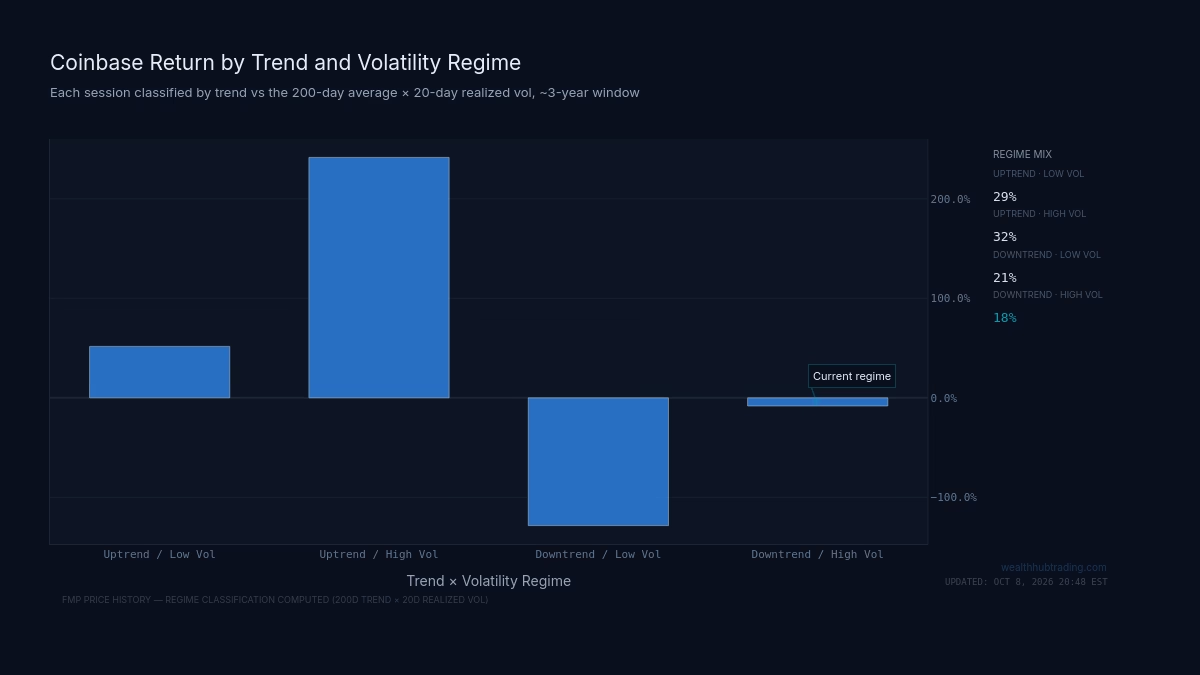
That is the trap in plain sight. The rally will look like confirmation of the franchise. It will mostly be confirmation of the beta. Coinbase lost the large majority of its market value in 2022, when the fastest Fed tightening in four decades drained speculative liquidity. That episode is the reminder of what these stocks are underneath the tokenization narrative: instruments whose earnings track activity and sentiment, not durable pricing power. The 2022 analog is imperfect, because the present cycle began from lower inflation and the policy response has had less ground to cover. The lesson about what drives the multiple holds.
The consensus mood, based on available consensus data, is long risk with a soft landing as the base case and cross-asset correlations priced for a coordinated recovery. That backdrop favors the beta trade in the short run. It also means few holders are positioned for the outcome where the tokenization volume arrives as promised and the margin does not. The most likely path, as far as we can see it, is the slow one: adoption continues, the regulatory frame fills in, and the intermediaries post strong activity numbers for a while before routing efficiency starts showing up as compressed fees and shared float. A faster version, where agent-driven reallocation reaches estimates before anyone repositions, is less likely but not remote. The scenario where the transition stalls and the old walls hold is the least likely of the three, and even that scenario does not rescue the exchange multiple; it simply removes the volume.
I don't know when the compression shows up in the filings. Liberalizations reliably take longer to erode margins than the skeptics expect and less time than the incumbents hope. What we know is where the mechanism points. A take rate is a fee for friction, and the entire tokenization thesis is a program to eliminate friction.
What If Citrini Is Right?
Then the essay's conclusion and its trade separate. Assets come onchain, agents become the dominant users of financial plumbing, and Wall Street's wall falls the way the fixed-commission wall fell in 1975. The saver wins. The issuer and custodian with a license win. The venues earn more trades and less per trade, and the float businesses on both sides of the old divide get competed down toward the bill rate.
Citrini compared the moment to TCP/IP being abstracted away by browsers. The comparison is better than intended. The protocols that carried the internet captured almost none of its value, and the first great browser company was commoditized within a few years. Value went to whoever sat on a scarce, permissioned resource the protocol could not route around.
The position is to treat crypto exchange strength as a beta rally to rent, not a franchise to own, and to look for the economics where the agent cannot shop: at the gate that holds the license.
When the wall comes down, the money moves to the gate.