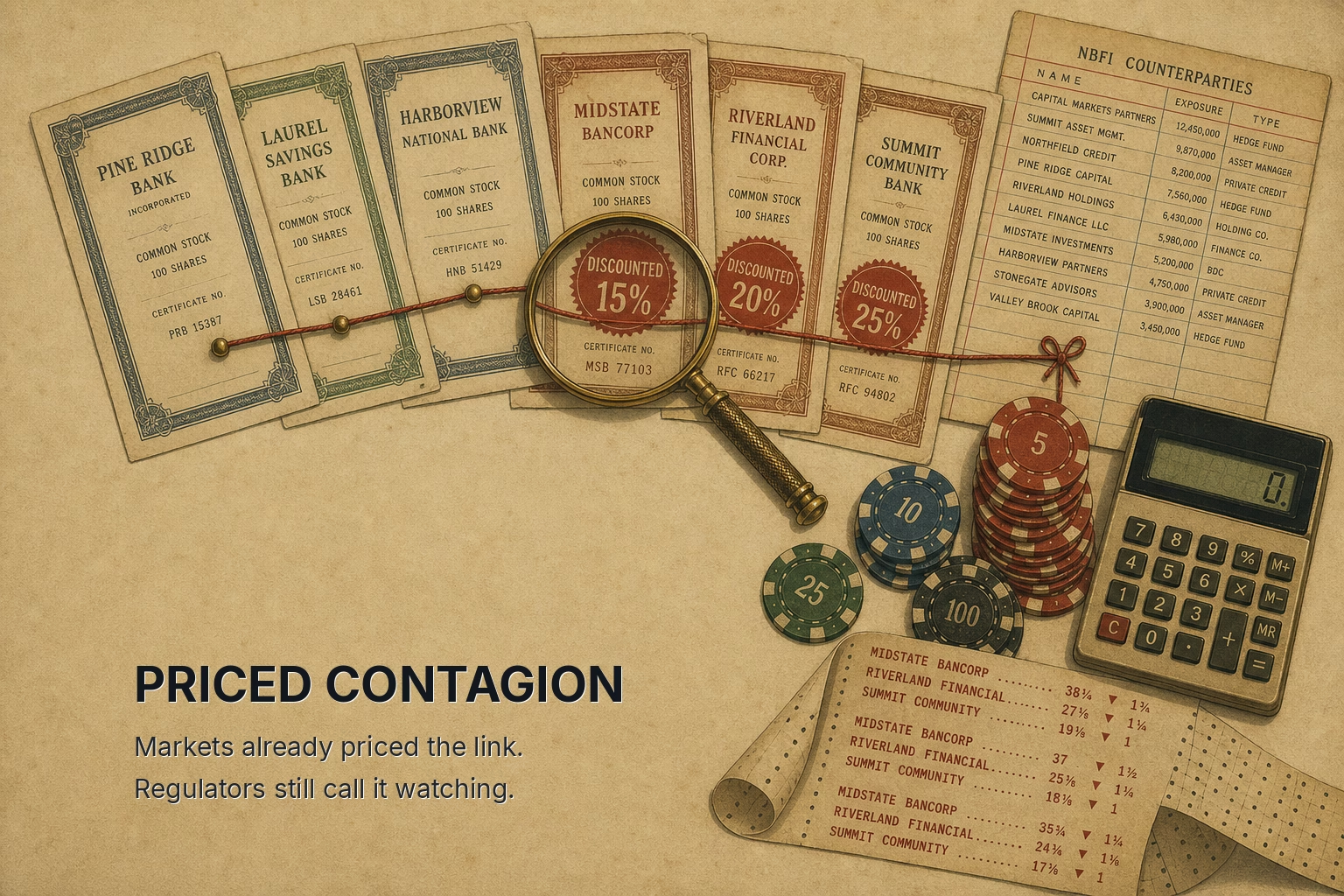
The Federal Reserve's stress test overhaul will not change how much capital the banking system must hold. By the Board's own estimate it will not "materially affect aggregate capital requirements." What it changes is how much capital banks choose to hold on top of the requirement. That is where the market consequence sits. A stress capital buffer that swings roughly 50 percent less from year to year lets large banks run thinner management buffers above it. Over time, the capital freed from that precautionary layer is most likely to leave as share repurchases. The headline is about transparency and accountability. The flow is about a steadier, more predictable buyback bid in large-bank equities, and a stress-test release that loses much of its power as a binary event.
The Cushion Above the Requirement
The stress capital buffer is set from each bank's projected peak-to-trough decline in common equity tier 1 under the Fed's severely adverse scenario, plus four quarters of planned dividends, with a 2.5 percent floor. That calculation is rerun every year. Scenarios change, models change, and a bank's balance sheet changes, so the resulting requirement can jump sharply between cycles even when the bank's underlying risk has barely moved.
Treasurers respond to that unpredictability rationally. They hold capital above the regulatory minimum so a bad draw in June does not force them to halt distributions or scramble to rebuild ratios. That management buffer is dead capital from a shareholder's perspective. It earns nothing extra and it supports no incremental lending. It exists because the requirement is noisy.
The final rules attack the noise directly. The second rule requires the Board to average the results of the two most recent annual supervisory stress tests when setting each firm's stress capital buffer, for firms tested in both years. The Board says the package together should cut year-over-year volatility in capital requirements by approximately 50 percent. If the requirement moves half as much, the rational cushion above it shrinks too, though not necessarily one for one. The proportion is the unverified link in this chain. Boards and treasurers are conservative, and some will keep cushions sized for the old regime until they have seen the new one behave. The direction is clear. The speed is not.
How Smoothing Becomes a Flow
Capital released from a management buffer has three possible destinations: loan growth, acquisitions, or distributions. For the largest banks, loan growth is constrained by demand and by other parts of the capital stack, including leverage ratios and the GSIB surcharge, which this package does not touch. Acquisitions face their own approval process. Repurchases are the path of least resistance, and the stress test calendar has historically governed when banks announce them.
The second-order effect matters more for positioning than the first. Under the old regime, the late-June results release was a genuine catalyst. A surprise jump in a firm's buffer could cap buybacks for a year, so investors positioned ahead of it and some event-driven money traded the outcome. Averaging two years of results mechanically dampens the surprise. A single severe scenario now carries only half the weight in the requirement. The publication of scenarios for public comment, which the first rule mandates annually alongside any material model change, removes much of the remaining uncertainty before the test even runs.
The likely result is that the June release becomes less of a volatility event for bank equities. That has two consequences for flows:
- Repurchase programs become more forward-guidable. If management can forecast its requirement with more confidence, it can commit to larger, steadier authorizations rather than back-loading them after the results. A buyback that is smoother in time is a more persistent bid in the tape, and it is the kind of flow that sometimes supports a stock through periods when discretionary investors are net sellers.
- The catalyst trade weakens. Positioning built around stress-test outcomes, whether long a name expecting a buffer cut or short one expecting a hike, has less to work with. The implied volatility premium that options markets have sometimes priced around the release has less reason to exist. This is inference: the package does not touch options markets directly, and no options data supports it here. The mechanism follows from the dampened requirement, but the size of any vol compression is unmeasured.
Who Gains and Who Pays Under the Market Shock Changes
Aggregate neutrality hides distribution. The first final rule changes the global market shock, the component applied to banks with large trading books. Those firms will now face two global market shock components each year, and the Board will use whichever produces the larger loss for each firm. Taking the worse of two shocks is, by construction, a weakly tougher standard for any single year's result than facing one. For trading-heavy institutions, this is the part of the package that cuts against the buyback read.
Averaging partly offsets it. A punitive market shock in one year is blended with the prior year's outcome, so the hit to the requirement is diluted, but it also lingers. This is the feature most investors are likely to miss. Averaging is symmetric. It halves the relief from a benign year just as it halves the damage from a harsh one, and it carries either into the following cycle. A firm that draws a bad shock pays for it twice at half weight instead of once at full weight. For banks whose stress results have been trending better, averaging slows the payoff. For banks whose results have been deteriorating, it buys time.
The request for comment on the noninterest income model points to a different set of potential winners. The Board wants to revise how the test projects fee income under stress so that it better captures "business model diversity across firms." The plain reading is that the current model treats fee-driven franchises in ways that do not reflect how their revenue actually behaves in a downturn. Custody, asset management, and wealth platforms are the obvious candidates. This is a proposal with comments due 60 days after Federal Register publication, not a final rule, and which firms benefit depends on the final specification. Any equity read here is provisional. Investors who extrapolate a fee-income model change into specific names now are trading a draft.
The Countercase: Timing, Dissent, and Gaming
The strongest objection to the buyback read is the calendar. The Board will not begin averaging stress capital buffer requirements until 2028, so that only models built with public input enter the calculation. The rule also adopts the models that will be used for the 2027 test. That means the next two cycles still run on single-year requirements. The volatility reduction is a 2028 event, and a treasurer who shrinks the cushion today is front-running a rule that is not yet operating. The flow argument is therefore a slow one. It describes a gradual reset in how banks size their buffers over several cycles, not an immediate surge in authorizations.
The second objection is political durability. Governors Barr and Cook each released separate statements alongside the final rules. Their content is not summarized here, and their existence alone does not prove disagreement. Still, a rule finalized under one supervisory leadership can be revisited under another. Banks that size multi-year capital plans on a reduced cushion are implicitly betting the framework survives. That bet is reasonable on a two- to three-year horizon and less certain beyond it.
The third objection is substantive rather than procedural. Publishing scenarios for comment and smoothing results makes the test more predictable, and predictability is a two-edged property in supervision. A test banks can anticipate is a test banks can optimize against, positioning balance sheets to look better under the known scenario than they would under the unknown one that actually arrives. Vice Chair for Supervision Michelle Bowman framed the changes as preserving resilience by making the test "transparent, granular, and risk-sensitive." Critics of transparency in stress testing have long argued the opposite risk. If that critique proves right, the cost would surface not in capital ratios but in the next real stress event. That is a tail risk for the system, not a near-term driver for the stocks.
The final caveat is the one the Board itself supplied: aggregate requirements do not materially change. Nothing here releases capital by regulatory fiat. Any freed capital comes from banks' own reassessment of how much precaution they need. That reassessment is behavioral, and behavioral changes in bank treasury departments tend to happen slowly.
What Confirms the Read
The thesis is falsifiable on observable terms. If smoothing translates into flows, management commentary in the 2026 and 2027 capital cycles should start discussing smaller target buffers above the stress capital buffer. Buyback authorizations should begin to be framed on multi-year horizons rather than set reactively after each June release. The bank-equity response on results day should become more muted relative to recent cycles.
The read breaks if banks hold their cushions steady through the first averaged cycle in 2028. That would mean the precautionary layer was never really sized to requirement volatility but to something the rule does not address, such as leverage constraints, surcharge uncertainty, or the political risk of reversal. It also weakens if the dual global market shock produces large enough losses at trading-heavy firms that their averaged requirements rise. That would offset the cushion release where the largest buybacks have historically been concentrated.
Until either happens, the cleaner interpretation is that the Fed has not lowered the bar for big banks. It has made the bar steadier. A steadier bar means less capital held against the risk of the bar moving.