In 2020 and 2021, roughly 600 blank-check companies raised more than $160 billion in a rush that made "SPAC" a household acronym. A blank-check company,...
In 2020 and 2021, roughly 600 blank-check companies raised more than $160 billion in a rush that made "SPAC" a household acronym. A blank-check company, or special purpose acquisition company (SPAC), is a shell with no operations that raises cash in an IPO, parks the money in a trust, and then hunts for a private business to merge with. The pitch to the public buyer was clean: put in $10 a share, get your money back if you dislike the eventual deal, and keep the upside if it flies.
The results were not clean. By 2022, a large share of companies that had gone public through a SPAC merger traded well below the $10 they started at, some down 70% or more. The failure was widely blamed on bad businesses picked in a mania. That explanation is incomplete. Many of those deals were structurally engineered to leak value away from the public holder before the target's fundamentals ever mattered. The mechanism is worth understanding, because it repeats every time the structure comes back into fashion.
The sponsor's promote sets the leak in motion
Every SPAC has a sponsor, the team that forms the shell, runs the IPO, and finds a target. For assembling the deal, the sponsor typically receives founder shares equal to 20% of the post-IPO equity for a nominal sum, often about $25,000. This 20% slice is called the promote.
Consider the arithmetic. A SPAC raises $200 million from the public at $10 a share, so public holders own 20 million shares. The sponsor pays $25,000 and receives 5 million founder shares. The moment the merger closes, the sponsor owns a quarter of what the public owns for a rounding-error price.
Here is where intuition gets it wrong. Investors assume the sponsor only wins if the merged company succeeds. In fact the promote is worth a great deal even if the stock falls sharply after the deal. If the post-merger stock drops to $5, the public holder who paid $10 has lost half their money, but the sponsor's 5 million shares are still worth $25 million against a $25,000 cost. The sponsor is paid to close a deal, almost any deal, not to close a good one.
The practical implication is direct. When you evaluate a SPAC merger, calculate what the sponsor's founder shares are worth at the current price and compare it to what they paid. If the sponsor profits handsomely at a price that ruins you, your incentives and theirs are not aligned.
Warrants dilute the holder who stays
The second leak comes from warrants, which are options to buy more shares later at a fixed price, usually $11.50. SPAC IPO buyers typically receive units, and each unit bundles one share with a fraction of a warrant. The warrant is a sweetener that made the IPO easier to sell.
Warrants leak value through dilution, the reduction in each existing share's claim on the company as new shares are issued. When warrants are exercised, the company prints new shares at $11.50. If the stock trades at $20, those new shares are sold to warrant holders far below market, and every existing shareholder's slice of the company shrinks to make room.
The subtlety is who holds the warrants at exercise time. Many original IPO buyers redeem their shares before the merger but keep the detachable warrants, because warrants trade separately once the unit splits. So a fund can pull its $10 principal out of the trust, walk away from the merger entirely, and still hold a free option on the upside. The dilution that option creates lands on the shareholder who stayed.
What this means for you: read the warrant overhang before buying a post-SPAC stock. Count the warrants outstanding and their strike, and treat them as shares that will appear the instant the price justifies exercise. A company that looks cheap on reported share count can be meaningfully more expensive once warrants are included.
Redemptions drain the trust the deal was supposed to use
The third and largest leak is the redemption right. Public holders can vote to approve a merger and, separately, redeem their own shares for the trust value of roughly $10 plus interest. Approval and redemption are decoupled. A holder can wave the deal through and still take their cash out.
During the 2021 to 2022 unwind, average redemption rates on many deals ran above 80%. Picture a SPAC that raised $200 million to fund a merger. If 80% of holders redeem, $160 million leaves the trust and walks out the door. The merged company that was promised $200 million of fresh capital receives $40 million.
This produces a specific and underappreciated failure. The target company agreed to the merger assuming a certain cash injection to fund growth or pay down debt. Heavy redemptions gut that assumption. The business arrives on the public market undercapitalized, and the shareholders who did not redeem now own a company that received a fraction of its expected funding while still carrying the full dilution from promote and warrants.
The practical takeaway is to watch the redemption disclosures that appear just before a deal closes. High redemptions are a signal that informed money is choosing the guaranteed $10 over the merged equity. When the holders closest to the deal prefer cash, the holder who prefers the stock is taking the other side of that trade.
Why the structure leaks by design
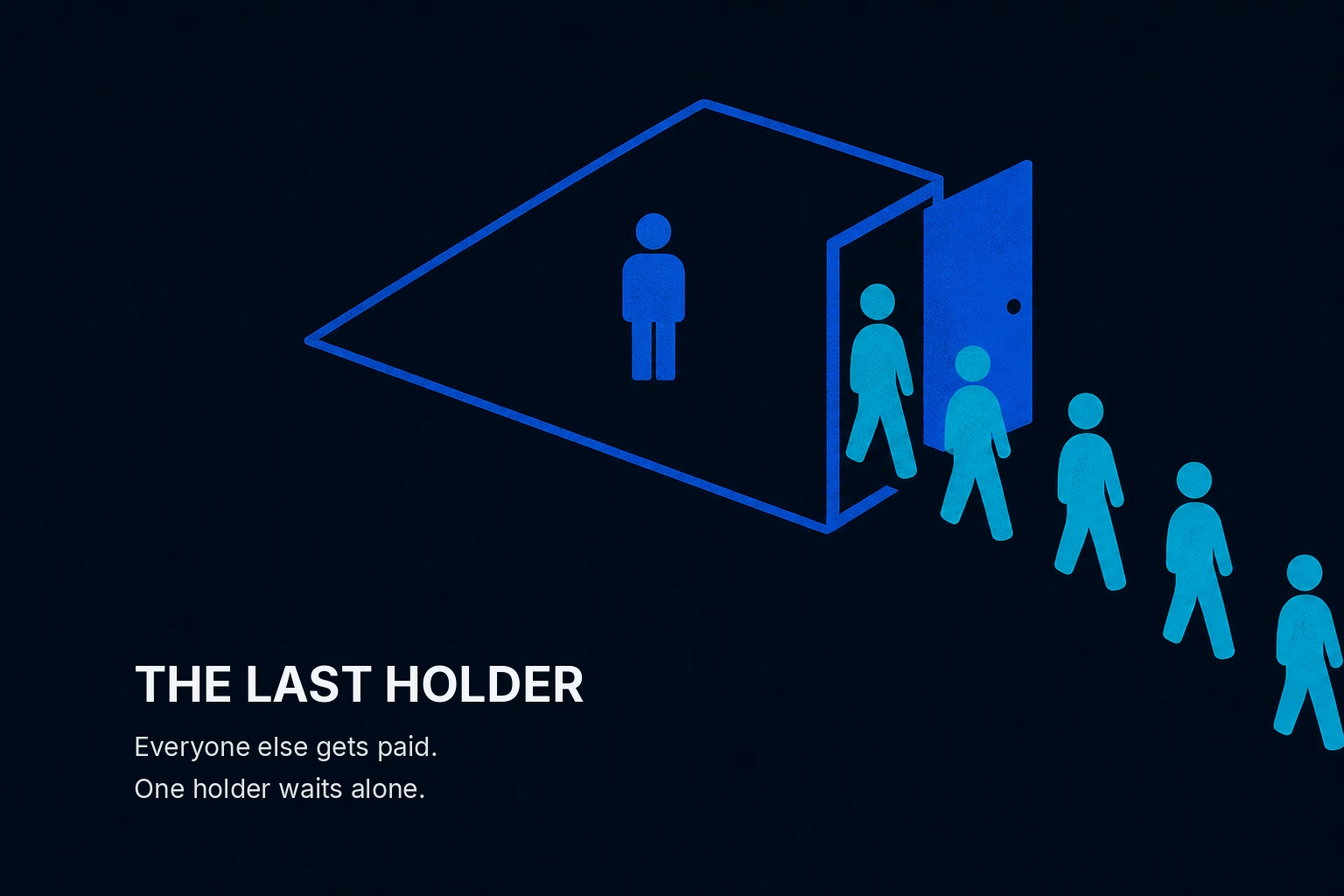
Step back and the pattern is coherent rather than accidental. The sponsor is paid to close. The IPO buyer is handed a risk-free trade: park cash at $10, redeem if unimpressed, keep the warrant either way. The only participant whose return depends on the merged business actually performing is the public holder who declines to redeem and holds through the close.
Every other party has a paid exit. The sponsor exits into a promote worth millions at almost any price. The arbitrage fund exits by redeeming principal while retaining warrants. The redeeming holder exits with cash and interest. Each of those exits is funded, in economic terms, by the shareholder who stays, through dilution, through the promote's claim on equity, and through a trust drained of the capital the merger was supposed to deploy.
This is why so many post-SPAC stocks fell even when the underlying business was merely ordinary rather than fraudulent. The structure imposed a large drag before operations were tested. A private company that would fetch a fair valuation in a traditional IPO can arrive through a SPAC saddled with a 20% promote, a warrant overhang, and a trust emptied by redemptions. The same business, wrapped differently, delivers a materially worse outcome to its public owners.
The mechanism also explains the timing of blame. Losses were attributed to bad businesses because the losses showed up in the stock price after the merger, where fundamentals are visible and structure is not. The value had already leaked at the moment of the deal; the price simply revealed it later.
What understanding the mechanism changes
The correct way to price a post-SPAC stock is to start from the fully diluted, fully redeemed reality rather than the headline $10 and the headline share count. Add the promote shares. Add the warrants at their strike. Subtract the cash that redeemed away. The company you are actually buying is smaller and more crowded with claims than the merger announcement suggested.
History offers a plain anchor. The 2020 to 2021 wave raised more than $160 billion; the deals that followed destroyed a substantial part of it, and the destruction concentrated on the holders who stayed through the close. That is not a verdict on any single management team. It is a verdict on a structure that pays everyone to leave and leaves the bill with whoever remains.
The SPAC leaks value because its economics reward exit before the merger, and the public holder who stays through the close funds the promote, the warrants, and the drained trust all at once.