The threat to the hyperscaler capex story is not a demand air pocket or a rate shock. It is that the workload the data centers were built for is quietly migrating onto hardware that already sits on desks and in pockets. A Stanford-affiliated team ran downloadable small language models (Qwen 3, Gemma 3, GPT-OSS, Granite 4.0) on ordinary high-end PCs powered by Nvidia or Apple M4 silicon, and pitted them against ChatGPT 5, Claude Sonnet 4.5, and Gemini 2.5 Pro. Blended across chat and reasoning tasks weighted by how often each type actually occurs, the best local model matched or beat the cloud frontier in 81.2% of cases. If that figure holds up under replication, the marginal economics of hundreds of billions in AI infrastructure spending look very different from what guidance implies.
That is the disclosure worth sitting with. Not the accuracy number itself, but the gap between it and the narrative that every hyperscaler capital plan is priced against: that frontier intelligence is a scarce, centralized good you rent by the token from a data center.
What The Paper Actually Claims
The results ladder up from the mundane to the alarming. On chat requests, which still dominate real usage, the best small model tied or won in 90%-plus of cases across every domain, averaging 98.6%. Chat is the easy case, so treat it as a floor rather than a headline.
Reasoning is where the interesting movement is. On pure reasoning the local models won or tied only 62.5% of the time on average, a real deficit. But the trajectory is the point. The authors trace success on reasoning tasks by difficulty from 2023 to October 2025: roughly 50% success across all difficulty levels two years ago, versus 99% on the two easiest tiers, 85% to 92% on the middle tiers, and only 51.5% on the hardest level today. The frontier's remaining edge has been compressed into the top difficulty band and a handful of domains: engineering, life sciences, transportation, computer science, and agentic workflows where local success rates still sit below 50%.
Then the cost line, which is what makes this a capital-allocation story rather than a benchmark curiosity. The paper puts energy and compute costs for local inference at 50% to 85% below the cloud equivalent. When a good-enough answer costs a fraction as much and never leaves the device, the burden of proof shifts onto the expensive centralized option to justify itself on every workload it wants to keep.
The Mechanism, Not The Benchmark
Benchmarks age badly. The mechanism underneath this one does not, and it runs in the wrong direction for anyone underwriting data-center returns on a fifteen-year depreciation schedule.
Inference is the recurring cost of AI, the part that scales with usage rather than with training runs. The hyperscaler thesis assumes that inference stays in the data center because the models are too large to run anywhere else. Small models running competently on commodity endpoints break that assumption at its root. Every task that migrates to a laptop or phone is a task that generates no cloud inference revenue, consumes no rented GPU time, and requires no incremental centralized capacity.
The addressable-market framing in the paper is aggressive and deserves a skeptical eye: it estimates the US market reachable by small models at roughly $10tn, about a third of GDP. Take the specific number as an analyst's estimate, not a measured fact. The directional claim is what matters. If four of five common workloads can run locally at good-enough quality and a fraction of the cost, then the segment where large cloud models are genuinely indispensable is narrower than the capital plans assume, and it is getting narrower each model generation.
This is the part guidance language obscures. Capex is justified by total AI demand growth, which is real. But total demand and centralized-inference demand are not the same quantity, and the paper is a direct argument that the wedge between them is widening.
Where The Read Could Break
The thesis has a specific failure mode, and it is worth stating plainly because it is the more likely outcome than a data-center collapse.
The paper is a working paper. Its central 81.2% figure depends on task-frequency weightings, model selection, and grading rubrics that independent teams have not yet reproduced. The domains where cloud models still dominate, agentic AI most of all, are precisely the domains the industry is betting will drive the next demand wave. If autonomous multi-step agents become the dominant workload, and local success rates there remain under 50%, then the migration stalls exactly where the money is going. The frontier keeps its moat in the segment that matters most, and the capex looks prescient rather than stranded.
There is also a Jevons-paradox rebuttal that hyperscaler bulls will make, and it is not weak. Cheaper, ubiquitous local inference could expand total AI usage so dramatically that centralized demand grows in absolute terms even as its share of workloads falls. Falling cost per task has historically expanded total consumption more often than it has shrunk aggregate spend, though not always. Cloud would then capture the hardest, highest-value tail: training, frontier reasoning, agentic orchestration, regulated enterprise workloads. That is a smaller share of a much larger pie, which can still be a large business.
So the bear case is not that data centers empty out. It is that they get repriced from "infrastructure for all AI" to "infrastructure for the hard tail of AI," and the current capex is sized for the former.
The Fundamentals Footnote Worth Naming
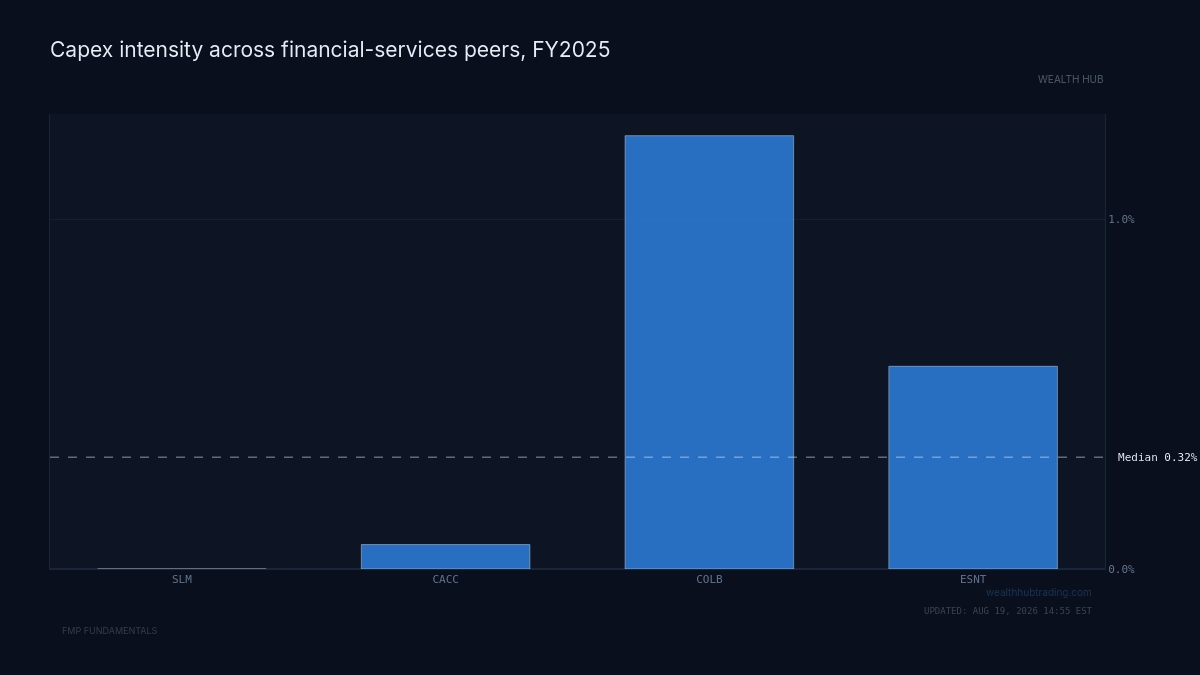
One clarification, because the ticker that shares this theme's shorthand is not the theme. $SLM is SLM Corporation, the student lender, not a small-language-model pure play. Its FY2025 filings show $3.1B in revenue at a 31.9% operating margin and, tellingly for a financial-services balance-sheet business, essentially zero capex against $575.5M in free cash flow. That capital-light profile is the mirror image of the hyperscaler problem: the AI infrastructure names are the ones carrying the tens of billions in property, plant, and equipment that this research puts under question. There is no clean listed proxy for the local-inference thesis; it shows up as a subtraction from data-center demand, not as a stock you can simply buy.
The Condition That Settles It
Watch two things, and the debate resolves without needing to trust the working paper's headline.
First, independent replication of the reasoning trajectory. The chat numbers are unremarkable; the reasoning slope is the whole argument. If other teams confirm that local models are closing the gap on levels 3 and 4 while the frontier holds only level 5, the migration thesis strengthens with each model generation. If replication shows the middle tiers are harder to hold locally than the paper claims, the moat is wider than it looks.
Second, and more immediately legible to a public-market investor, watch how the hyperscalers themselves narrate inference in their filings and calls. The tell will not be a capex cut, which no one announces early. It will be language: a shift from talking about total AI compute demand toward emphasizing agentic, enterprise, and frontier-reasoning workloads specifically. That rhetorical narrowing would be management pricing in the same segmentation this paper describes, before the depreciation schedules force the issue.
The read breaks if agentic AI becomes the dominant workload and small models fail to crack 50% success there. Until that resolves, the cleaner interpretation is that the market is pricing centralized-inference demand as if it equals total AI demand, and a growing body of evidence says those are two different, and diverging, numbers.