The re-contracting story that lit up CoreWeave's earnings call is not evidence that GPUs last longer than the market thinks. It is evidence that the marginal buyer of compute has changed, and that change points in the opposite direction from the bull thesis.
When CoreWeave management said it recently signed an A100 contract extending into 2029, at "an attractive price," for a chip introduced in 2020, the bullish read wrote itself: if the previous generation still commands premium pricing on multi-year terms, the useful life assumption baked into depreciation schedules is too short, and reported earnings across the compute complex are understated. Gavin Baker pushed a version of the same idea on Invest Like the Best, arguing that consensus models Blackwell and Rubin gigawatts to monetize at roughly the rate of Ampere, two generations behind, against $1.3 to $1.4 trillion in hyperscaler operating cash flow. If that monetization assumption is wrong on the low side, the revenue base is understated.
Both arguments can be true and still miss what the A100 contract is actually telling you.
What The Marginal Buyer Reveals
The cleaner interpretation, the one DaRazor surfaced, is about customer composition rather than chip physics. Ask who signs a four-year contract for A100 silicon in a market where Blackwell exists and Hopper is widely available. It is not a frontier training lab. Frontier labs need the newest interconnect, the highest memory bandwidth, the densest FLOPs per watt, because their bottleneck is training the next model before a competitor does. They are structurally short the newest chips and structurally indifferent to Ampere.
The buyer taking A100 capacity into 2029 is running inference, batch, or internal workloads where the economics are dominated by cost per token, not time to frontier. That buyer is price sensitive, latency tolerant, and perfectly happy to run energized production-grade compute that already has a proven ROI. In other words, the re-contracting premium is real, but it is the premium a value buyer pays for cheap, available, already-installed capacity, not the premium a growth buyer pays for scarce, cutting-edge silicon.
That distinction matters because it inverts the flow story. The bull case reads the A100 price as a signal about supply scarcity at the frontier. The composition read says the A100 price is a signal that demand has broadened down the workload stack, which is a different and less thrilling claim. Broadening demand supports volume; it does not by itself support the pricing power narrative that justifies marking up the entire installed base.
The Depreciation Trap Is Not Uniform
Suppose you reject the composition argument and hold to the view that GPU useful lives genuinely run longer than accounting assumes. Even then, the conclusion that earnings are understated does not distribute evenly, and the temptation to rank operators by depreciation aggressiveness is a trap.
If longer useful lives are real, the operators reporting the fastest depreciation schedules would be the ones most understating earnings. On that logic you could argue Amazon, Meta, and Nebius are under-reporting more than CoreWeave and Alphabet. But depreciation rate is not a policy choice floating free of physics. The actual rate at which a chip loses economic value depends on utilization intensity, power availability, and what one might call workload cascade depth: how far an operator can demote a chip from training to inference to batch to internal use before it is truly stranded.
An operator with a deep bench of lower-intensity workloads can keep an aging chip economically productive far longer than one running a narrow, training-heavy book. Two operators buying the identical Nvidia SKU in the identical quarter can therefore face genuinely different economic depreciation, and the one with the deeper cascade is not being conservative when it depreciates slowly, it is being accurate. Ranking the field by headline depreciation rate and calling the aggressive depreciators cheap assumes a uniformity that the workload structure does not support.
Where The Flow Actually Moves The Tape
Strip the accounting debate away and the position that matters is this: the compute complex is being priced as though scarcity at the frontier and durability at the tail are the same trade. They are not.
The frontier trade is a supply story. New capacity is constrained, power is the binding input, and the newest silicon clears at whatever the training labs will pay because their bottleneck is time. The tail trade is a demand-breadth story. Prior-generation fleets re-contract at firm prices because inference and internal workloads have scaled enough to absorb them. A single bullish quote about A100 pricing gets read as confirmation of both at once, which is how a crowded long in "AI infrastructure" gets built on two incompatible premises.
The exposure to watch is the semiconductor and AI-infrastructure basket that has been bid as a single theme. 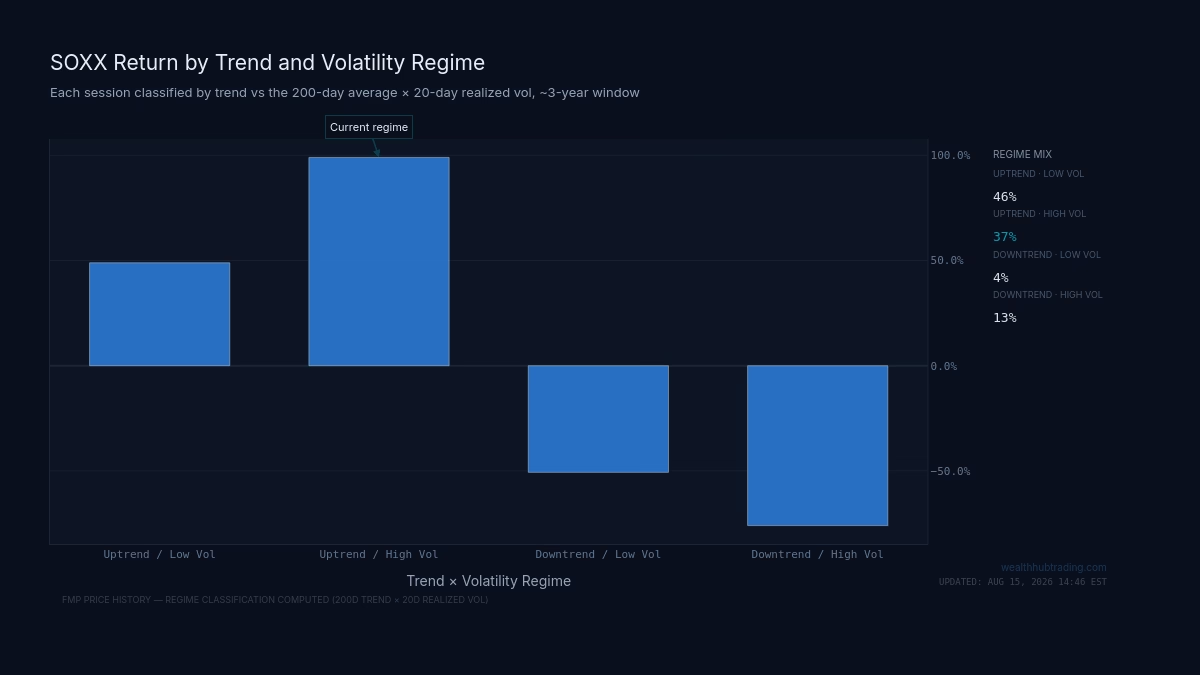
What Would Confirm Or Break The Read
The composition thesis is falsifiable, and the fact that could break it is specific: if operators disclose that the counterparties re-contracting prior-generation fleets are themselves frontier labs rather than inference and internal-workload buyers, the "marginal buyer has changed" read collapses and the supply-scarcity interpretation regains the high ground. That disclosure has not appeared. Until it does, the intuitive reading is that A100 demand in 2025 is value-buyer demand, and value-buyer demand does not underwrite a markup on the whole installed base.
The second confirming condition sits in the depreciation disclosures. If operators with demonstrably deeper workload cascades hold or extend useful-life assumptions while narrow-book operators do not, that is the workload-structure argument showing up in the accounting rather than in theory. Watch whether the durability claim is uniform across the field or clusters where the cascade is deepest.
The thesis breaks if frontier labs turn out to be the ones signing the long-dated prior-generation contracts. Until that shows up in disclosure, the sharper reading is that the compute squeeze is real at the top of the stack and the re-contracting premium is real at the bottom, and the market's mistake is pricing them as the same thing.