The market will read Morpho-1 as a geology story. The geology is the least scarce input. What made Stabroek extraordinary was the speed of conversion from discovery to barrels. Brazil's Equatorial Margin has no comparable conveyor belt. It has one state-controlled operator funding a frontier on its own balance sheet, an environmental licensing history measured in years, and a presidential runoff that will shape the capital allocation behind the drilling. If the Margin becomes another Stabroek, the supply shows up in the 2030s. It does not show up as a variable in today's crude balance.
What Guyana Actually Proved
The numbers in Doomberg's setup are worth reading as a production schedule, not as a GDP miracle. Guyana's real GDP was $5.5 billion in 2020, according to the IMF. It grew 20% in 2021, 63% in 2022, then 34%, 44% and 19% across 2023 to 2025, reaching $27 billion. The IMF estimates another 22% for 2026. With the Errea Wittu joining four other FPSOs on Stabroek, output is set to pass one million barrels per day once full operations begin in December. A decade ago it was zero.
That trajectory came from a specific combination. The discoveries were stacked inside a single block. The operator, ExxonMobil, had partners sharing the bill and had committed to a standardized FPSO design that could be repeated. The host government chose a fiscal deal that critics called one-sided, and that deal is exactly what let capital move quickly. The criticism and the speed were the same feature viewed from two sides. Guyana traded take for tempo, and tempo is what converted a resource into barrels before the commodity cycle could turn against it.
Suriname is the second point on Doomberg's line, and it says something more modest. The GranMorgu development in Block 58 is targeting 220,000 bpd by mid-2028, a respectable result but a fraction of Stabroek. The play extends east, and its quality varies along the way. Treat the ruler with care.
What Morpho-1 Has and Has Not Shown
Petrobras's disclosure in mid-August was narrow. The Morpho-1 well in Block FZA-M-59, more than 100 miles offshore Amapá in almost 9,500 feet of water, confirmed hydrocarbons through well logs. The company released nothing on the quality of the discovery. In October it reported an additional oil-bearing layer in the same block.
Log-confirmed hydrocarbons are the minimum. They do not establish reservoir quality, connectivity, fluid type in commercial terms, or recoverable volume. Two oil-bearing layers in one well are encouraging because stacked pay was part of what made Stabroek repeatable. One well, however, does not make a basin. The industry's usual sequence from here involves flow testing or detailed fluid analysis, then appraisal wells to define the accumulation's size, then a development concept, then an FPSO order. Each of those stages takes time even when results are excellent.
That sequence is the binding constraint on the market consequence. Guyana's first discovery, Liza-1 in 2015, reached first oil in December 2019, which the industry regarded as exceptionally fast for deepwater. Even if Petrobras matched that pace from the August 2026 announcement, first oil would land around 2031. Matching it would require that every step after the logs go well, on a block where the operator has disclosed almost nothing about quality.
The Constraint That Sits Above the Geology
Three features separate the Equatorial Margin from Stabroek, and none of them is about rock.
Single-operator capital. According to the reporting Doomberg cites, Petrobras is the sole owner and operator of FZA-M-59. There is no partner sharing exploration and appraisal risk, unlike Stabroek's consortium. Every appraisal well competes for capital inside one company that is also sustaining a large pre-salt program whose output is, in Petrobras's own framing, gradually maturing. That is the reason the company wants a new frontier. It also explains why the frontier has to fight for budget against the assets paying the bills today.
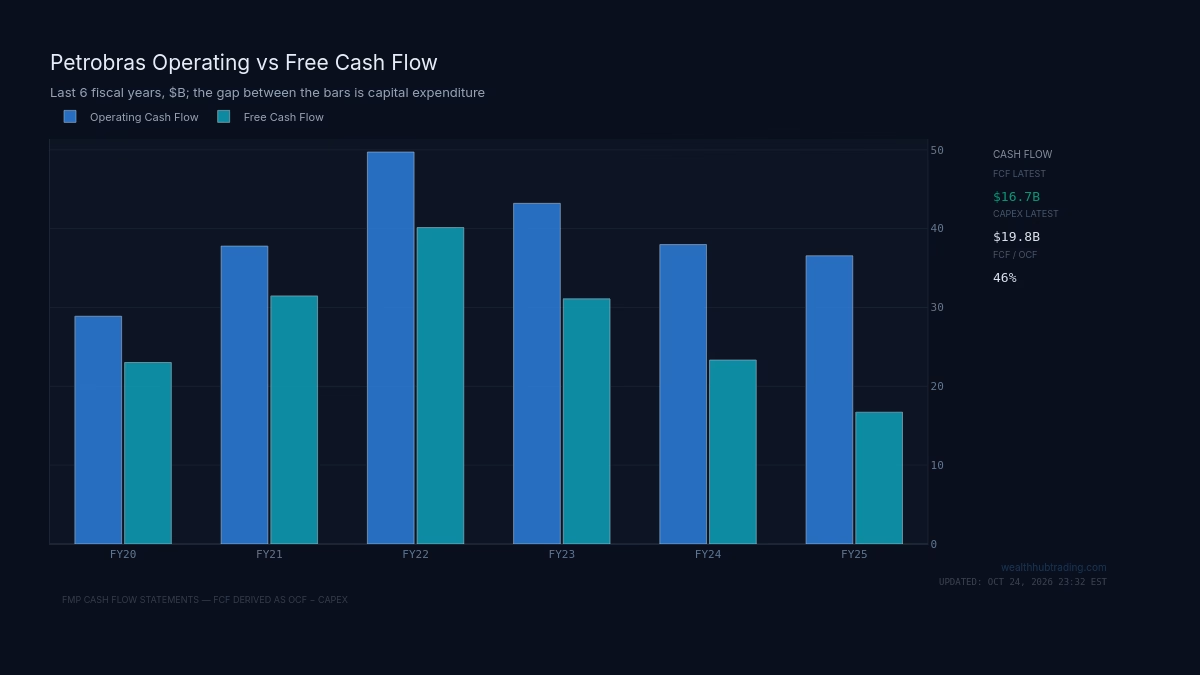
The gap between Petrobras's operating cash flow and its free cash flow is the capital program. That gap is the pool from which an Equatorial Margin appraisal campaign must be funded, alongside pre-salt maintenance and growth, and alongside a dividend policy that a state-controlled company does not set in isolation.
Licensing friction. Drilling in the deepwater portion of the Margin was blocked for years. Brazil's environmental regulator refused Petrobras a license for the Foz do Amazonas area in 2023 before granting one in late 2025. Exploration permission is not development permission. A commercial project 300 miles from the mouth of the Amazon will face a more demanding approvals process than an exploration well, and opposition from environmental groups has not disappeared because a log showed oil. Guyana's government actively cleared obstacles. Brazil's approvals process has repeatedly added them in this region.
Political capital allocation. Brazil's presidential runoff is scheduled for October 25. The constraint here is a policy setting, not a forecast about which candidate wins. Petrobras's capex-versus-payout mix, its appetite for frontier risk, and its willingness to bring in partners all sit within a government's influence over a state-controlled company. A Margin discovery is worth more to an administration that will fund appraisal aggressively and expedite licensing. It is worth less to one that prefers to extract cash from the pre-salt and treat the frontier as optionality. The election does not change what sits under the seabed. It changes the discount rate the operator effectively applies to it.
The Case Against This Read
The strongest counterargument is that Petrobras is one of the most capable deepwater operators in the world and has done this before. The pre-salt was dismissed as technically forbidding before Petrobras turned it into the backbone of Brazilian production. The company has the engineering staff, the FPSO experience, and a domestic supply chain that a frontier country like Guyana lacked entirely. If Morpho's fluids and reservoirs prove high quality, Petrobras could plausibly compress the appraisal timeline by reusing pre-salt development templates and contracting FPSOs from the same yards that serve its Santos Basin program.
A second counterpoint is geological momentum. Guyana and Suriname show that the Equatorial Atlantic play works at scale in at least part of the region. A second oil-bearing layer in Morpho-1 is consistent with the stacked-reservoir architecture that made Stabroek repeatable.
Both points have force, and neither removes the queue. The pre-salt also took years to move from discovery to meaningful production. Pre-salt development templates also compete for the same FPSO slots and engineering crews the Margin would need. The regional history urges more caution than the ruler suggests. In 2011, the Zaedyus well off French Guiana found oil on what was pitched as the South American mirror of Ghana's Jubilee field. Follow-up wells disappointed and the play went quiet for years. Equatorial Atlantic margins have sometimes produced a lucky first well followed by an expensive lesson in reservoir heterogeneity. That is a pattern to weigh against Morpho-1, not a law. Stabroek itself is the counterexample. It is still a reason to price a single logged well as a single logged well.
Who Clears the Constraint, and What Would Change the View
For the oil market, the read is straightforward. The Equatorial Margin is a 2030s supply option, not a current balancing variable. Anyone treating the Morpho headlines as bearish for medium-term crude is reacting to tonnage that, on the most optimistic timeline, cannot flow for roughly five years. Guyana's growth through December and Suriname's 2028 target are the Atlantic barrels that matter for the next three years. Both belong to the ExxonMobil-led and TotalEnergies-led developments, not to Brazil.
For Petrobras equity, the discovery is an option whose value depends on who controls the strike price. The appraisal program is the strike, and it is paid in capex. The election is the first variable to resolve. The second is the company's next strategic plan, which Petrobras typically publishes in late November. That plan will show whether the Equatorial Margin receives a dedicated appraisal budget and a well count, or stays a line item in exploration.
Three observable conditions would move the read toward a genuine Stabroek analog:
- Petrobras discloses fluid quality, net pay, or a flow test result for Morpho-1, replacing "hydrocarbons confirmed by logs" with numbers.
- An appraisal well is spudded in FZA-M-59 or an adjacent block within the next planning cycle, signaling capital commitment rather than announcement.
- Petrobras brings in a partner through a farm-down or invites one into adjacent acreage, which would show that the company is solving for tempo the way Stabroek's consortium did.
Absent those, the Equatorial Margin is a real resource sitting behind a constraint that is capital, regulatory, and political, not geological. Guyana's lesson is that the country that clears the queue fastest captures the cycle. Brazil has the rock. Its next two months of decisions will show whether it intends to compete on speed.