When Robinhood launched commission-free trading in 2013, the obvious question was how a broker that charged nothing per trade could survive. The answer ...
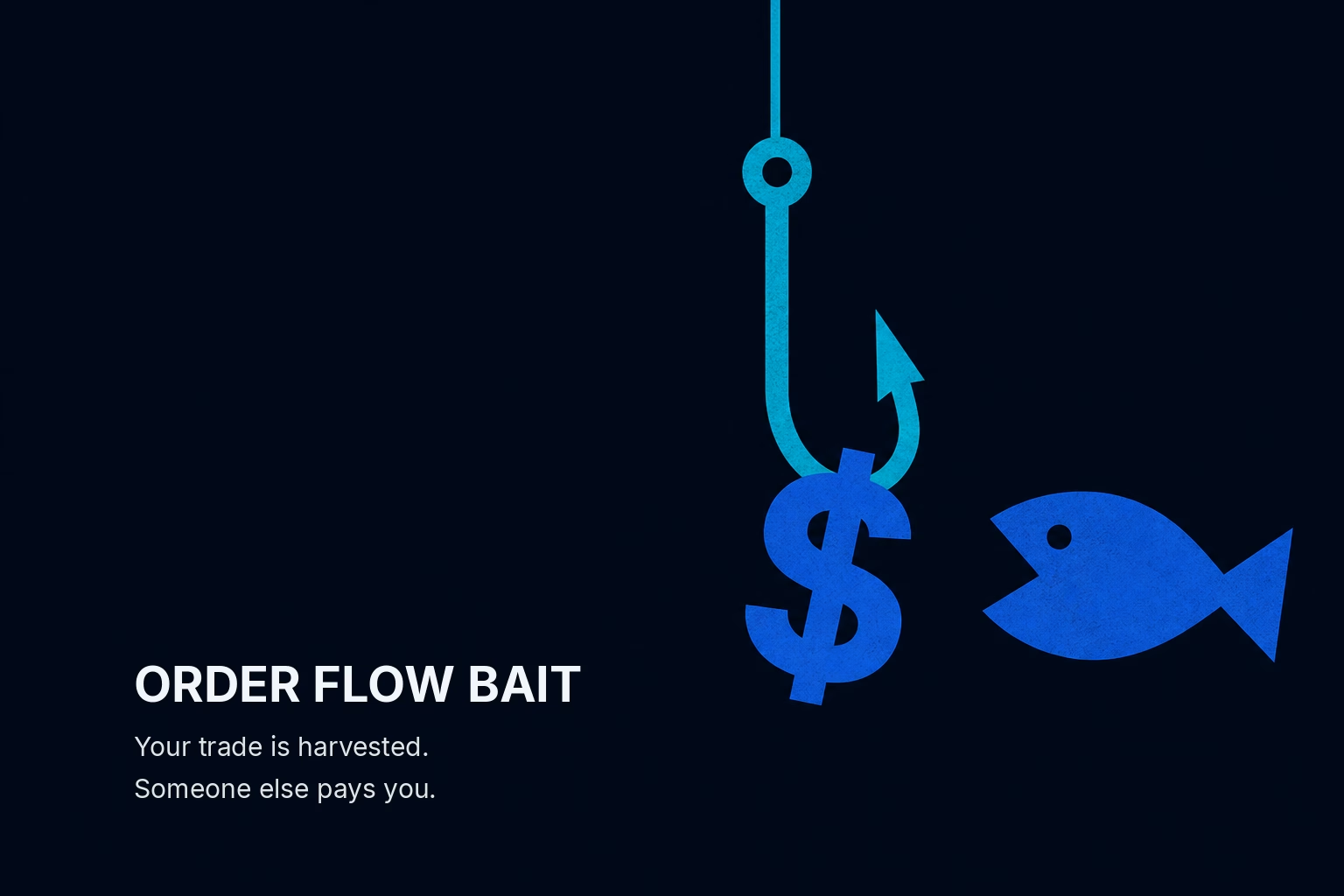
When Robinhood launched commission-free trading in 2013, the obvious question was how a broker that charged nothing per trade could survive. The answer was hiding in the plumbing. Robinhood did not sell trades to its customers; it sold its customers' trades to someone else. That someone else was a wholesale market maker, a firm like Citadel Securities or Virtu, willing to pay for the right to fill those orders. The arrangement has a name that sounds procedural and dull: payment for order flow, the practice of a broker routing customer orders to a wholesaler in exchange for a per-share payment.
The dull name hides the interesting mechanism. Payment for order flow does not work because retail orders are large or profitable in the obvious sense. It works because retail orders are safe.
Why safe orders are worth paying for
Start with the problem a market maker actually has. A market maker is a firm that stands ready to buy and sell a stock continuously, quoting a price to buy (the bid) and a slightly higher price to sell (the ask). The gap between them, the bid-ask spread, is the market maker's gross compensation for providing that service.
The danger in this business is not volatility. It is being on the wrong side of someone who knows more than you do. When a hedge fund with a research edge sells you a stock, it is often selling because the stock is about to fall. You buy at your bid, the price drops, and you lose. This is adverse selection: the risk that the person trading against you is trading precisely because they have information you lack. A market maker who fills only informed orders bleeds money regardless of how wide the spread is.
Retail orders are different. A person buying twenty shares of Apple because they got a bonus, or selling a fund position to pay for a kitchen, is not trading on an information edge. The order is, in the language of the trade, uninformed or benign flow; it carries no predictive signal about the stock's next move. Filling that order is close to a coin flip, and a coin flip with a spread attached is a business.
This is the part intuition gets wrong. Most people assume the wholesaler pays for order flow because retail volume is large. The volume matters, but the real prize is the quality of the flow: orders that can be filled without being systematically picked off. The wholesaler is paying to trade against people who are not trying to beat it.
What this means for you: the reason your broker can route your order for a fraction of a cent per share is that you, statistically, pose no threat to the firm filling it.
How the payment gets split, and where price improvement comes from
Once you see that safe flow is valuable, the economics fall into place. The wholesaler captures the spread on a low-risk trade, keeps part of the gain, and returns two slices to the rest of the chain.
The first slice goes to the broker as the literal payment for order flow. The second slice goes to you, as price improvement, a fill at a price better than the best publicly quoted bid or ask at the moment your order arrived. If the public market shows a stock offered at $50.00 and the wholesaler fills your buy at $49.998, you received two hundredths of a cent per share of improvement. On its own that is trivial. Aggregated across billions of shares, it is a real transfer, and it is the honest core of the industry's defense: retail traders often do get filled at prices slightly better than the screen shows.
Trace the causal chain plainly. Your order is uninformed, so the wholesaler faces little adverse selection filling it. Low adverse selection means the wholesaler keeps more of the spread. Keeping more of the spread lets it pay the broker and still improve your price and still profit. Every link in that chain depends on the first one: your order being safe to trade against.
Consider a simplified fill. Suppose the national best bid is $99.98 and the best offer is $100.02, a four-cent spread. You send a market buy for 100 shares. The wholesaler fills you at $100.01, a one-cent improvement worth $1.00 to you, then lays the position off or waits for a matching seller, capturing most of the remaining spread against a near-random counterparty. Out of its gross, it pays your broker perhaps a fraction of a cent per share. Everyone visible in the transaction is better off than the public quote suggested.
What this means for you: price improvement is real, but it is a rebate carved out of a spread the wholesaler was able to capture cheaply because your order carried no information. You are being paid a little for being harmless.
Who actually pays
If the broker earns a payment, you get price improvement, and the wholesaler profits, the natural question is who absorbs the cost. The answer is the group that never appears in your trade confirmation.
When wholesalers siphon off the safe, uninformed orders, those orders stop reaching the public exchanges. What remains on the exchange is a higher concentration of informed flow; orders from participants trading on genuine information or edge. A market maker quoting on the public exchange now faces a counterparty pool that is, on average, more dangerous than before. Adverse selection on the exchange rises.
A market maker facing worse adverse selection protects itself the only way it can: by widening its quoted spread. So the public spread, the reference price against which your improvement is measured, drifts wider than it would be if all flow, safe and informed alike, met in the same place. The cost of the arrangement does not vanish. It migrates onto whoever still has to trade on the exchange against the informed remainder: institutions, pension funds, and anyone routing an order that must interact with the public book.
This is the mechanism's genuinely non-obvious feature. The retail trader sees a small benefit and concludes the system works for them. It does, locally. But the price improvement is measured against a benchmark, the public quote, that the same order-segmentation process has quietly degraded. You win against a yardstick that has been bent.
What this means for you: the "free" in free trading is not free to the market as a whole. It is a redistribution, and the party bearing the cost is the large institutional trader whose fund may sit inside your retirement account.
When the mechanism strains
The arrangement holds only as long as retail flow stays reliably uninformed. That assumption is not a law of nature.
The January 2021 episode in GameStop showed what happens when retail flow briefly stops being benign. When a large, coordinated crowd trades the same direction on the same catalyst, the flow acquires a signal; it is no longer a set of independent coin flips. Wholesalers filling that flow faced real directional risk, and the strain ran back up the chain to the brokers, some of which restricted buying in the affected names. The restriction was not primarily malice. It reflected the collateral and risk plumbing seizing when supposedly safe flow turned informed and correlated all at once.
The mechanism also strains under regulatory pressure. Regulators periodically propose rules to force more retail orders into open auctions where multiple market makers compete for each fill, on the theory that competition would return more of the spread to the trader. Whether such rules would help retail or simply shift the surplus among intermediaries is genuinely contested, and I will not assert an outcome the record does not yet support. The structural point stands regardless: the value in the system originates in flow segmentation, so any rule that changes how flow is segmented changes who captures the surplus.
What this means for you: the model is stable in normal conditions and fragile in exactly the moments retail traders care about most, when a crowd moves together and the safe flow stops being safe.
The one thing to hold onto
Payment for order flow is best understood as a market for safety, not a market for volume: wholesalers pay to trade against uninformed retail orders, return part of the gain as price improvement, and push the residual cost onto the informed flow left stranded on the exchange. Understanding that lets you read the "commission-free" pitch accurately. You are not the customer being charged, and you are not quite the customer being served. You are the safe counterparty whose harmlessness is the product being sold, and the small rebate you receive is your cut for playing that role well.