For one afternoon in October 2008, the most valuable company on earth was a carmaker whose share price came from the hedge books of the banks that had sold its largest shareholder a pile of options, not from any earnings forecast.
The afternoon Volkswagen outgrew the world
On Sunday, October 26, 2008, Porsche disclosed that it controlled about 74% of Volkswagen's ordinary shares: roughly 43% held outright and roughly 31% through cash-settled options. The state of Lower Saxony held another 20% and was not selling. Simple subtraction left a free float of around 6%. Short sellers, who had bet that VW was overvalued in the middle of a global auto collapse, held a position larger than that float.
VW ordinary shares had closed the previous Friday near €210. By Tuesday, October 28, they traded above €1,000 intraday, briefly giving Volkswagen a market value larger than ExxonMobil's. No analyst raised a forecast. No new car was sold. The price was set by a single question: who had to buy, and how much stock was left for them to buy?
The banks that wrote Porsche's cash-settled options are the overlooked actors in this story. A cash-settled option pays the holder the price gain without delivering shares. The banks that sold those options were exposed to every euro of upside, so they hedged by buying VW stock themselves. That hedge quietly took shares out of circulation. Porsche never owned them, but nobody else could get them either. The shorts were competing with the dealers' hedges for the same tiny float, and every euro the price rose increased what the dealers needed to hold.
The squeeze broke on October 29, when Porsche announced it would release up to 5% of the stock through its options positions. The supply problem eased and the price fell back. The valuation story had not changed. The flow was simply finished.
What this means for you: when a price is moving on a supply constraint created by hedging, the useful question is when the constrained buyer stops needing to buy. Whether the price is justified tells you little.
The hedging loop behind the episode
Reflexivity is the term George Soros popularized for a feedback loop in which market prices do not just reflect fundamentals but change them, and the changed fundamentals then justify the new price. Dealer positioning is the most mechanical form of that loop, because dealers are not making judgments. They follow risk rules.
Start with delta, the amount an option's value changes for a $1 move in the underlying asset. A dealer who sells call options is short delta, so it buys shares to stay neutral. Gamma measures how fast delta itself changes as the price moves. A dealer who has sold options is short gamma: as the price rises, the calls it sold gain delta, and the dealer must buy more shares to stay hedged. As the price falls, it must sell. Short-gamma dealers trade in the same direction as the market, every time.
A worked example makes the size concrete. The figures are illustrative, not drawn from a specific stock.
Shares to hedge per $1 move = gamma × contracts × 100
Suppose dealers are net short 10,000 call contracts, each covering 100 shares, with a gamma of 0.02 per $1. Each $1 rise forces them to buy 0.02 × 10,000 × 100 = 20,000 shares. A $5 rally forces 100,000 shares of buying. If the stock trades 2 million shares a day, hedging alone is 5% of daily volume, all of it bidding in the direction of the move. Gamma also rises as the price approaches the strike, so the sixth dollar demands more than the first.
The reverse is long gamma. A dealer that has bought options sells into rallies and buys into dips to stay neutral, which dampens moves. The same market can calm itself one week and amplify itself the next, depending on which side of the options trade dealers ended up holding.
What this means for you: the sign of dealer gamma tells you whether hedging will lean against a move or chase it. That matters more than the size of the open interest.
Why dealers have no choice
Why does this matter? Because the hedging is compelled. Nobody is forecasting anything.
Market makers and bank trading desks run under delta-neutral risk mandates: internal limits that cap how much directional exposure a desk may carry overnight. Their capital charges under bank regulation rise with unhedged risk, and their value-at-risk limits (a statistical estimate of the worst expected daily loss) tighten automatically when volatility rises. A desk that falls out of compliance has to trade back into it, at whatever price the market offers. The dealer earns its living on the bid-ask spread and the volatility premium it charged when selling the option. Directional bets are not part of the business, so it hedges mechanically and immediately.
That institutional constraint is what turns a price move into a fundamental change. Three channels carry it.
The first is collateral value. Assets pledged as collateral are marked to market. When flows push the price down, lenders demand more collateral or apply larger haircuts (the discount a lender applies to a pledged asset's value). The borrower sells to meet the call, which pushes the price down again. The September 2022 UK gilt crisis ran on exactly this circuit: pension funds using liability-driven investment strategies faced collateral calls as long gilt yields jumped, sold gilts to meet them, and drove yields higher until the Bank of England stepped in to buy long-dated gilts on September 28.
The second is funding cost. A company whose share price is squeezed upward can issue equity cheaply. One whose bonds are being dumped by forced sellers pays more to refinance. In both cases the flow changes the actual cost of capital, a real input to the business that the flow itself created.
The third is forced hedging feeding volatility. Rising realized volatility tightens risk limits across every desk at once, which forces more selling, which raises volatility. The loop closes on itself.
What this means for you: if a price move changes someone's collateral, funding, or risk limit, expect the move to generate more of its own flow before it fades.
When the loop breaks
The mechanism has hard limits, and misreading them is the most common way to lose money on it.
Expiration removes the fuel. Options that expire take their gamma with them. A squeeze driven by short-dated options can lose its engine on a single Friday, with no change in news. This also explains why flow-driven moves often reverse sharply after major monthly expirations.
The gamma sign can flip. When the price travels far enough, dealers can move from short gamma to long gamma, and the same hedging that amplified the move begins to absorb it. The level where this happens shifts daily as positions open and close, so a precise threshold from last week is stale this week.
The supply constraint can loosen. Volkswagen ended when Porsche released stock. Any squeeze resting on scarce float ends when a large holder decides to sell into the price, and large holders tend to do so precisely because the price has run so far.
Speed can outrun the hedge. If the market gaps faster than dealers can trade, hedging stops being smooth and becomes a scramble at the open, which produces the violent single-session moves that look irrational on a fundamentals chart.
The misapplication to avoid is treating reflexivity as a permanent state. It describes a regime that lasts as long as the constrained flow lasts. It is not a new valuation framework.
What this means for you: identify what ends the flow (an expiry date, a holder who can sell, a central bank that can buy) before you decide how long the trend can run.
The modern version runs faster
The same loop operates today with shorter fuses. Options volume has shifted heavily toward very short-dated contracts, including same-day expiries, which concentrates gamma into hours rather than weeks. Volatility-targeting funds and trend-following CTAs (commodity trading advisors, which size positions by recent trend and volatility) add another layer of rule-based selling when volatility rises.
August 5, 2024 showed how these layers stack. The unwind of yen-funded carry trades hit Japanese equities first; the Nikkei 225 fell 12.4% that day. In New York, the VIX printed an intraday high near 65, a level last seen in the 2020 pandemic crash, before closing below 40. Within weeks it was back under 20. Nothing about US corporate earnings changed by that much in that time. Risk limits, collateral, and hedging needs changed, and when the forced sellers finished, the index retraced.
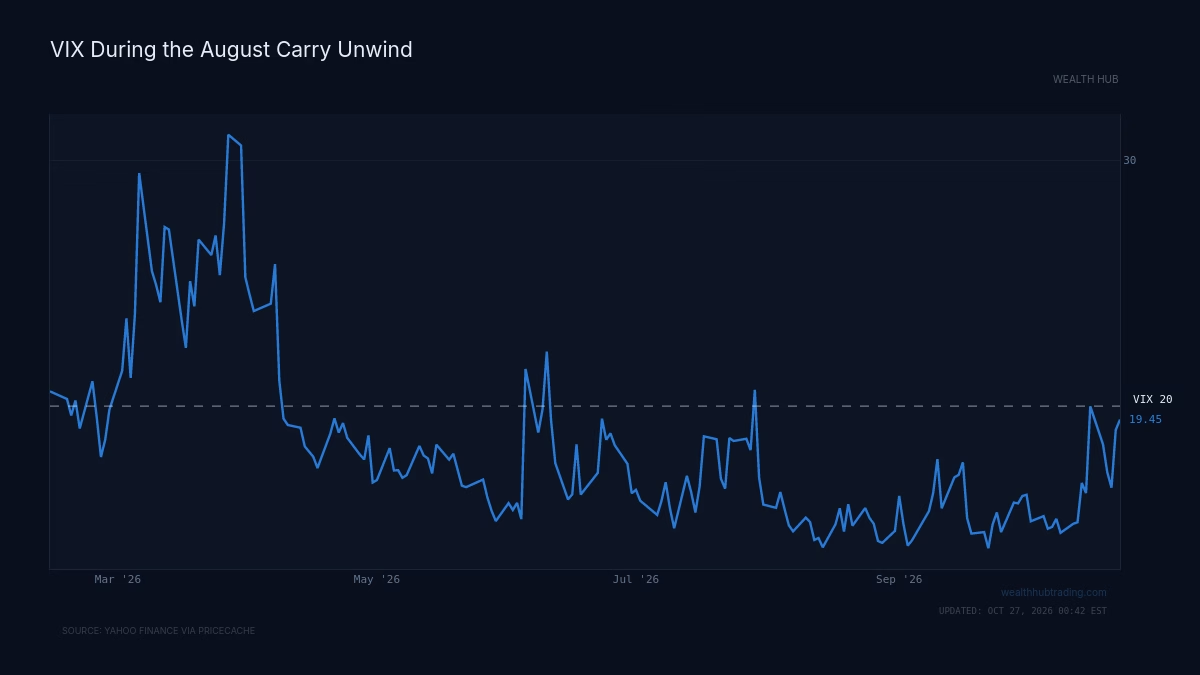
Absent live positioning data for any specific instrument here, the right claim is structural: the more of a market's daily volume comes from rule-bound hedgers, the more often price will overshoot any fair-value estimate in both directions, and the faster those overshoots will reverse once the rules are satisfied.
What this means for you: in a market with heavy short-dated options activity, a sharp move tells you less about new information and more about who was forced to trade.
Reading the flow before the story
The mechanism comes down to one sentence: when dealers are short gamma and price changes collateral, funding, or risk limits, the flow writes the fundamentals until it is spent, and only then do fundamentals reassert themselves.
The practical discipline follows directly. Do not fade a flow-driven trend on valuation alone, because the trend's end is set by the flow's exhaustion point, and valuation cannot tell you when that comes. Ask who is forced to trade, in which direction, and what releases them: an expiry, a holder willing to sell, an official buyer. Size positions for the overshoot, since the fair-value model will be wrong for longer than it seems it should be. Once the releasing event arrives, move quickly, because the snapback in a reflexive regime tends to be as mechanical as the move that preceded it.