
On many quiet trading days the tape drifts lower into the close with no headline attached. Traders scan the wires, find nothing, and shrug. The move was...
The afternoon the S&P fell on no news
On many quiet trading days the tape drifts lower into the close with no headline attached. Traders scan the wires, find nothing, and shrug. The move was real, and it had a cause, but the cause was not in the news. It was in the options market, where dealers who had sold contracts to the public were forced to sell the underlying index to keep their own books neutral. Volatility ticked down, the clock ticked forward, and their required hedge changed. So they sold. No fundamental event occurred. The flow occurred.
This is the part of the market most participants never see. They watch price and they watch news, and they assume that when price moves without news, the move is noise or sentiment. Often it is neither. It is a mechanical hedging flow generated by two forces with unfamiliar names: vanna and charm. Understanding them explains why markets sometimes grind in one direction for hours with no story behind the move.
What dealers are actually managing
To see where these flows come from, start with what an options dealer does. When you buy a call option, someone sells it to you. That seller is usually a market maker, a dealer whose business is providing liquidity, not betting on direction. Having sold you the call, the dealer is now short that option and exposed to the market moving against them.
To neutralize the directional risk, the dealer hedges. The first-order hedge is delta, the option's sensitivity to the price of the underlying. If the option behaves like 40 shares of the index, the dealer buys 40 shares to offset it. Do this across an entire book and the dealer is, for a moment, indifferent to which way the market goes. That indifference is the whole point. The dealer earns the spread and the premium, not the direction.
The problem is that delta does not stay still. It changes as the underlying moves, as volatility shifts, and as time passes. Every time delta changes, the dealer must adjust the hedge, buying or selling the underlying to stay neutral. Those adjustments are the flows nobody sees. They are not driven by a view. They are driven by the arithmetic of staying neutral.
Most explanations of dealer hedging stop at gamma, the change in delta caused by a move in the underlying price. Gamma is the flow you get when the market itself moves. Vanna and charm are the flows you get when the market does not move at all.
Vanna: the flow that volatility creates
Vanna is the sensitivity of an option's delta to a change in volatility. Put plainly: when implied volatility rises or falls, the delta of the dealer's position changes, even if the price of the underlying has not moved one tick. The dealer must then rebuild the hedge to match the new delta.
Here is why this matters. Implied volatility and the direction of the market are usually linked. When equities fall, volatility tends to rise; when equities rally, volatility tends to drift lower. So a change in volatility is often the first thing that happens, and the vanna hedge follows.
Consider a concrete case. Dealers across the market are typically short downside put options, having sold crash protection to investors. Those short puts carry vanna. When volatility falls on a calm day, the delta of those short puts shifts in a way that requires the dealer to buy the index to stay neutral. That buying supports the market. It is why a market can grind higher on a quiet day when volatility is bleeding lower: the hedging machinery is a steady, mechanical buyer, and no news is required.
Now run it in reverse. When volatility spikes, the same vanna flips the required hedge, and dealers become forced sellers into a falling market, accelerating the decline. The flow that gently supported the market on the way up becomes the flow that intensifies the drop. This is the mechanism behind the observation that selloffs feed on themselves. The feedback is not psychological. It is a hedging identity.
The practical takeaway: when you see volatility falling on a session with no obvious catalyst, expect a mechanical bid under the market. When volatility is spiking, expect that same machinery to be selling, and do not assume a dip is finished simply because no bad news has arrived.
Charm: the flow that time creates
Charm is the sensitivity of an option's delta to the passage of time. Every option has an expiration date, and as that date approaches, the option's delta drifts toward one of two endpoints: it either behaves fully like the underlying or it behaves like nothing at all. This drift happens regardless of whether the price moves.
Because the dealer's hedge tracks delta, and delta is drifting purely from time passing, the dealer must adjust the hedge every day the calendar advances. This is charm. It is the reason certain flows cluster around the end of the trading day and intensify as major expiration dates approach.
The clearest place to see charm is the run into a large monthly or quarterly options expiration. As thousands of contracts approach expiry, their deltas resolve toward zero or one, and dealers unwind or rebuild hedges accordingly. The flows are predictable in timing because they are driven by the clock, not by events. A market that pins near a large strike price into a Friday expiration is often being held there by charm-driven hedging, not by any collective decision that the level is fair.
The practical takeaway: the days around monthly and quarterly expirations carry a mechanical flow that has nothing to do with fundamentals. If you are trading those sessions, you are trading against a hedging schedule, and treating the resulting moves as information about value will mislead you.
When the machinery misleads you
These flows are real, but reading them is where most people go wrong, and it is worth being honest about the failure modes.
The first mistake is assuming dealers are always positioned the same way. The direction of vanna and charm flows depends entirely on whether dealers are net long or net short options, and on which strikes. When dealers are net long gamma, their hedging dampens moves; when they are net short, it amplifies them. The sign can flip, and it flips at levels that shift daily. A flow you correctly identified last week can run the other way this week because positioning changed. There is no fixed rule that says dealers buy dips.
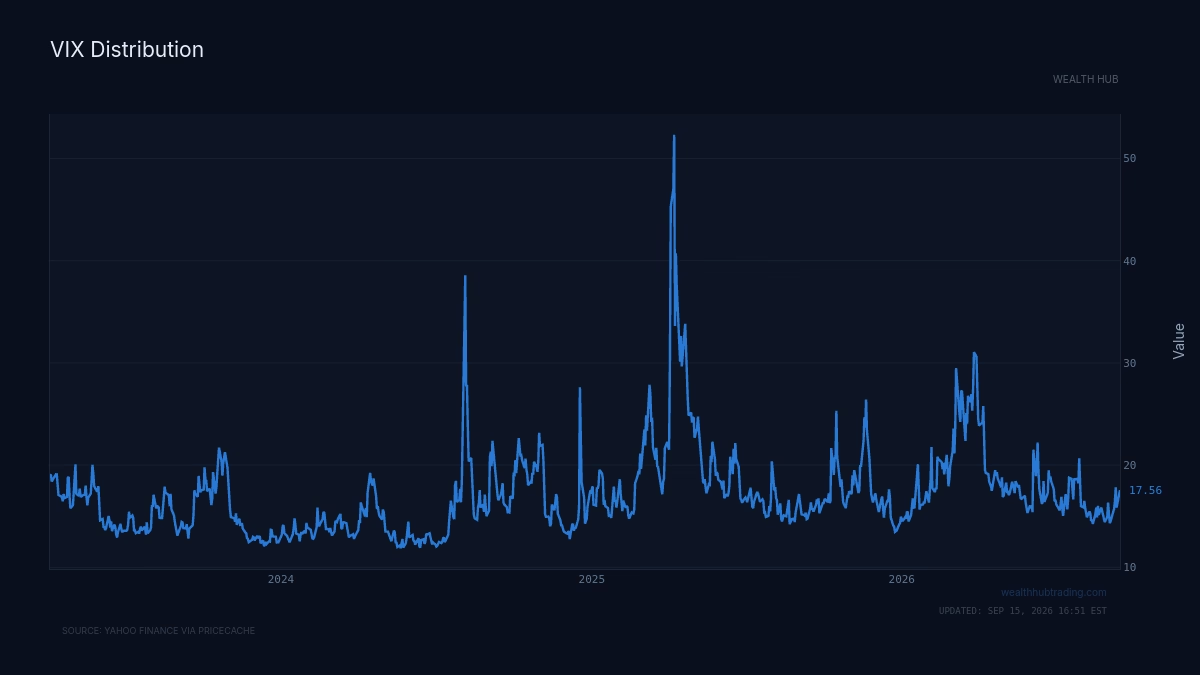
The second mistake is treating these flows as a standalone trading signal. Vanna and charm shape the path of the market between events, but a genuine fundamental shock overwhelms them instantly. When real news hits, positioning resets and the mechanical flows are swamped by directional repositioning. The August 2024 volatility spike, when a sudden unwind sent the VIX to an intraday reading near 65, is a reminder that when the move is large and fast enough, dealers cannot hedge smoothly at all, and the orderly mechanics break down into a scramble.
The third mistake is precision you do not have. The exact size and sign of aggregate dealer positioning is not public. It is estimated, and estimates disagree. Anyone claiming to know the precise gamma or vanna exposure of the entire market to the dollar is selling certainty that does not exist. The honest use of these concepts is directional and conditional, not a number you can trade to two decimal places.
What to actually do with this
The value of understanding vanna and charm is not a new indicator. It is a better default explanation for the moves that used to look like noise.
When the market drifts and there is no story, stop assuming the move is meaningless. Ask whether volatility is falling, which points to a vanna bid, or whether a large expiration is approaching, which points to charm-driven flows. When a selloff accelerates faster than the news seems to justify, consider that a volatility spike may have flipped the hedging machinery from buyer to seller. And when the market pins to a round number into a Friday, recognize the pin for what it usually is: a hedging artifact, not a verdict on value.
The second-order flows nobody sees are simply the arithmetic of firms staying neutral as volatility and time change around them. Once you can name that arithmetic, a large share of the market's otherwise inexplicable behavior stops being inexplicable, and you stop mistaking mechanical flow for information.