The number that actually matters at IREN is not the Microsoft contract or the NVIDIA partner status. It is that the company spent $1.4 billion in cash on capital expenditures against $501 million of revenue in its FY2025 year, burned through free cash flow of negative $1.1 billion, and funded the gap by selling $602.7 million of new stock. That is the entire griftco model rendered in filing lines, and it is the frame the headline narrative is built to keep you from looking at.
What the label actually describes
There is a useful distinction buried in the fintwit habit of calling everything a shitco. A shitco is a company you dislike. A griftco is something more specific: a business that is not yet a business, sustained on the promise of a future that requires enormous capital raised at enormous valuations, whose executives get paid handsomely along the way, and which often leans on government contracts or regulatory tailwinds to survive. The insult is real. So is the observation that these things can become spectacularly valuable, because they run on reflexivity. If the stock is high enough, the raise is large enough, and the raise builds the future the stock was promising.
Tesla is the archetype. A decade of robotaxi imagery that has still not arrived nonetheless funded a trillion-dollar business earning billions a year. The promise did not have to be true on time. It only had to be credible long enough to raise the money that made it partly true. That is the mechanism, and it is why a griftco is worth studying rather than simply shorting.
The bitcoin miners are the purest expression of the type. They rode inflated valuations to build out power-hungry infrastructure that would have destroyed capital on its stated purpose, until AI compute demand created a power squeeze those same sites were perfectly positioned to fill. Assets that were nearly worthless became fortunes overnight. Nobody underwrote that pivot. The reflexivity funded the buildout, and the buildout happened to land in the right place.
Where IREN sits on the ladder
IREN is the miner that executed the pivot better than almost anyone. Former bitcoin miner, now positioned as an AI cloud operator, preferred NVIDIA partner, holder of a large Microsoft contract, and the beneficiary of a stock that has run hard since the turn began. On the narrative, IREN is the griftco that graduated.
The FY2025 10-K complicates that story in a specific, unglamorous way. Revenue was $501 million and operating income was $22.1 million, for an operating margin of 4.4 percent. That is a real profit line, not a fake one, and it is worth crediting. But the cash flow statement is where the model lives. Operating cash flow of $245.9 million was dwarfed by $1.4 billion of capex, which is 274 percent of revenue and 558 percent of operating cash flow. Free cash flow came in at negative $1.1 billion. The company is not converting a business into cash. It is converting cash into a business, at a rate its own operations cannot come close to funding.
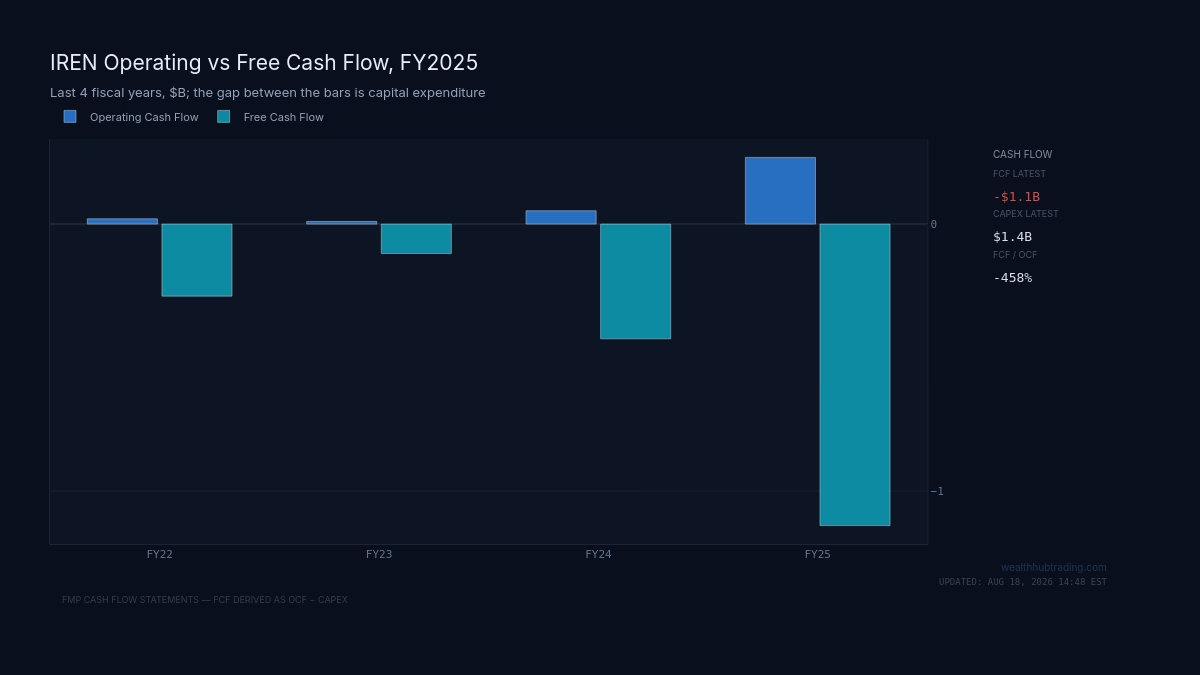
The funding for that gap is the tell. Net common stock issuance was $602.7 million in the year. Total debt sits at $964.2 million against total assets of $2.9 billion, with a cash balance of $564.5 million. This is a company building its future by selling equity and taking on leverage, which is exactly what the reflexivity model requires and exactly what the graduation narrative wants you to stop noticing. The Microsoft contract and the NVIDIA relationship are the credibility that keeps the stock high enough to fund the next raise. That is not a criticism of the strategy. It is a description of it.
Alignment versus enrichment
The reason to watch a griftco closely is that it is never shy about paying insiders, and it is frequently willing to play the edges on compensation. When a company of this profile makes a large, structured equity grant to its executives, the grant is data. The question it forces is whether the award aligns management with the shareholders funding the buildout, or whether it enriches management ahead of a future that has not yet arrived.
That distinction is not answered by the size of a grant. It is answered by its structure. An alignment grant vests on outcomes the outside shareholder also needs: sustained stock price hurdles held over time, delivered capacity, contracted revenue that converts to cash. An enrichment grant vests on presence, on time served, or on hurdles set low enough that the reflexivity does the work regardless of whether the operating business ever stands on its own. In a company diluting shareholders by hundreds of millions a year to fund capex it cannot self-finance, the compensation structure is the clearest available signal of whose future is actually being built.
Stock-based compensation ran $42.6 million in FY2025. That is a real, ongoing dilution layered on top of the $602.7 million of issuance, and it is modest against the raise but not trivial against the $22.1 million of operating income. When operating income is smaller than the year's stock comp, the comp package is not a footnote to the business. It is a claim on it.
The countercase, stated fairly
The strongest argument against reading IREN as a griftco is that the pivot is not a promise anymore. It is contracted. A signed Microsoft agreement and preferred NVIDIA status are not robotaxi renderings. They are commercial relationships with counterparties who did their own diligence, and they sit behind a genuine operating profit rather than a projected one. On that view, the capex is not speculative buildout funded by narrative. It is committed capacity against demand that already exists, and the negative free cash flow is simply what growth capex looks like before the assets are switched on.
That case has real weight, and it is why the operating margin matters. A pure griftco does not post a profit; IREN does. But the case turns entirely on whether the contracted revenue is large and durable enough to make $1.4 billion of annual capex look like investment rather than dependence. Standardized filings do not let an outsider size the Microsoft contract or its duration, and sector comparability is genuinely limited here. The peer set the data pulls, financial and crypto-adjacent names rather than power-and-compute operators, is not a clean comparison, so the capex-intensity gap against those peers should be read as directional, not decisive.
The condition that resolves it
The thesis breaks the moment operating cash flow scales fast enough to carry the capex without another equity raise. If the contracted revenue converts and IREN can fund its buildout internally, the griftco frame stops applying and the graduation narrative was right. Until that happens, the cleaner reading of the FY2025 filings is that IREN remains a reflexivity machine that has landed better collateral than its peers, still funding its future by selling the story that keeps the stock high enough to sell more stock.
The two lines to watch are the ones the headline never mentions. First, whether the next fiscal year narrows the gap between operating cash flow and capex, or whether the equity issuance line grows again to cover it. Second, whether the next major executive grant vests on price and delivery hurdles the outside shareholder shares, or on time and presence. One of those funds a business. The other funds the people building it. On the current evidence, IREN has earned the benefit of the doubt on the first and has not yet given the market enough to judge the second.