In the autumn of 2008, a strange thing happened to some of the safest corporate bonds in the world. A five-year bond issued by a solid company would tra...
The two instruments referenced the identical credit event, yet the market was pricing that credit two different ways at the same moment. The gap between them, known as the CDS-bond basis, went deeply negative, in some names by several hundred basis points.
A credit default swap, or CDS, is a contract that pays out if a borrower defaults; buying one is economically similar to buying insurance on a bond. In theory, if you own a corporate bond and also buy CDS protection on the same issuer for the same maturity, you have hedged away the default risk. What remains should be a nearly riskless return roughly equal to a Treasury yield. If the bond yields far more than that combination costs, you are being paid to hold something close to riskless. That is an arbitrage, and arbitrage is supposed to disappear the instant someone notices it.
In 2008 it did not disappear. It got wider, and it stayed wide for months. Understanding why is the whole point of the basis.
What the basis is and why it should be zero
The CDS-bond basis is defined simply: it is the CDS spread minus the bond's credit spread over a reference rate. When the two prices agree, the basis is zero. A positive basis means CDS protection is expensive relative to the bond. A negative basis means the bond is cheap relative to the protection, which is the case that dominated 2008 and every crisis since.
The reason it should be zero is a no-arbitrage argument. Suppose the basis is negative, meaning the bond yields more than the cost of insuring it. You buy the bond, you buy CDS protection, and you have manufactured a position that earns more than the riskless rate while carrying almost no default risk. If default happens, the CDS pays you. If it does not, you collect the extra yield. Rational traders should pile into this until buying pressure lifts the bond price, buying pressure lifts the CDS cost, and the gap closes.
The clean version of this argument assumes something that is almost never true in a crisis: that you can fund the bond purchase cheaply and hold the position to maturity. Strip away that assumption and the arbitrage stops being an arbitrage. It becomes a trade that requires capital, and capital is exactly what vanishes when the basis is at its most attractive.
The practical takeaway here is that "no-arbitrage" is a statement about a frictionless world. Real basis trades live and die on the frictions.
The frictions that keep the same credit priced twice
Three specific frictions do the work, and each one is a cost that the textbook version ignores.
The first is funding. To own a corporate bond you must pay for it, and unless you have unlimited cash you borrow against it in the repo market, the market where a bond is used as collateral for a short-term loan. The rate you pay to fund the bond, and the haircut (the fraction of the bond's value the lender refuses to lend against), determine whether the trade is profitable at all. In 2008, repo haircuts on corporate bonds jumped from a few percent to twenty percent or more, and repo rates for anything below the safest collateral spiked. A trade that clears easily at a two percent haircut becomes unfinanceable at twenty percent, because you now need far more of your own capital to hold the same bond.
The second friction is balance-sheet cost. A dealer or a hedge fund cannot expand its book without limit. Every position consumes balance-sheet capacity, and since the post-crisis leverage rules, that capacity carries an explicit regulatory charge. Holding a cash bond uses balance sheet in a way that writing a CDS contract, which is off the balance sheet in cash terms, largely does not. So the two economically identical exposures are not identical to the institution holding them. The bond costs the firm rent on its balance sheet; the swap costs far less. That wedge alone can sustain a persistent basis even in calm markets.
The third friction is counterparty and liquidity risk in the CDS itself. A CDS only protects you if the seller can pay. In 2008, when protection was written by firms whose own solvency was in doubt, the insurance was worth less than its face terms suggested, and buyers demanded compensation. The protection leg and the bond leg stopped being perfect mirrors of each other.
What this means for you is that the basis is not a mispricing waiting to be corrected. It is a price that accurately reflects the cost of capital, the cost of balance sheet, and the cost of counterparty risk at that moment. The gap is the rent.
Why the trade is best exactly when it is least fundable
Here is the cruel symmetry at the center of the basis, and it is a flow story more than a price story.
The basis goes most negative in crisis. That is precisely when the apparent return on the arbitrage is largest, and precisely when it is hardest to put on. The reason is that the same event drives both. When a crisis hits, everyone who owns cash bonds and funds them with borrowed money faces rising haircuts and margin calls. To meet those calls they must sell bonds. Forced selling pushes bond prices down and bond yields up, which drives the basis more negative. The very selling that creates the opportunity is the selling of the people who would otherwise be the buyers.
Meanwhile the natural arbitrageurs, the levered relative-value funds and dealer desks, are hitting their own funding walls. Their repo lines shrink, their haircuts rise, and their risk managers cut balance sheet at the worst possible time. The trade that looks like free money on a screen requires funding that no longer exists. In 2008 several large convergence funds saw negative-basis positions widen against them for months before the gap finally closed in 2009, and some were forced to liquidate at the bottom rather than harvest the convergence.
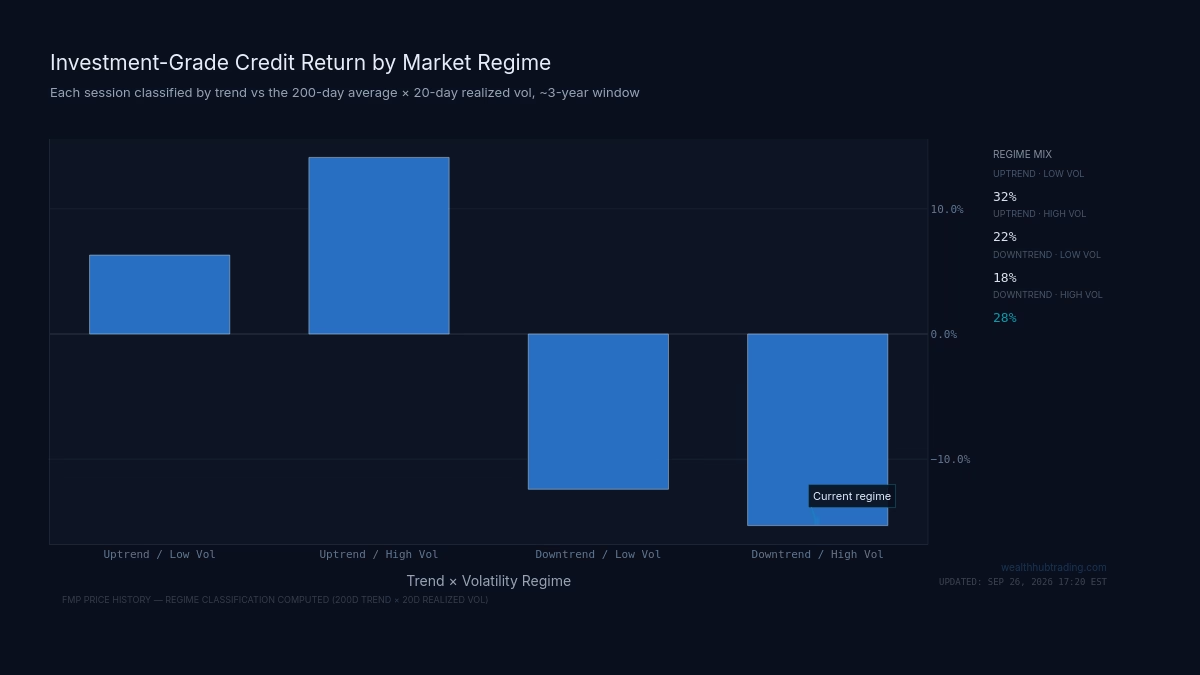
This is the flow that moves the tape. Consensus looks at the widening basis and calls it an opportunity. The blind spot is that the widening is the mechanical footprint of deleveraging, and deleveraging removes the marginal buyer at the same speed it creates the discount. Price is the symptom; the forced unwind of levered inventory is the cause.
The practical lesson is that a basis trade is a bet on your own funding surviving longer than the dislocation. The return is real, but it is compensation for holding a position through a period when your financing can be pulled. If you cannot guarantee your funding to maturity, you are not harvesting an arbitrage; you are selling liquidity insurance and hoping you are not called on to deliver it at the worst moment.
What the basis tells you even if you never trade it
Most readers will never put on a negative-basis trade. It still pays to watch the basis, because it is one of the clearest available gauges of funding stress in the credit system.
When the basis is near zero, capital is flowing freely and balance sheet is cheap. When it lurches negative across many names at once, it is telling you that repo is tightening, haircuts are rising, and levered holders are being forced to sell regardless of fundamentals. That signal often leads the broader credit market, because the funding squeeze shows up in the mechanics of financing before it shows up in default rates or downgrades.
The single sentence to carry away is this: the CDS-bond basis measures the price of balance sheet and funding, not the price of credit risk, which is why it widens most when funding is scarcest and closes only when capital returns. Read it as a thermometer for the plumbing of credit, and it will often tell you about stress before the headlines do.