In the autumn of 1998, a hedge fund called Long-Term Capital Management held a position that should have been nearly riskless. The fund had sold recently issued 30-year Treasury bonds and bought slightly older ones. The two bonds carried almost identical cash flows and identical credit risk, because both were obligations of the same issuer, the United States government. The older bond traded a little cheaper. LTCM's bet was that the tiny price gap between them would close, as it usually did.
Instead, in August and September 1998, that gap widened. Russia had defaulted, investors were fleeing anything they could not instantly sell, and the newer bond, being easier to trade, commanded a rising premium. The spread that was supposed to converge blew out. LTCM, leveraged more than twenty-five to one, could not survive the move. The Federal Reserve organized a rescue to prevent the fund's forced liquidation from cascading through the banking system.
The instrument at the center of that episode was the on-the-run / off-the-run basis. Understanding it tells you something no yield chart can: the real-time price of liquidity itself.
What the basis actually measures
An on-the-run Treasury is the most recently auctioned security of a given maturity: the current 2-year, 5-year, 10-year, or 30-year. As soon as the Treasury auctions a newer security of the same maturity, the previous one becomes off-the-run. Nothing about the bond's contractual terms changes. Its coupon, its maturity date, and its issuer are fixed at auction. What changes is where it lives in the market's plumbing.
The on-the-run bond is the one everyone trades. Dealers quote it tightest, it clears in the largest size, and it serves as the reference security for hedging and financing. The off-the-run bond, only weeks older, sits in fewer hands and trades in a thinner market. When you want to sell it, the bid is a touch lower and the crowd of buyers a touch smaller.
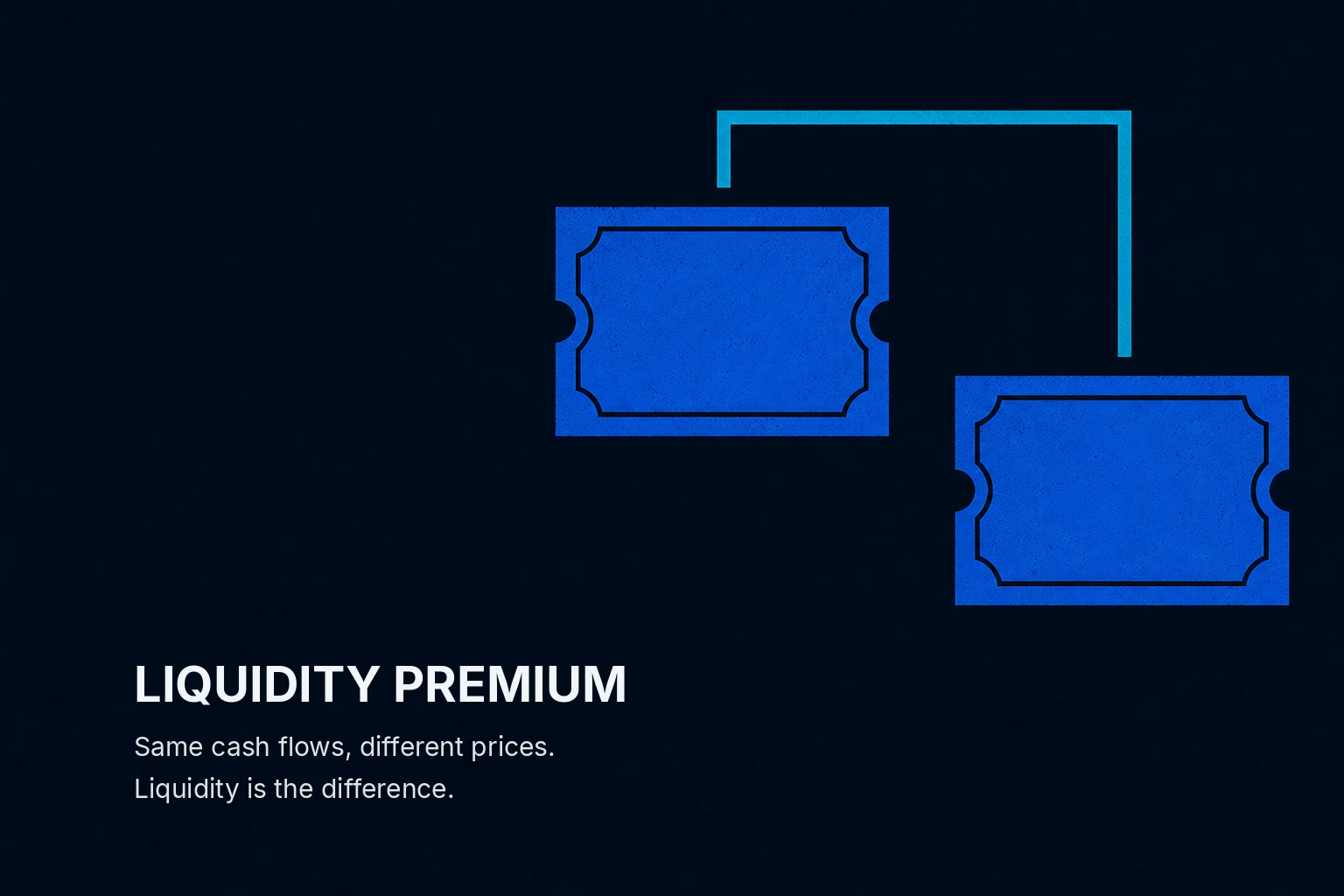
Because the two bonds share the same cash flows and the same credit, any yield difference between them cannot be compensation for default risk or for interest-rate exposure. It is compensation for something else entirely: the ability to transact quickly at a fair price. That is the definition of liquidity, and the on-the-run / off-the-run basis is one of the few places in finance where liquidity is priced directly and separately from everything else.
The practical takeaway is that this spread isolates a variable most metrics blur together. A widening basis is not the market repricing credit or growth. It is the market repricing how much it costs to get out.
Why the premium exists at all
Here is the place intuition tends to get it wrong. Most people assume the on-the-run bond yields less because it is somehow "safer." It is not safer. Both bonds are backed by the same taxing authority. The on-the-run bond yields less because investors will accept a lower return in exchange for guaranteed ease of exit.
Think through who is paying that premium and why. A dealer who needs to hedge a large client trade wants the security that moves fastest and finances cheapest. A leveraged fund that may need to unwind on short notice wants the bond it can sell in size without moving the price against itself. A foreign central bank parking reserves wants an asset it can liquidate the moment it needs dollars. All of them will pay up for the on-the-run bond, and that willingness to pay is the premium.
The off-the-run bond, meanwhile, tends to migrate into portfolios that intend to hold it to maturity. Once it settles into those hands, it trades less, and its slightly higher yield is the reward for accepting that reduced tradability.
The mechanism that keeps the two prices tethered is arbitrage. Specialized trading desks and relative-value funds buy the cheap off-the-run bond, sell the rich on-the-run bond, finance both positions in the repo market, which is the market for short-term borrowing against securities as collateral, and earn the spread as it converges. Their capital is what normally keeps the basis narrow. This is the role LTCM was playing in 1998.
What this means for you is that the size of the basis is a direct readout of how much arbitrage capital is present and willing to work. A narrow basis means that capital is abundant and confident. A wide basis means it is scarce or scared.
What the spread tells you when it moves
The basis is quiet almost all the time. In normal conditions the premium on a 10-year on-the-run bond over its off-the-run counterpart is a few basis points, small enough that only relative-value desks pay attention. Its usefulness comes precisely from that stability. When a variable normally sits still and then jumps, the jump carries information.
When the basis widens, two things are happening at once, and they reinforce each other. First, demand for immediate liquidity rises. Investors want to hold the bond they can sell fastest, so they bid up the on-the-run security. Second, the arbitrage capital that would ordinarily lean against that move retreats. Repo financing becomes more expensive or less available, funds face redemptions, and the desks that arbitrage the spread pull back rather than add risk into a falling market. With the stabilizing force weakened at the exact moment demand for liquidity spikes, the spread gaps out.
That is why the basis is a measure of the system's true risk appetite rather than its stated one. Surveys and positioning reports tell you what investors say. The basis tells you what they do when exiting becomes costly. In September 1998 it revealed that the appetite for holding anything hard to sell had collapsed. It sent the same message in the fall of 2008, when the flight into the most liquid Treasuries drove on-the-run premiums sharply higher, and again in March 2020, when the scramble for cash during the early pandemic forced even the Treasury market into a liquidity crisis and the Fed to intervene as a buyer of last resort.

The practical implication is that you can watch this spread the way a doctor watches a pulse. You do not need to trade it to read it. A stable basis is a signal that the financing plumbing is working and arbitrage capital is engaged. A widening basis is an early warning that liquidity is being withdrawn, often before the stress shows up in equity indices or credit spreads.
Where the mechanism breaks down
The basis is a powerful gauge, but it is not infallible, and reading it carelessly leads to two errors.
The first error is treating every widening as a crisis. The basis moves for technical reasons that have nothing to do with systemic stress. Around auction dates, the flip from on-the-run to off-the-run mechanically resets the spread. Quarter-end and year-end balance-sheet constraints make dealers reluctant to finance positions, which can widen the basis briefly without signaling anything about genuine risk appetite. A small, transient move is often just the plumbing, not a fire.
The second error is the one that ruined LTCM. The trade assumes convergence, and convergence is only reliable when someone has the capital and the time to wait for it. In a liquidity crisis the spread can widen far past any historical norm and stay there for weeks, because the very force that closes it, arbitrage capital, has fled. A position sized for a normal environment gets destroyed in an abnormal one. The relationship that holds in calm markets inverts precisely when it matters most: the trade that profits from liquidity being cheap loses catastrophically when liquidity becomes expensive.
This is the deeper lesson of the basis. It measures liquidity, and liquidity is the one thing that vanishes exactly when it is most needed. Any strategy built on the assumption that you can always exit is, in effect, short the on-the-run premium, whether or not the trader ever looks at a Treasury.
The one line to carry away
The on-the-run / off-the-run basis strips out credit and rate risk to price a single variable, the cost of being able to sell, and that price rises the moment the market stops trusting that it can. Watch it when it is quiet, and respect it when it moves, because it is telling you what the rest of your dashboard will only confirm later.