On the morning of May 28, 2024, the US equity market did something it had not done since the 1920s: it settled trades one business day after they were s...
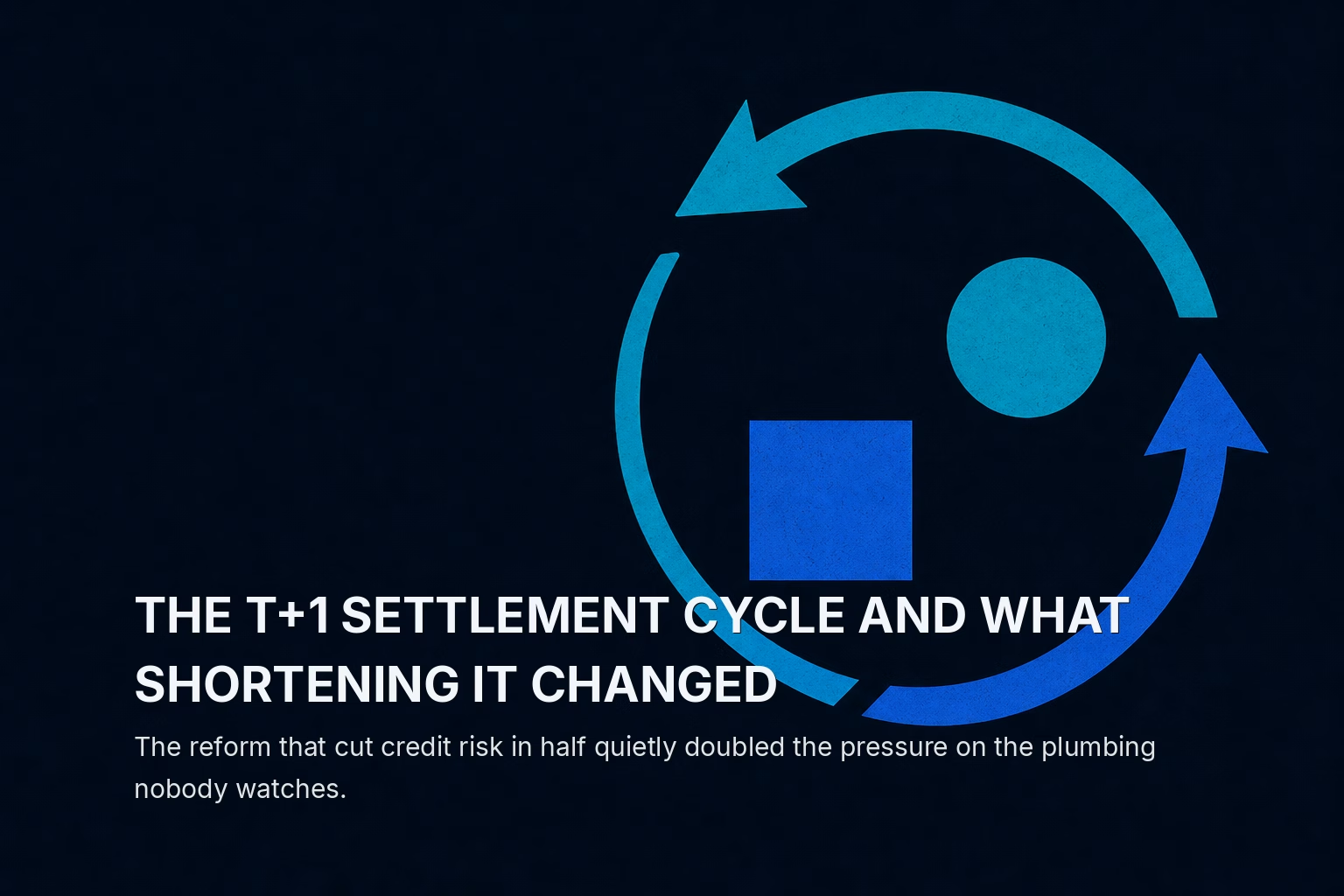
On the morning of May 28, 2024, the US equity market did something it had not done since the 1920s: it settled trades one business day after they were struck. The shift from T+2 to T+1 sounds like a bureaucratic tightening, the kind of change that lives in an operations manual and nowhere else. But for the firms that clear and settle trades, it compressed a two-day scramble into a single afternoon, and it moved the market's central risk from one place to another without eliminating it.
To see why that matters, look at what settlement actually is, and what happens when it fails.
What settlement means, and why the gap exists at all
Settlement is the moment ownership and cash actually change hands. When you buy 100 shares, the trade "executes" instantly, but you do not own the shares yet and the seller does not have your money. That final exchange happens later, on the settlement date. The gap between the two is not an accident. It exists because the plumbing behind a trade takes time: the buyer's broker must confirm the trade details, arrange the cash, and instruct the custodian; the seller's broker must locate the actual shares and deliver them.
Under T+2, that gap was two business days. Under T+1, it is one.
During the gap, both sides carry counterparty risk, the risk that the other party fails before the exchange is complete. If a broker collapses mid-gap, the trades in flight are suddenly orphaned. This is not hypothetical. When Lehman Brothers failed in September 2008, the central clearinghouse spent days unwinding and re-hedging thousands of open positions that had not yet settled. A shorter gap means fewer open trades exposed to that kind of failure at any moment.
For you, the practical point is simple: the settlement window is the market's exposure window, and halving it halves how much unsettled value is at risk when something breaks.
Why a shorter gap reduces the margin the system must post
The clearinghouse standing between buyers and sellers does not take the counterparty risk for free. It collects margin, cash and collateral posted by member firms to cover potential losses if a member defaults before its trades settle. The size of that margin is driven by two things: how much a position could move against the clearinghouse, and how long the clearinghouse is exposed to that move.
Cut the exposure window in half and the second input shrinks directly. A position has less time to move against the system before it settles, so the buffer required to cover a default falls.
Consider a rough worked example. Suppose the clearinghouse sizes margin to cover a plausible two day price move, and it estimates a stock could move 3% over two days. On a $10 million position, that is a $300,000 buffer. Compress the window to one day and the plausible move is smaller, roughly 2% if moves scale with the square root of time. The buffer drops to about $200,000, a third less capital tied up as collateral.
Multiply that across the whole system and the freed collateral runs to billions. The Depository Trust and Clearing Corporation estimated the shift would cut the volatility component of its margin fund by around 40%.
For you, this is the visible win: less capital frozen as margin is capital that can be deployed elsewhere. That is the benefit the reform was sold on.
The part intuition gets wrong: the risk did not disappear
Here is where most descriptions of T+1 stop, and where they mislead. The reform is framed as pure risk reduction. It is not. It is a risk transfer.
Halving the settlement window also halves the time available to fix everything that can go wrong before settlement. And a great deal can go wrong. Trade details must match between buyer and seller. Currency must be converted for foreign buyers. Borrowed shares sold short must be located and delivered. Under T+2, a mismatch discovered on the afternoon of trade day could be chased down the next morning and still settle on time. Under T+1, that same afternoon is now the last chance.
The clearest pressure point is securities lending. When an institution sells shares it does not physically hold yet, or a short seller sells borrowed stock, the actual shares must be sourced and delivered by settlement. The recall and return of loaned securities used to have a two day runway. Now it has one. A recall notice sent late in the day may not leave enough time to return the stock, and the trade fails to deliver, meaning the shares do not arrive on the settlement date.
Foreign investors feel this most sharply. A buyer in Asia executing a US trade must convert local currency to dollars to fund it. Under T+2, the foreign exchange leg had room to settle alongside the equity leg. Under T+1, the dollars may be needed before the investor's home market has even opened for the currency trade. The result is that many overseas managers now pre-fund their US trades, holding dollars in advance, which is itself a cost.
The risk, in other words, moved. It left the credit domain, where the danger was a counterparty collapsing during a long window, and entered the operational domain, where the danger is a process failing during a short one. Credit risk is now smaller. Operational risk is now larger.
Why operational risk is a different animal
Credit risk and operational risk fail in different ways, and that difference is the whole point.
Credit risk is concentrated and rare. A major counterparty defaults infrequently, and when it does, the clearinghouse's margin buffer is designed to absorb it. It is a low-frequency, high-severity risk, and the system holds capital against it.
Operational risk is diffuse and constant. A trade fails to match. A share cannot be located in time. A currency conversion misses a cutoff. None of these is catastrophic on its own, but they happen every day, and compressing the timeline raises their frequency. You cannot post margin against a missed cutoff. You defend against it with staffing, automation, and process, which is a different kind of investment entirely.
In the months after the transition, US fail-to-deliver rates ticked up modestly before firms adapted, exactly the pattern the mechanism predicts. The system did not break, but the strain showed up precisely where the risk had been relocated, in the operational plumbing rather than the credit buffers.
This is the trade the reform actually made. It swapped a risk the system was good at pricing and capitalizing against for a risk the system must manage through execution. That is not obviously a bad trade. Operational risk, unlike a counterparty default, is largely within a firm's own control. But it is a trade, not a free lunch, and calling it pure risk reduction misreads what happened.
What this means for how you read settlement reform
The next step in this direction is already visible. India has moved to same-day settlement for part of its market, and T+0 discussions are live in the US. Each further compression follows the same logic: less credit exposure, less margin, and less time to fix anything.
When you evaluate the next shortening, do not ask only how much counterparty risk it removes. Ask where the risk goes instead. A shorter settlement cycle almost always trades a slow, capitalized credit risk for a fast, operational one, and whether that is an improvement depends entirely on how well the firms involved run their plumbing.
The mechanism to remember is this: shortening the settlement cycle does not destroy risk, it converts credit risk into operational risk, and the reform is only a genuine improvement for participants whose operations can absorb the tighter clock.