MercadoLibre's third-quarter margin compression reads less like deteriorating economics than like a capacity bill paid one quarter early. The CFO's own breakdown shows it: shipping margin fell roughly 60 basis points because the company grew logistics capacity 20% quarter-on-quarter, double the 10% step it took a year earlier, ahead of fourth-quarter peak season. Michael Burry's post-earnings note, which puts his adjusted IV15 at $1,433 and says he has been waiting for a price below $1,500, takes the benign reading. On the operating line, that reading holds up. The case for MercadoLibre does not rest on the margin line, though. It rests on two disclosures the headline numbers do not resolve. One is how much of the company's very large reported cash generation is operating profit and how much is fintech float. The other is whether a credit book growing 62% can keep its delinquency ratio flat for a reason other than its own growth.
A Capacity Step, Not a Cost Leak
Start with what management disclosed, because the split matters more than the total. Chief Financial Officer Martin de los Santos broke the shipping compression into about 40 basis points in cost of goods sold and 20 basis points in operating expense. He tied most of it to footprint expansion. Taking capacity in the third quarter is a pattern MercadoLibre repeats every year ahead of the fourth-quarter peak. What changed this year was the size of the step. A 20% sequential increase on a logistics base that is already much larger than a year ago carries a much bigger fixed cost than last year's 10%, and that cost lands before the volume that justifies it.
This is the kind of compression that usually reverses, and management said it expects part of it "to come back in Q4." The cost is fixed and front-loaded. The revenue that absorbs it is seasonal and arrives next quarter. A buyer who annualizes the third-quarter shipping margin is pricing a warehouse that is half-empty by design.
The unscheduled part of the miss is smaller and more durable. Fuel and energy costs rose, and the company passed only some of the increase to consumers. Management said it expects that pressure to persist. It is the component of the 60 basis points that will not come back in the fourth quarter, and it is the honest residue of the margin story.
The other 40 basis points went to affiliate marketing, which management described as a deliberate investment line. The CFO's broader point was that sales and marketing has held in the 11% to 12% of revenue band the company has run in for several years. The affiliate spend is a reallocation inside a ceiling the company has kept to, not a new cost layer stacked on top of it.
Paying for Warehouses With Room to Spare
The filings give the capacity build useful context. MercadoLibre's FY2025 10-K shows revenue of $28.9B and operating income of $3.2B, an operating margin of 11.1%. That is essentially level with Amazon's 11.2% on FY2025 figures, at roughly one twenty-fifth of the revenue. The FY2025 cash flow statement shows capital expenditure of $1.3B, or 4.6% of revenue.
Set against peers, that intensity is what makes the logistics build look affordable rather than reckless:
- Amazon (FY2025): capex 18.4% of revenue, consuming 94.5% of operating cash flow
- Alibaba (FY2026): capex 12.4% of revenue, 166.6% of operating cash flow, with free cash flow negative at -$50.7B
- Coupang (FY2025): capex 3.6% of revenue but 70.6% of operating cash flow, on a 1.4% operating margin
- MercadoLibre (FY2025): capex 4.6% of revenue, 11.1% of operating cash flow
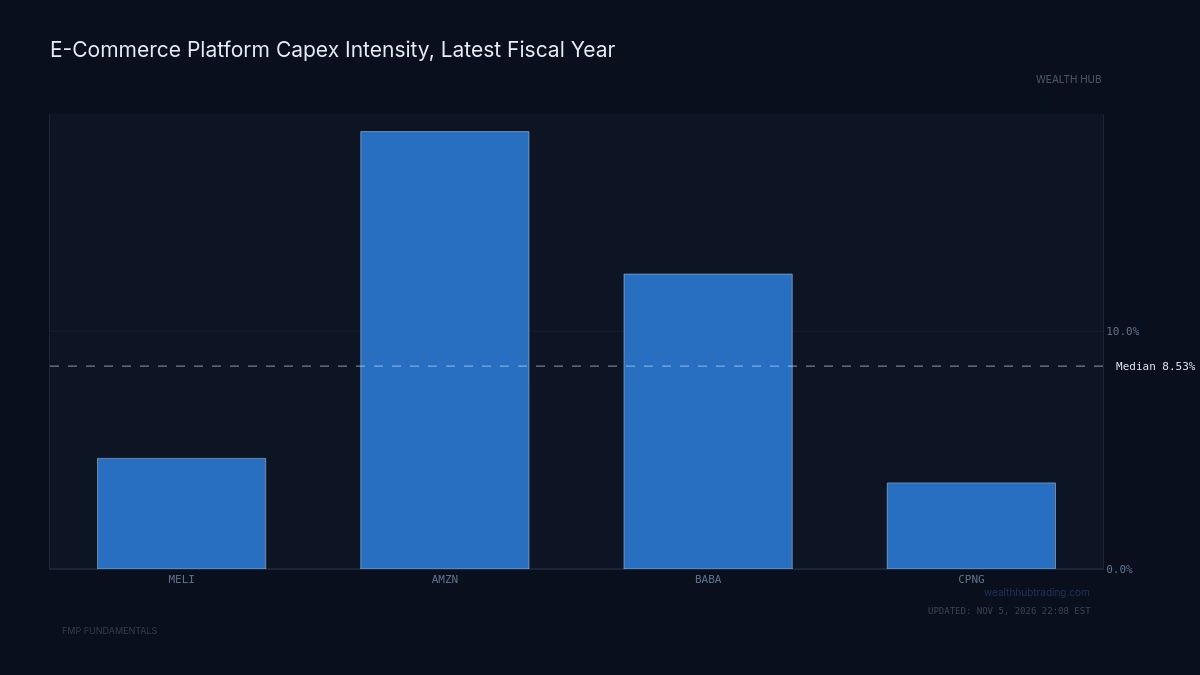
Coupang is the instructive comparison. It runs at a lighter capex ratio than MercadoLibre, yet that spending eats most of its operating cash because there is so little operating margin underneath it. MercadoLibre builds at Coupang-like intensity while earning Amazon-like margins. A 20% capacity step is a manageable cost at that combination. At Coupang's margin it would be a strain. The bull case Burry gestures at, a moat being widened through logistics density, is funded from inside the business rather than from the capital markets.
Where the Cash Figure Flatters
The same cash flow statement also contains the figure an informed reader should question before admiring it. FY2025 operating cash flow was $12.1B and free cash flow $10.8B, against operating income of $3.2B. Free cash flow at more than three times operating income, about 37% of revenue, is not what a retailer with an 11% operating margin produces from selling goods and shipping parcels.
The likeliest explanation is Mercado Pago. A payments and credit business holds customer balances, and changes in funds payable to users and related working-capital items can move through operating cash flow. Loan originations may sit elsewhere in the statement. The supplied figures do not include the line-item breakdown, so the size of that float effect cannot be quantified here. The direction is clear enough to change how the peer comparison above should be read. MercadoLibre's 11.1% capex-to-operating-cash-flow ratio partly reflects a denominator boosted by money that belongs to depositors and merchants. It is not all owner earnings.
The balance sheet shows the same thing. Total debt was $11.4B against total assets of $42.7B at FY2025. Some of that debt funds the credit portfolio. An investor valuing MercadoLibre on free cash flow multiples alone would be capitalizing a fintech balance sheet as if it were marketplace cash. A defensible intrinsic-value figure has to strip that out. It is fair to assume Burry's "adjusted" qualifier on his IV15 does some version of this. The post does not show the adjustment.
The Credit Book's Denominator Problem
This is where the strongest counterargument lives, and it deserves a fair statement. Fintech President Osvaldo Gimenez reported a 15-to-90-day non-performing loan ratio of 7%, stable both sequentially and year-on-year, while the portfolio grew 62%. He added that Argentine NPLs are near historical lows despite industry weakness, and that the company has been "a little bit more cautious" in the riskiest Brazilian segments.
A stable delinquency ratio on a book growing that fast is ambiguous. New loans have not had time to go bad. When originations compound at 62%, the denominator fills with recently issued, current credit, and the ratio can hold flat even if each vintage is performing worse than the last. Rapid-growth lenders sometimes show their weakest underwriting only when growth slows and the seasoned loans become a larger share of the book. The headline 7% cannot distinguish disciplined growth from that denominator effect.
Management's answer is an information advantage, and it is a real one. Gimenez said the marketplace shows the company "how users buy, how they pay, how they use installments" before it extends credit. He also said lending can be adjusted by product, risk cohort, credit-line size and duration, and that the company pulls back at signs of deterioration. That is a credible underwriting edge over a bank lending to the same customers without purchase data. Burry's verdict, that the finance business is acceptable "if it is done eyes wide-open, as it seems to be," is a judgment about management's discipline. The ratio alone does not prove it. The proof would be cohort data: loss curves by origination vintage, which a 15-to-90-day snapshot does not provide.
There is a second-order link to flag, with appropriate hedging. If some of the operating cash flow strength discussed above comes from fintech balances, the credit book and the cash figure are not independent observations. A credit stumble would hit both reported earnings and the funding float that flatters free cash flow. That coupling is an inference from the structure of the business. It is not something the disclosed figures confirm.
What Would Change the Read
On the evidence management disclosed, the commerce margin story supports Burry's lack of concern. The shipping compression is mostly a sized-up, seasonal capacity step with a stated fourth-quarter recovery. The affiliate spend sits inside a long-held marketing range. The build is funded at a capex intensity that leaves the business far less stretched than Amazon, Alibaba or Coupang on the same filings.
The thesis has two tests, and neither is the next headline earnings figure. The first is the fourth quarter. If shipping margin does not recover a meaningful part of the 60 basis points as peak volume fills the new capacity, the "timing artifact" reading fails and the 20% step starts to look like overbuilding. The second, and the more important, is the credit book once growth decelerates. A 15-to-90-day NPL ratio that holds near 7% as portfolio growth falls well below 62% would show the underwriting edge is real. A ratio that drifts higher just as growth cools would show the stability came from the denominator. Burry's $1,433 figure is only as sound as the second answer, because the free cash flow behind any intrinsic value for MercadoLibre is partly the lending business's balance sheet.