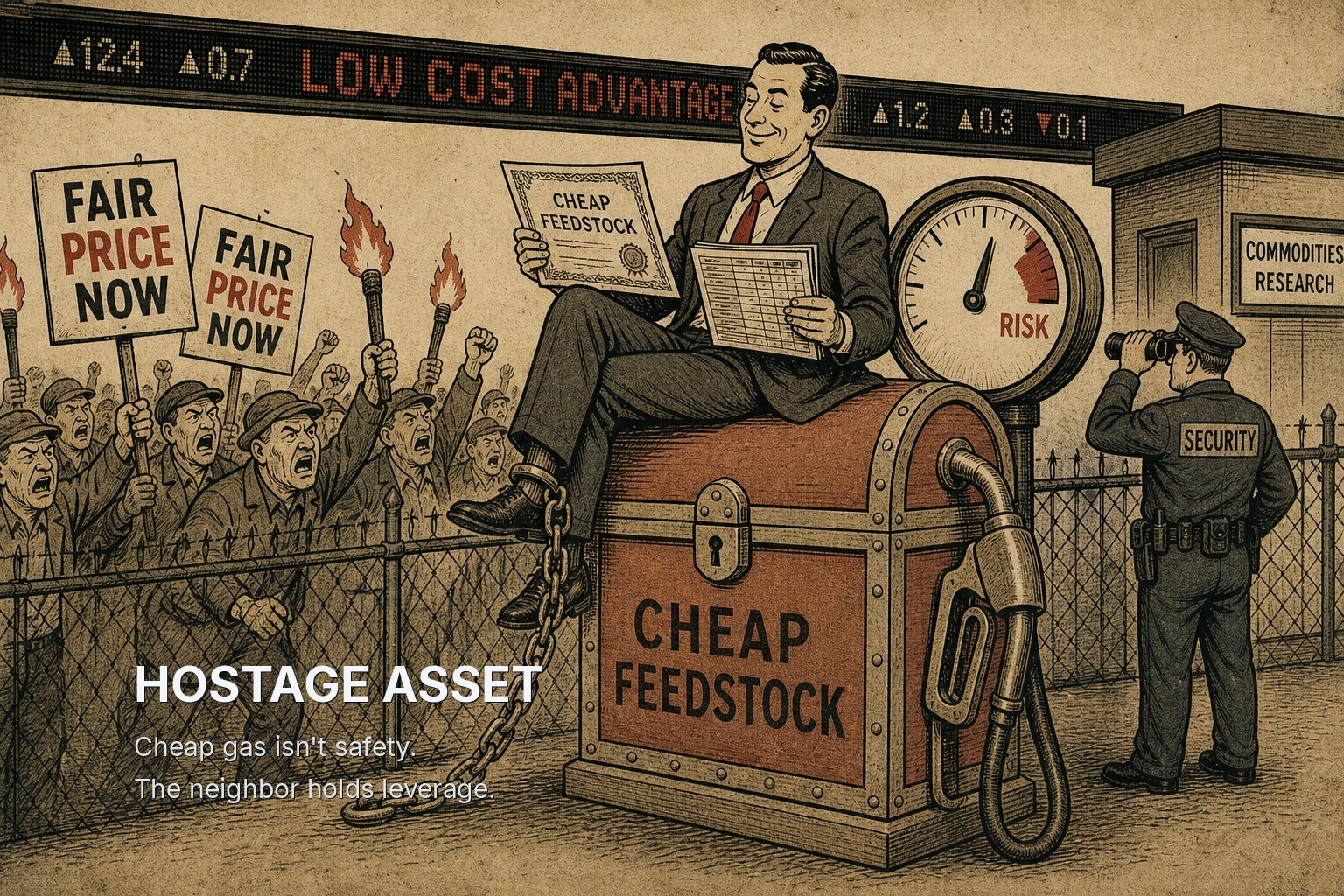
The thing that makes Alberta's natural gas cheap is the same thing that makes it dangerous to sell. Consensus reads a "value trap" as a mispricing waiti...
This one is not waiting for a catalyst. It is waiting for a customer who can vote.
Start with the number that frames everything. Alberta produces roughly 11 billion cubic feet per day of natural gas. Seven of those eleven are consumed inside the province. Only four leave. That single ratio, not the wellhead cost, is the whole story, and the consensus keeps reading the wellhead cost.
Why is cheap gas not the same as valuable gas?
Cheap gas is trapped gas. The price at AECO sits at rock bottom not because the resource is poor but because the molecules cannot get out. Egress is the constraint. A commodity that sells below its cost of transport is not underpriced; it is stranded. The market sees a low number and reads "bargain." The correct read is "landlocked."
Contrast the Permian, where more than 23 bcf/d of dry gas floods a desert nobody lives in. In West Texas the gas is frequently given away at the wellhead, sometimes at negative prices, because flaring restrictions and pipeline lag force producers to move it or pay to burn it. And nobody riots. There is hardly anyone out there to riot. The gas is worthless at the margin and that worthlessness has no political cost, so egress gets built, and the stranded discount compresses over time as pipe reaches the Gulf.
Alberta's discount looks similar on a screen and is nothing alike underneath. The same low print carries a completely different liability, because in Alberta the buyer of last resort is a voter.
A resource is only an asset when the person who consumes it cannot punish you for pricing it correctly.
What does Angola teach a Canadian premier?
In early July of 2025, Angola raised diesel prices by one-third, continuing a multi-year effort to phase out fuel subsidies. A three-day strike by minibus and taxi drivers metastasized into nationwide unrest. By month's end, some 30 people were dead, 277 injured, over 1,500 arrested. The government held. The subsidy cut held with it.
The lesson is not that subsidies are bad. The lesson is the mechanism of the trap. When native demand is large, you cannot charge the local pool one price and the export pool another without the arbitrage devouring you. Bootlegging, organized crime, cross-border smuggling, and every species of corruption materialize the moment two prices exist for one fungible molecule. Angola discovered that enforcing a price on a population that consumes the resource is a public-order problem, not a pricing problem.
This is the part the "value trap" framing misses entirely. Consensus treats the discount as a temporary inefficiency: build the pipe, add the LNG train, sign the data-center offtake, and the gap closes. But the gap is not an accident of infrastructure. Seven of eleven bcf/d flow to Albertans who have been paying near-nothing for heat and power their entire lives. Raise the export volume enough to lift the local price toward world levels, and you have run the Angolan experiment on your own electorate.
Danielle Smith understands energy economics as well as any politician on the continent. That is precisely why the leak of her cabinet's private deliberations landed like a bomb. The document did not reveal incompetence. It revealed that the smart move and the survivable move are not the same move.
Why is now the worst possible moment for this contradiction to surface?
Three pressures arrive at once, and they do not resolve in the same direction.
A separatist referendum sits weeks away. A trade war between Canada and the United States is escalating, which taxes every barrel and cubic foot that crosses south. And a wall of demand is forming from data-center developers who want Alberta's cheap fuel precisely because it is cheap. Each of these makes the local-price question more explosive, not less.
Consider the second-level problem the data-center demand creates. First-level thinking says: enormous new buyer arrives, soaks up the stranded 4 bcf/d of export gas, discount closes, everybody wins. Second-level thinking asks what happens to the 7 bcf/d that Albertans burn. If new industrial load bids the province's gas toward export parity, the household bill rises. The referendum voter who was told separatism would keep the wealth at home now watches the wealth get bid away by a server farm. The very demand that "fixes" the value trap detonates the political premise underneath it.
Smith cannot let the local price rise without inviting the Angolan sequence. She cannot hold the local price down without either capping export egress or running a two-tier scheme that smuggling will hollow out. There is no clean thread through this needle. The leak simply made the private version of that arithmetic public.
What is the market actually mispricing?
Not the gas. The optionality.
The bull case treats Alberta's stranded gas as a coiled spring: cheap input, ballooning AI-driven power demand, LNG capacity finally arriving on the coast. Load the offtake and let the arbitrage close. It is one outcome among several, and it is not the most likely one, because it assumes the political constraint is soft. The constraint is not soft. It is the hardest variable in the equation, and it points the other way. The path the arithmetic actually supports is a prolonged discount, because the premier's dominant incentive is to keep the local price suppressed, which means keeping export egress deliberately throttled below what the resource could bear.
Absent live positioning data on the relevant Canadian gas names, treat the specific instruments as unverified; the mechanism is the point, not a trade ticket. What is verifiable is the structural asymmetry between the two basins. The Permian's discount is a temporary infrastructure gap with no political cost to closing it. Alberta's discount is a permanent political feature disguised as a temporary infrastructure gap. The market prices both as the former. 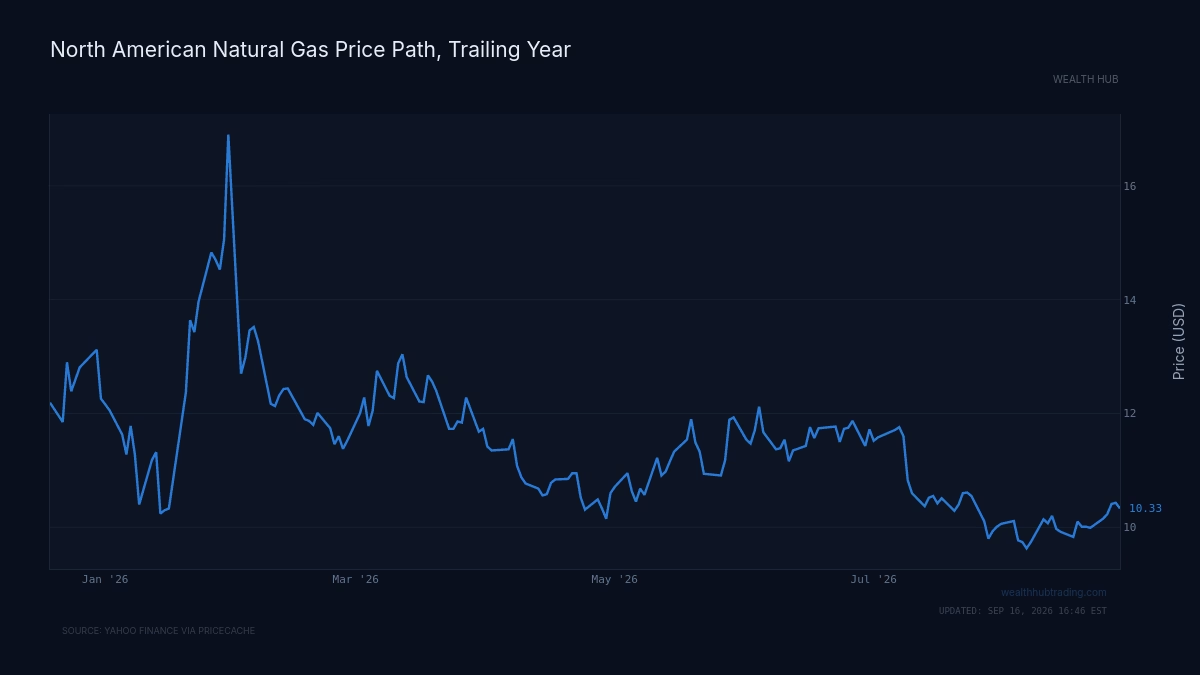
Kindleberger, in "Manias, Panics, and Crashes," described how the credit that fuels a boom is extended precisely when the underlying assumption is least examined. The AI-power thesis is extending capital to stranded-gas basins on the assumption that cheap gas will be allowed to reach the buyer. In West Texas that assumption is fine. On the northern stretch of the Great Divide it is the exact thing nobody is pricing.
The value trap is not a low number waiting for a catalyst. It is a low number that a politician needs to keep low.