The cleanest red flag at Perdoceo Education is not the ghost-student allegation or the AI hit to graduate hiring. It is that the bull case's two load-bearing pillars, enrollment quality and the cash-rich balance sheet, both run through the Treasury curve, in opposite directions. Today's curve shape is the least favorable combination for a for-profit lender-dependent school. With the 10-year at 5.24% and the 2-year at 4.80% as of October 9, the 2s10s spread sits at +0.44%. A steepening curve has a specific effect on this company: it raises the federal borrowing cost its students carry while threatening the interest income that quietly props up a "10 to 11 times forward earnings" valuation.
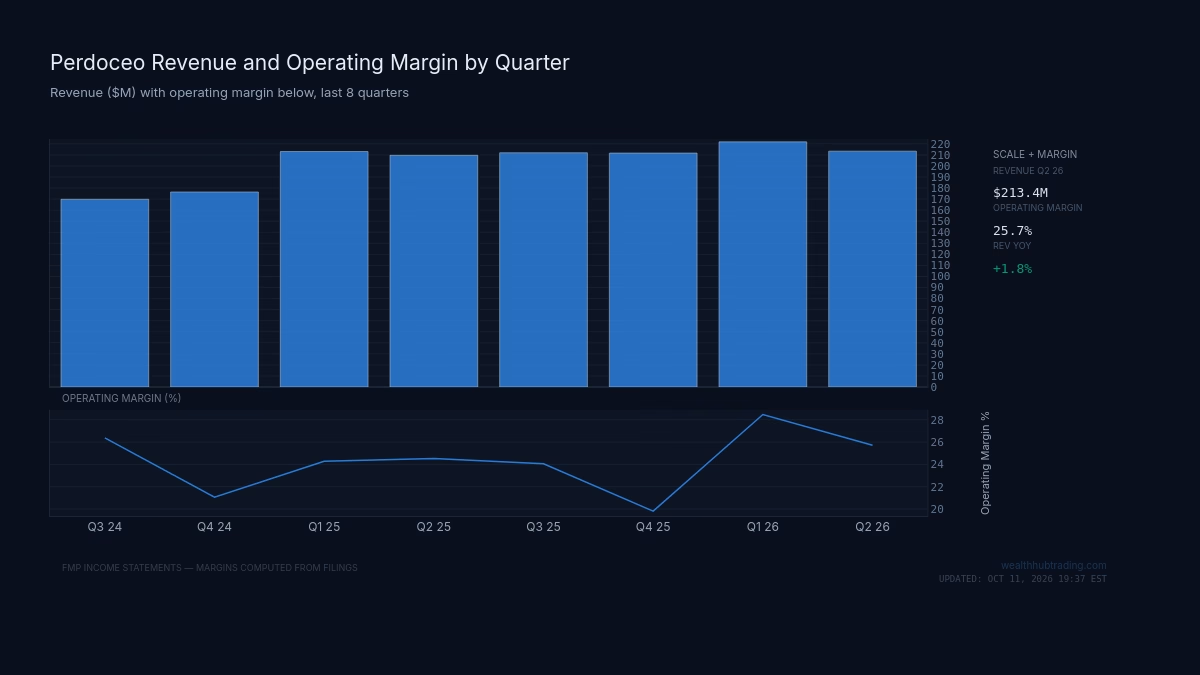
The bull summary circulating among investors is accurate as far as it goes. Perdoceo runs Colorado Technical University, American InterContinental University System and the University of St. Augustine for Health Sciences. More than 90% of enrollments are fully online. Operating margins run above 25%, and net cash exceeds $600 million with minimal debt, which funds dividends and buybacks. The open question is what produces those numbers and whether they hold when the rate regime that flattered them shifts.
A Business Built on Federal Credit Terms
Perdoceo's revenue depends largely on federal student aid, so its customers' price of money is set by formula rather than by the company. Federal Direct Loan rates reset each July. Each rate is the high yield of the May 10-year Treasury auction plus a fixed add-on: 2.05 points for undergraduates (capped at 8.25%), 3.60 points for graduate unsubsidized loans (capped at 9.50%), and 4.60 points for PLUS loans (capped at 10.50%).
For the 2025-26 award year that formula produced 6.39% for undergraduates and 7.94% for graduate borrowers. If next May's auction clears near the current 5.24%, the arithmetic gives roughly 7.29% for undergraduates and 8.84% for graduate students. That is about 90 basis points of additional annual cost on balances the student cannot shop elsewhere. The figures are a projection from today's yield, not a set rate. The May auction is the only print that matters, and a rally between now and then would shrink the move.
The channel matters more for Perdoceo than for a state university because of who enrolls. The student is an adult, often working, often financially stretched, and pursuing a credential whose payoff depends on the labor market. That is the same labor market Hunterbrook's The Bear Cave recently flagged as being hollowed out by AI for exactly this kind of graduate. A higher loan rate does not usually stop enrollment directly, because aid-funded students rarely compare rates. It shows up later as repayment stress, and repayment stress is what federal accountability metrics measure.
Where Ghost Students and Rates Meet
Bleecker Street Research's report argues that Perdoceo's rising enrollment and retention coincided with a wave of enrollment fraud by criminal networks that use fake identities to collect federal aid. Management has offered a different explanation for the growth. The allegation is unproven, and nothing here treats it as established. It still deserves weight because of how it would interact with the rate channel.
A fraudulent enrollee never repays. If any meaningful share of the enrollment growth is synthetic, three things follow:
- Reported enrollment overstates the base of real, repaying students. The economics of the genuine cohort are therefore weaker than the headline count implies.
- Default and non-repayment pressure is already embedded in the loan book before any rate increase arrives.
- Higher federal loan rates then land on a population whose credit quality is worse than reported, which compresses the time before accountability thresholds become a live issue.
Federal eligibility tests built on cohort default rates and program-level earnings outcomes do not care whether the bad borrower was a struggling adult or a stolen identity. Both damage the institution's numbers. Verification has also tightened at the federal level as the sector-wide fraud problem has drawn media and regulatory attention. Better screening would push synthetic enrollments out of the count, so the "consistent enrollment growth" the bull case cites is exposed to a reversal that has nothing to do with demand.
This is the mechanism the market's framing misses. The fraud debate is usually treated as a binary headline risk: either a regulator acts or it does not. The rate channel makes it a slow-burn credit problem, because higher borrowing costs speed up the point at which bad enrollments become visible in outcome data.
The Cash Pile Is a Rate Trade
The second pillar is the balance sheet. Net cash above $600 million is real strength, and it gives management room to keep buying back stock through a regulatory storm. It is also, in effect, a short-duration fixed-income position whose yield has been unusually generous.
The following figures are illustrative and do not come from the company's filings. At a front-end yield near the 2-year's 4.80%, $600 million of cash earns roughly $27 million to $29 million a year before tax. For a company valued on earnings, that income is counted inside the forward multiple, but it is not a return on educating students. It is a return on the Federal Reserve's policy setting. Precise interest income figures for Perdoceo are not broken out in this analysis. The direction of exposure, however, follows from the size of the cash position.
The steepener is the key point. Curve steepening driven by front-end cuts reduces Perdoceo's interest income quickly, because cash reprices within months. The student loan rate is fixed for a full award year off the May auction, so a sticky long end keeps students' borrowing costs elevated. A curve that steepens from the front pulls the earnings cushion away while leaving the funding burden in place. The current +0.44% spread with a 5.24% long end is close to that configuration already. The equity may look cheap at 10 to 11 times precisely because a rate-dependent slice of earnings is being capitalized as if it were permanent.
The Strongest Case Against the Red Flag
The bull case has a serious reply, and it should be stated in full.
If Perdoceo's enrollment is substantially genuine, the rate channel amounts to a few hundred basis points on loan balances that students do not price-shop. Adult learners choose programs for schedule, credential and employer recognition, not for loan terms set in Washington. Over 25% operating margins on an online delivery model leave room to absorb modest increases in bad debt. The interest income, while real, is a minority of earnings at that margin. A company with no debt and $600 million of net cash can buy back stock aggressively into any weakness and shrink the share count faster than rate pressure erodes earnings. USAHS, the health sciences school the bull case calls a key profit driver, trains for clinical fields where hiring is less exposed to AI substitution than generic business or IT credentials.
The fraud allegation also has a history of not resolving the way short sellers hope. For-profit education has seen repeated bear campaigns, and some companies survived them for years as regulatory regimes changed. Career Education itself was pushed into crisis by an aggressive federal crackdown. It then got a reprieve when rules were rolled back under the first Trump administration and rebranded as Perdoceo in 2020. Political cycles have sometimes rescued this sector, and they could again.
These are fair points. They do not answer the central problem. The bull case depends on enrollment being high quality, and the evidence offered for that quality, rising enrollment and rising retention, is the same data the fraud allegation says is contaminated. Retention can rise when enrollees exist only to keep drawing aid. Until the company shows outcome data that separates genuine students from synthetic ones, the margin and growth figures cannot fully defend themselves. The cheap multiple is not a margin of safety if the "E" contains both unverified enrollment and rate-dependent cash yield.
What Confirms or Breaks the Read
The thesis is measurable, and three observations would move it.
First, the May 10-year auction sets the 2027-28 federal loan rates. An auction clearing near or above 5.24% locks in the roughly 90 basis point increase in student borrowing cost described above. A sharp rally into spring would weaken the credit-pressure leg of this argument.
Second, Perdoceo's reported interest income relative to operating income. If front-end rates fall and that line shrinks while operating income holds, the cash-cushion concern was overstated. If reported earnings growth slows in step with the decline in short rates, the market will have been paying a multiple on a rate trade.
Third, and most decisive, bad debt expense and withdrawal patterns after tighter identity verification. If enrollment growth survives stricter screening with no jump in early withdrawals or allowances, Bleecker Street's thesis loses most of its force and the remaining risk is cyclical. If enrollment flattens or turns down as verification tightens, the growth story was partly synthetic, and the rate channel becomes an accelerant on an already deteriorating credit base.
The red flag holds until that third test is passed. A for-profit school whose enrollment quality is disputed, whose customers' borrowing costs are indexed to a 5.24% long bond, and whose earnings include interest on cash that the next easing cycle will reduce is not a value stock at 10 times earnings. It is a position on the shape of the yield curve that has not been labeled as one.